

FHZ |
Catalog No.GC30699
 One-Click Copy Product Info
|

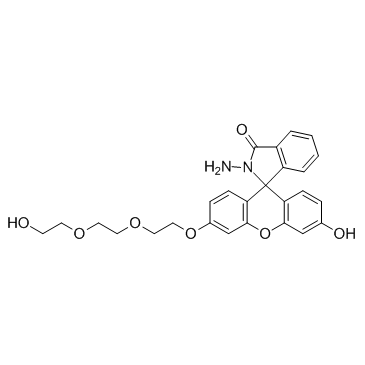
FHZ es una sonda fluorescente.
Products are for research use only. Not for human use. We do not sell to patients.
Cas No.: 1883737-63-0
Sample solution is provided at 25 µL, 10mM.
_1-3.$$$39978408@51.jpg');)
_1-9.$$$38538795@65.jpg');)
_1-9.$$$39112701@51.jpg');)
_1-7.$$$37316672@70.jpg');)
_366-372.$$$36198801@70.jpg');)
.$$$38565142@65.jpg');)
_1867-1883.$$$33248023@67.jpg');)
_eads6055.$$$39977546@45.jpg');)
_eadm9805.$$$40080571@45.jpg');)
_eadj3020.$$$39666821@45.jpg');)
_1-20.$$$39757301@28.jpg');)
_1-24.$$$38898113@28.jpg');)
_273-287.$$$36806353@46.jpg');)
_1-16.$$$37156877@44.jpg');)
_1-19.$$$37460805@44.jpg');)
_1291-1307.$$$34518654@46.jpg');)
FHZ is a fluorescent probe.
After loaded with probe FHZ and treated with HClO and H2O2/EDTA-Fe2+ in order, HeLa cells display the bright fluorescences from both cyan and green channels. FHZ can give out two different fluorescent signals in the presence of both •OH and HClO, suggesting the synchronous discrimination of •OH and HClO by a dual-channel detection model with two exciting wavelengths. Probe FHZ shows very high specificity to the detections of •OH and HClO with the excitations at 410 and 490 nm, respectively. The probe FHZ can efficiently enter the cellular mitochondria and exhibit the differentiable/visual capabilities to the endogenous •OH and HClO by the dual fluorescent responses[1].
Probe FHZ can rapidly be absorbed into the blood circulation system from the zebrafish intestine, and spread out whole zebrafish tissues, and keep its stability in the blood, organs and tissues in the absence of ROS. The probe can keep its stability in biological environments and only selectively react with •OH and HClO species[1].
[1]. Zhang R, et al. Real-Time Discrimination and Versatile Profiling of Spontaneous Reactive Oxygen Species in Living Organisms with a Single Fluorescent Probe. J Am Chem Soc. 2016 Mar 23;138(11):3769-78.
Cell experiment: | HeLa cells and RAW264.7 macrophages are cultured in high glucose Dulbecco’s modified Eagle’s medium (DMEM) supplied with 10% fetal bovine serum (FBS) and 1% antibotics (penicillin and streptomycin) at 37°C in humidified incubator containing 5% CO2. The cells are seeded into glass-bottomed dishes and cultured for 24 h. Subsequently, the cells are incubated with FHZ for 30 min at 37°C and then washed with PBS buffer three times. Each treatment of cells with H2O2, EDTA-Fe2+, HClO or scavengers kept 30 min[1]. |
Animal experiment: | Wild type zebrafish is used in this study. Seven-day old fertilized zebrafish embryos are cultured in 50 μM FHZ for 30 min, and then the zebrafish embryos are transferred to fresh water. A FHZ-loaded zebrafish is fixed under confocal microscope using 2% agarose gel to keep its living state for fluorescent imaging. In order to observe the release of •OH in fresh wound, the ventral fin of the FHZ-loaded zebrafish is carefully cut a small wound using a blade. After raised for 20 min in water, the wound of injured zebrafish is imaged using confocal microscope[1]. |
References: [1]. Zhang R, et al. Real-Time Discrimination and Versatile Profiling of Spontaneous Reactive Oxygen Species in Living Organisms with a Single Fluorescent Probe. J Am Chem Soc. 2016 Mar 23;138(11):3769-78. | |
| Cas No. | 1883737-63-0 | SDF | |
| Canonical SMILES | O=C1N(N)C2(C3=C(OC4=C2C=CC(OCCOCCOCCO)=C4)C=C(O)C=C3)C5=C1C=CC=C5 | ||
| Formula | C26H26N2O7 | M.Wt | 478.49 |
| Solubility | DMSO : 100 mg/mL (208.99 mM; Need ultrasonic) | Storage | Store at -20°C |
| General tips | Please select the appropriate solvent to prepare the stock solution according to the
solubility of the product in different solvents; once the solution is prepared, please store it in
separate packages to avoid product failure caused by repeated freezing and thawing.Storage method
and period of the stock solution: When stored at -80°C, please use it within 6 months; when stored
at -20°C, please use it within 1 month. To increase solubility, heat the tube to 37°C and then oscillate in an ultrasonic bath for some time. |
||
| Shipping Condition | Evaluation sample solution: shipped with blue ice. All other sizes available: with RT, or with Blue Ice upon request. | ||
| Prepare stock solution | |||

|
1 mg | 5 mg | 10 mg |
| 1 mM | 2.0899 mL | 10.4495 mL | 20.8991 mL |
| 5 mM | 418 μL | 2.0899 mL | 4.1798 mL |
| 10 mM | 209 μL | 1.045 mL | 2.0899 mL |
Step 1: Enter information below (Recommended: An additional animal making an allowance for loss during the experiment)
 g
μL
g
μL
Step 2: Enter the in vivo formulation (This is only the calculator, not formulation. Please contact us first if there is no in vivo formulation at the solubility Section.)
Calculation results:
Working concentration: mg/ml;
Method for preparing DMSO master liquid: mg drug pre-dissolved in μL DMSO ( Master liquid concentration mg/mL, Please contact us first if the concentration exceeds the DMSO solubility of the batch of drug. )
Method for preparing in vivo formulation: Take μL DMSO master liquid, next addμL PEG300, mix and clarify, next addμL Tween 80, mix and clarify, next add μL saline, mix and clarify.
Method for preparing in vivo formulation: Take μL DMSO master liquid, next add μL Corn oil, mix and clarify.
Note: 1. Please make sure the liquid is clear before adding the next solvent.
2. Be sure to add the solvent(s) in order. You must ensure that the solution obtained, in the previous addition, is a clear solution before proceeding to add the next solvent. Physical methods such as vortex, ultrasound or hot water bath can be used to aid dissolving.
3. All of the above co-solvents are available for purchase on the GlpBio website.
Quality Control & SDS
- View current batch:
- Purity: >98.00% Appearance: A solid
- COA (Certificate of Analysis)
- SDS (Safety Data Sheet)
- Datasheet
Average Rating: 5 (Based on Reviews and 1 reference(s) in Google Scholar.)