

Fraxin (Synonyms: Fraxetol 8-glucoside, Fraxoside) |
Catalog No.GN10231
 One-Click Copy Product Info
|

Fraxin is a coumarin derivative extracted from Cortex Fraxini, possessing various biological activities including antioxidant, anti-inflammatory, analgesic, antibacterial, antiviral, and immunomodulatory effects.
Products are for research use only. Not for human use. We do not sell to patients.
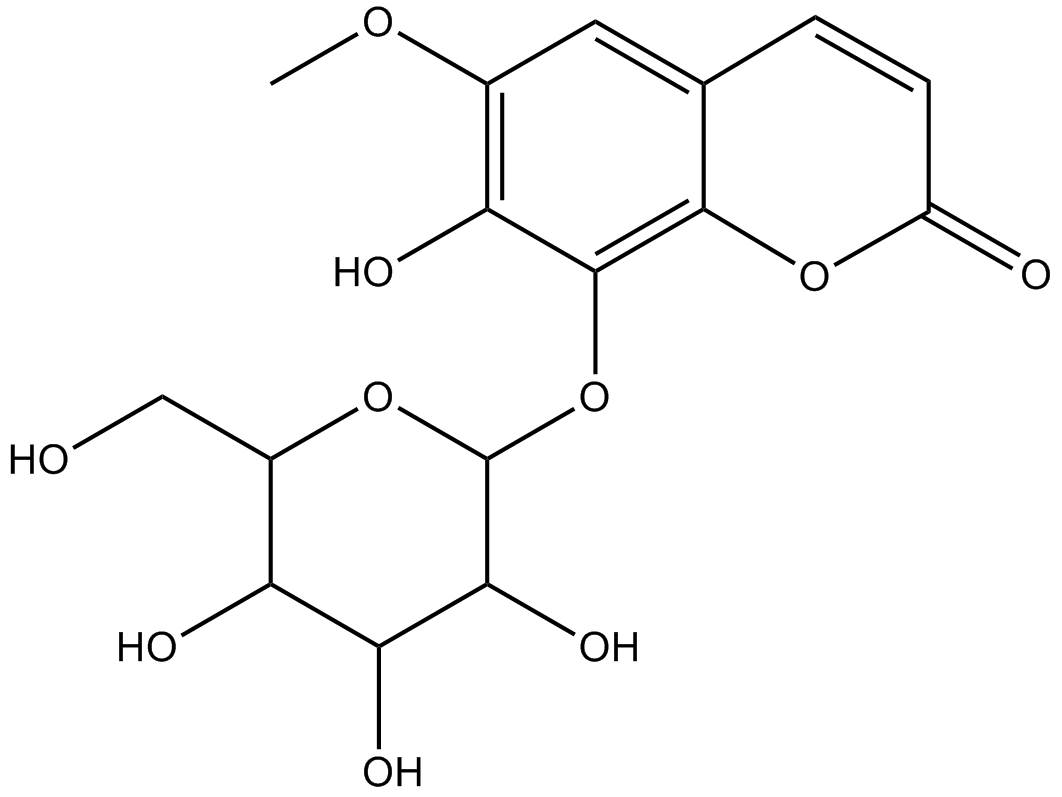
Cas No.: 524-30-1
Sample solution is provided at 25 µL, 10mM.
_1-3.$$$39978408@51.jpg');)
_1-9.$$$38538795@65.jpg');)
_1-9.$$$39112701@51.jpg');)
_1-7.$$$37316672@70.jpg');)
_366-372.$$$36198801@70.jpg');)
.$$$38565142@65.jpg');)
_1867-1883.$$$33248023@67.jpg');)
_eads6055.$$$39977546@45.jpg');)
_eadm9805.$$$40080571@45.jpg');)
_eadj3020.$$$39666821@45.jpg');)
_1-20.$$$39757301@28.jpg');)
_1-24.$$$38898113@28.jpg');)
_273-287.$$$36806353@46.jpg');)
_1-16.$$$37156877@44.jpg');)
_1-19.$$$37460805@44.jpg');)
_1291-1307.$$$34518654@46.jpg');)
Fraxin is a coumarin derivative extracted from Cortex Fraxini, possessing various biological activities including antioxidant, anti-inflammatory, analgesic, antibacterial, antiviral, and immunomodulatory effects. Fraxin can modulate signaling pathways such as TLR4/PI3K/Akt and PPAR-γ/NF-κB. Fraxin can be used in research related to atherosclerosis, non-alcoholic fatty liver disease (NAFLD), cerebral ischemia-reperfusion injury, and oral lichen planus (OLP)[1-4].
In vitro, Fraxin (20-320μM) pretreated the melanoma cell line (MNT1) cells for 24-48 hours, followed by stimulation with H₂O₂ (1mM) for 24 hours. Fraxin significantly inhibited the expression of melanogenesis-related proteins (MITF, TYR, TYRP1, DCT) and tyrosinase activity, reduced reactive oxygen species production and cell apoptosis, activated the NRF2 signaling pathway, and upregulated the expression of antioxidant enzymes (CAT, HO-1)[5]. Fraxin (10-40μM) pretreated human immortalized keratinocytes (HaCaT) for 48 hours, followed by stimulation with lipopolysaccharide (10μg/mL) for 24 hours. Fraxin significantly increased cell viability, reduced cell apoptosis, and decreased the expression and secretion of inflammatory factors interleukin-6 and tumor necrosis factor-α[6].
In vivo, Fraxin (10, 20, 50mg/kg; daily administration) was orally administered to dextran sulfate sodium-induced C57BL/6J mouse ulcerative colitis models for 10 days. Fraxin significantly alleviated colon injury, reduced the secretion of pro-inflammatory cytokines, and inhibited the activation of the TLR4/NF-κB and MAPK signaling pathways[7]. Fraxin (5, 10, 50mg/kg; daily administration) was orally administered to CCl4-induced Sprague-Dawley rat hepatotoxicity models for 5 consecutive days. Fraxin significantly reduced serum AST and ALT levels in rats, increased liver GSH, decreased MDA, and alleviated liver tissue pathological damage[8].
References:
[1] Whang WK, Park HS, Ham I, et al. Natural compounds,fraxin and chemicals structurally related to fraxin protect cells from oxidative stress. Exp Mol Med. 2005 Oct 31;37(5):436-46.
[2] Ferdous J, Bhuia MS, Chowdhury R, et al. Pharmacological Activities of Plant-Derived Fraxin with Molecular Mechanisms: A Comprehensive Review. Chem Biodivers. 2024 May;21(5):e202301615.
[3] Tang FL, Xie LW, Tang LF, et al. Fraxin (7-hydroxy-6-methoxycoumarin 8-glucoside) confers protection against ionizing radiation-induced intestinal epithelial injury in vitro and in vivo. Int Immunopharmacol. 2024 Mar 10;129:111637.
[4] Li W, Li W, Yu J, et al. Fraxin inhibits lipopolysaccharide-induced inflammatory cytokines and protects against endotoxic shock in mice. Fundam Clin Pharmacol. 2020 Feb;34(1):91-101.
[5] Luo L, Yu X, Zeng H, et al. Fraxin inhibits melanogenesis by suppressing the ERK/MAPK pathway and antagonizes oxidative stress by activating the NRF2 pathway. Heliyon. 2023 Aug 3;9(8):e18929.
[6] Peng B, Dai Q, Liu X, et al. Fraxin alleviates oral lichen planus by suppressing OCT3-mediated activation of FGF2/NF-κB pathway. Naunyn Schmiedebergs Arch Pharmacol. 2024 Dec;397(12):10125-10141.
[7] Sun W, Hang L, Chen L, et al. Fraxin Ameliorates Ulcerative Colitis by Modulating Oxidative Stress, Inflammation and TLR4/NF-κB and MAPK Signaling Pathways. Altern Ther Health Med. 2024 Dec;30(12):117-125.
[8] Chang BY, Jung YS, Yoon CS, et al. Fraxin Prevents Chemically Induced Hepatotoxicity by Reducing Oxidative Stress. Molecules. 2017 Apr 6;22(4):587.
| Cell experiment [1]: | |
Cell lines | MNT1 cells (human melanoma cell line enriched in melanin) |
Preparation Method | MNT1 cells were maintained in Dulbecco's modified Eagle's medium (DMEM) supplemented with 20% fetal bovine serum (FBS) and 1% penicillin-streptomycin at 37°C, 5% CO₂. MNT1 cells were pretreated with Fraxin at concentrations of 20-320μM for 24-48 hours, then stimulated with H₂O₂ (1mM) for 24 hours. |
Reaction Conditions | 20-320μM; 24-48 hours pretreatment |
Applications | Fraxin significantly inhibited the expression of melanogenesis-related proteins (MITF, TYR, TYRP1, DCT) and tyrosinase activity. Fraxin reduced reactive oxygen species (ROS) production and cell apoptosis, while activating the NRF2 signaling pathway and upregulating the expression of antioxidant enzymes (CAT, HO-1). |
| Animal experiment [2]: | |
Animal models | Male C57BL/6J mice |
Preparation Method | Mice were given 2.5% dextran sulfate sodium in drinking water for 7 days, then replaced with normal drinking water. The low, medium, and high dose Fraxin treatment groups were given oral 10mg/kg, 20mg/kg, and 50mg/kg Fraxin, respectively, daily for 10 days. The control group was given the same amount of distilled water orally. |
Dosage form | 10, 20, 50mg/kg; oral; daily for 10 days |
Applications | Fraxin significantly alleviated body weight loss, decreased disease activity index score, ameliorated colon length shortening, and reduced histological damage including mucosal epithelium defect, disordered gland structure, inflammatory cell infiltration, cryptitis, goblet cell reduction, and ulcer formation. Fraxin significantly reduced the levels of pro-inflammatory cytokines (IL-6, IL-1β, TNF-α) and increased the level of anti-inflammatory cytokine IL-10 in colon tissue. Fraxin decreased malondialdehyde content and increased superoxide dismutase activity in colon tissue. Fraxin inhibited the activation of TLR4/NF-κB and MAPK signaling pathways by decreasing the expression of TLR4, phosphorylated NF-κB, phosphorylated IkBα, cyclooxygenase-2, inducible nitric oxide synthase, phosphorylated JNK, phosphorylated p38, and phosphorylated ERK. |
References: | |
| Cas No. | 524-30-1 | SDF | |
| Sinónimos | Fraxetol 8-glucoside, Fraxoside | ||
| Chemical Name | 7-hydroxy-6-methoxy-8-[(2S,3R,4S,5S,6R)-3,4,5-trihydroxy-6-(hydroxymethyl)oxan-2-yl]oxychromen-2-one | ||
| Canonical SMILES | COC1=C(C(=C2C(=C1)C=CC(=O)O2)OC3C(C(C(C(O3)CO)O)O)O)O | ||
| Formula | C16H18O10 | M.Wt | 370.31 |
| Solubility | ≥ 37mg/mL in DMSO | Storage | 4°C, protect from light |
| General tips | Please select the appropriate solvent to prepare the stock solution according to the
solubility of the product in different solvents; once the solution is prepared, please store it in
separate packages to avoid product failure caused by repeated freezing and thawing.Storage method
and period of the stock solution: When stored at -80°C, please use it within 6 months; when stored
at -20°C, please use it within 1 month. To increase solubility, heat the tube to 37°C and then oscillate in an ultrasonic bath for some time. |
||
| Shipping Condition | Evaluation sample solution: shipped with blue ice. All other sizes available: with RT, or with Blue Ice upon request. | ||
| Prepare stock solution | |||

|
1 mg | 5 mg | 10 mg |
| 1 mM | 2.7004 mL | 13.5022 mL | 27.0044 mL |
| 5 mM | 540.1 μL | 2.7004 mL | 5.4009 mL |
| 10 mM | 270 μL | 1.3502 mL | 2.7004 mL |
Step 1: Enter information below (Recommended: An additional animal making an allowance for loss during the experiment)
 g
μL
g
μL
Step 2: Enter the in vivo formulation (This is only the calculator, not formulation. Please contact us first if there is no in vivo formulation at the solubility Section.)
Calculation results:
Working concentration: mg/ml;
Method for preparing DMSO master liquid: mg drug pre-dissolved in μL DMSO ( Master liquid concentration mg/mL, Please contact us first if the concentration exceeds the DMSO solubility of the batch of drug. )
Method for preparing in vivo formulation: Take μL DMSO master liquid, next addμL PEG300, mix and clarify, next addμL Tween 80, mix and clarify, next add μL saline, mix and clarify.
Method for preparing in vivo formulation: Take μL DMSO master liquid, next add μL Corn oil, mix and clarify.
Note: 1. Please make sure the liquid is clear before adding the next solvent.
2. Be sure to add the solvent(s) in order. You must ensure that the solution obtained, in the previous addition, is a clear solution before proceeding to add the next solvent. Physical methods such as vortex, ultrasound or hot water bath can be used to aid dissolving.
3. All of the above co-solvents are available for purchase on the GlpBio website.
Quality Control & SDS
- View current batch:
- Purity: >98.00% Appearance: A solid
- COA (Certificate of Analysis)
- SDS (Safety Data Sheet)
- Datasheet
Average Rating: 5 (Based on Reviews and 30 reference(s) in Google Scholar.)