

Fagomine |
Catalog No.GC36024
 One-Click Copy Product Info
|

Fagomine es un inhibidor suave de la glucosidasa.
Products are for research use only. Not for human use. We do not sell to patients.
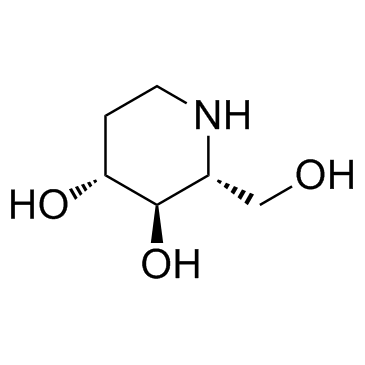
Cas No.: 53185-12-9
Sample solution is provided at 25 µL, 10mM.
_1-3.$$$39978408@51.jpg');)
_1-9.$$$38538795@65.jpg');)
_1-9.$$$39112701@51.jpg');)
_1-7.$$$37316672@70.jpg');)
_366-372.$$$36198801@70.jpg');)
.$$$38565142@65.jpg');)
_1867-1883.$$$33248023@67.jpg');)
_eads6055.$$$39977546@45.jpg');)
_eadm9805.$$$40080571@45.jpg');)
_eadj3020.$$$39666821@45.jpg');)
_1-20.$$$39757301@28.jpg');)
_1-24.$$$38898113@28.jpg');)
_273-287.$$$36806353@46.jpg');)
_1-16.$$$37156877@44.jpg');)
_1-19.$$$37460805@44.jpg');)
_1291-1307.$$$34518654@46.jpg');)
Fagomine is a mild glycosidase inhibitor. The Ki of the iminosugar Fagomine is 4.8 μM, 39 μM, and 70 μM for Amyloglucosidase (A.niger), β-Glucosidase (bovine), and Isomaltase (yeast), respectively. Glycosidase[1]
Fagomine (D-fagomine) is an iminosugar that has been shown to selectively agglutinate Enterobacteriales in vitro. Fagomine selectively agglutinates fimbriated enterobacteria (e.g., E.coli) and inhibits their adhesion to the intestinal mucosa; the reason for this is probably related to its structural similarity with lectin-binding saccharides (e.g., mannose). Fagomine is capable of altering this effect of high-fat high-sucrose diet (HFHS) on the proportion of Enterobacteriales and E.coli[2].
Fagomine (D-fagomine) is a natural iminosugar that counteracts the short-term effects of a high-energy-dense diet on body weight, fasting blood glucose levels and the proportion of gut Enterobacteriales[3]. Compare to the standard group, rats fed high-fat high-sucrose diet (HFHS) with Fagomine (D-fagomine) gain significantly less weight (15.3%) than those fed HFHS (20.9%)[2].
[1]. Mena-BarragÁn T, et al. Inhibitor versus chaperone behaviour of d-fagomine, DAB and LAB sp2-iminosugar conjugates againstglycosidases: A structure-activity relationship study in Gaucher fibroblasts. Eur J Med Chem. 2015 Aug 31. pii: S0223-5234(15)30222-1. [2]. Ramos-Romero S, et al. Effect of (D)-fagomine on excreted Enterobacteria and weight gain in rats fed a high-fat high-sucrose diet. Obesity (Silver Spring). 2014 Apr;22(4):976-9. [3]. Molinar-Toribio E, et al. D-Fagomine attenuates metabolic alterations induced by a high-energy-dense diet in rats. Food Funct. 2015 Aug;6(8):2614-9.
Kinase experiment: | Lysosomal enzyme activities in cell lysates are determined. Briefly, cells are scraped in ice-cold 0.1% Triton X-100 in water. After centrifugation (6000 rpm for 15 min at 4°C) to remove insoluble materials, protein concentrations are determined using Protein Assay Rapid Kit. The lysates are incubated at 37°C with the corresponding 4-methylumbelliferyl β-D-glycopyranoside solution in 0.1 M citrate buffer (pH 4). The liberated 4-methylumbelliferone is measured with a fluorescence plate reader (excitation 340 nm; emission 460 nm). For enzyme inhibition assay, cell lysates from normal skin fibroblasts are mixed with the 4-methylumbelliferyl β-D-glycopyranoside substrates in the absence or presence of increasing concentrations of Fagomine[1]. |
Cell experiment: | Human skin fibroblasts from a healthy and three Gaucher disease patients (with N188S/G183W, V230G/R296X and L444P/L444P mutations) are maintained in our laboratory with DMEM supplemented with 10% FBS as the culture medium. For enzyme activity enhancement assay, cells are cultured in the presence of different concentrations of Fagomine or DMSO alone (as a control) for 5 days and harvested by scraping. Cytotoxicity of Fagomine is monitored by measuring the lactate dehydrogenase activities in the cultured supernatants[1]. |
Animal experiment: | Rats[3] Sprague-Dawley rats (male, 22 weeks old) are randomly assigned to one of the three dietary groups: the control group, fed a standard diet (STD); a group fed HFHS (modified high-fat high-sucrose diet); and a group fed HFHS supplemented with 0.065% Fagomine (HFHS+FG). The percentage of Fagomine is adjusted so that its ratio to sucrose is 2 mg/g, as defined before from the results of post-prandial tests.The modified diets are processed. Feed consumption is monitored every day throughout the experiment and body weight is measured before and at the end of the nutritional intervention. All animal manipulations are carried out in the morning to minimize the effects of circadian rhythms. |
References: [1]. Mena-Barragán T, et al. Inhibitor versus chaperone behaviour of d-fagomine, DAB and LAB sp2-iminosugar conjugates againstglycosidases: A structure-activity relationship study in Gaucher fibroblasts. Eur J Med Chem. 2015 Aug 31. pii: S0223-5234(15)30222-1. | |
| Cas No. | 53185-12-9 | SDF | |
| Canonical SMILES | O[C@@H]1CCN[C@@H]([C@H]1O)CO | ||
| Formula | C6H13NO3 | M.Wt | 147.17 |
| Solubility | Water: ≥ 36 mg/mL (244.62 mM) | Storage | Store at -20°C |
| General tips | Please select the appropriate solvent to prepare the stock solution according to the
solubility of the product in different solvents; once the solution is prepared, please store it in
separate packages to avoid product failure caused by repeated freezing and thawing.Storage method
and period of the stock solution: When stored at -80°C, please use it within 6 months; when stored
at -20°C, please use it within 1 month. To increase solubility, heat the tube to 37°C and then oscillate in an ultrasonic bath for some time. |
||
| Shipping Condition | Evaluation sample solution: shipped with blue ice. All other sizes available: with RT, or with Blue Ice upon request. | ||
| Prepare stock solution | |||

|
1 mg | 5 mg | 10 mg |
| 1 mM | 6.7949 mL | 33.9743 mL | 67.9486 mL |
| 5 mM | 1.359 mL | 6.7949 mL | 13.5897 mL |
| 10 mM | 679.5 μL | 3.3974 mL | 6.7949 mL |
Step 1: Enter information below (Recommended: An additional animal making an allowance for loss during the experiment)
 g
μL
g
μL
Step 2: Enter the in vivo formulation (This is only the calculator, not formulation. Please contact us first if there is no in vivo formulation at the solubility Section.)
Calculation results:
Working concentration: mg/ml;
Method for preparing DMSO master liquid: mg drug pre-dissolved in μL DMSO ( Master liquid concentration mg/mL, Please contact us first if the concentration exceeds the DMSO solubility of the batch of drug. )
Method for preparing in vivo formulation: Take μL DMSO master liquid, next addμL PEG300, mix and clarify, next addμL Tween 80, mix and clarify, next add μL saline, mix and clarify.
Method for preparing in vivo formulation: Take μL DMSO master liquid, next add μL Corn oil, mix and clarify.
Note: 1. Please make sure the liquid is clear before adding the next solvent.
2. Be sure to add the solvent(s) in order. You must ensure that the solution obtained, in the previous addition, is a clear solution before proceeding to add the next solvent. Physical methods such as vortex, ultrasound or hot water bath can be used to aid dissolving.
3. All of the above co-solvents are available for purchase on the GlpBio website.
Quality Control & SDS
- View current batch:
- Purity: >98.00% Appearance: A solid
- COA (Certificate of Analysis)
- SDS (Safety Data Sheet)
- Datasheet
Average Rating: 5 (Based on Reviews and 21 reference(s) in Google Scholar.)