

PACAP (1-27), human, ovine, rat TFA (Synonyms: PACAP 1-27 TFA) |
Catalog No.GC38596
 One-Click Copy Product Info
|

PACAP (1-27), humano, ovino, TFA de rata (PACAP 1-27 TFA) es el fragmento N-terminal de PACAP-38, y es un potente antagonista del receptor PACAP con IC50 de 3 nM, 2 nM y 5 nM para PAC1 de rata, VPAC1 de rata y VPAC2 humano, respectivamente.
Products are for research use only. Not for human use. We do not sell to patients.
Sample solution is provided at 25 µL, 10mM.
_1-3.$$$39978408@51.jpg');)
_1-9.$$$38538795@65.jpg');)
_1-9.$$$39112701@51.jpg');)
_1-7.$$$37316672@70.jpg');)
_366-372.$$$36198801@70.jpg');)
.$$$38565142@65.jpg');)
_1867-1883.$$$33248023@67.jpg');)
_eads6055.$$$39977546@45.jpg');)
_eadm9805.$$$40080571@45.jpg');)
_eadj3020.$$$39666821@45.jpg');)
_1-20.$$$39757301@28.jpg');)
_1-24.$$$38898113@28.jpg');)
_273-287.$$$36806353@46.jpg');)
_1-16.$$$37156877@44.jpg');)
_1-19.$$$37460805@44.jpg');)
_1291-1307.$$$34518654@46.jpg');)
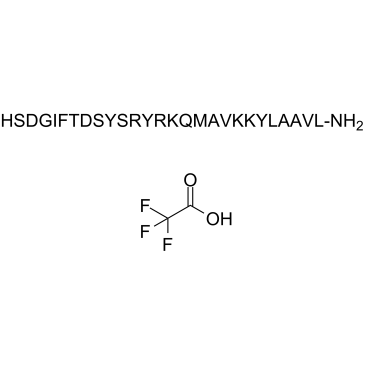
PACAP (1-27), human, ovine, rat TFA (PACAP 1-27 TFA) is the N-terminal fragment of PACAP-38, and is a potent PACAP receptor antagonist with IC50s of 3 nM, 2 nM and 5 nM for rat PAC1, rat VPAC1 and human VPAC2, respectively[1].
Radioligand receptor binding assays with I-monoiodinated PACAP (1-27), human, ovine, rat confirms the presence of PAC -receptors on AR4-2J cells, since PACAP (1-27), human, ovine, rat and PACAP(1-38) equipotently displaces radioligand binding with a Kd of 1-2 nM, whereas vasoactive intestinal peptide (VIP) is 1000-fold less potent. PACAP (1-27), human, ovine, rat exhibits a distinct and much higher susceptibility to VIP-amino acid substitutions. PACAP (1-27), human, ovine, rat has potency and binding affinity to stimulate IP3 and cAMP formation in AR4-2J cells[2].
The inhibitory effect of pituitary adenylate cyclase activating polypeptide (PACAP (1-27), human, ovine, rat) on the increase in total pulmonary resistance (RL) causes either by allergen or histamine in anaesthetized, ventilated guinea-pigs is studied. PACAP (1-27), human, ovine, rat given via i.v. infusion (0.045-4.5 nmol/kg/min) dose-dependently reduces the increase in RL caused by inhaled ovalbumin and histamine. At the highest dose, PACAP (1-27), human, ovine, rat prevents the increase in RL caused by ovalbumin and histamine completely. Infusion of PACAP (1-27), human, ovine, rat and the β2-adrenoceptor agonist, salbutamol (0.045-4.5 nmol/kg/min) inhibit the increase in RL similarly, but salbutamol increases the heart rate more than PACAP (1-27), human, ovine, rat[3].
[1]. Gourlet P, et al. Fragments of pituitary adenylate cyclase activating polypeptide discriminate between type I and II recombinant receptors. Eur J Pharmacol. 1995 Dec 4;287(1):7-11. [2]. SchÄfer H, et al. Structural motifs of pituitary adenylate cyclase-activating polypeptide (PACAP) defining PAC1-receptor selectivity. Regul Pept. 1999 Feb 5;79(2-3):83-92. [3]. LindÉn A, et al. Inhibition of bronchoconstriction by pituitary adenylate cyclase activating polypeptide (PACAP 1-27) in guinea-pigs in vivo. Br J Pharmacol. 1995 Jul;115(6):913-6.
| Cas No. | SDF | ||
| Sinónimos | PACAP 1-27 TFA | ||
| Formula | C144H225F3N40O41S | M.Wt | 3261.68 |
| Solubility | Water: 100 mg/mL (30.66 mM) | Storage | Store at -20°C |
| General tips | Please select the appropriate solvent to prepare the stock solution according to the
solubility of the product in different solvents; once the solution is prepared, please store it in
separate packages to avoid product failure caused by repeated freezing and thawing.Storage method
and period of the stock solution: When stored at -80°C, please use it within 6 months; when stored
at -20°C, please use it within 1 month. To increase solubility, heat the tube to 37°C and then oscillate in an ultrasonic bath for some time. |
||
| Shipping Condition | Evaluation sample solution: shipped with blue ice. All other sizes available: with RT, or with Blue Ice upon request. | ||
| Prepare stock solution | |||

|
1 mg | 5 mg | 10 mg |
| 1 mM | 306.6 μL | 1.533 mL | 3.0659 mL |
| 5 mM | 61.3 μL | 306.6 μL | 613.2 μL |
| 10 mM | 30.7 μL | 153.3 μL | 306.6 μL |
Step 1: Enter information below (Recommended: An additional animal making an allowance for loss during the experiment)
 g
μL
g
μL
Step 2: Enter the in vivo formulation (This is only the calculator, not formulation. Please contact us first if there is no in vivo formulation at the solubility Section.)
Calculation results:
Working concentration: mg/ml;
Method for preparing DMSO master liquid: mg drug pre-dissolved in μL DMSO ( Master liquid concentration mg/mL, Please contact us first if the concentration exceeds the DMSO solubility of the batch of drug. )
Method for preparing in vivo formulation: Take μL DMSO master liquid, next addμL PEG300, mix and clarify, next addμL Tween 80, mix and clarify, next add μL saline, mix and clarify.
Method for preparing in vivo formulation: Take μL DMSO master liquid, next add μL Corn oil, mix and clarify.
Note: 1. Please make sure the liquid is clear before adding the next solvent.
2. Be sure to add the solvent(s) in order. You must ensure that the solution obtained, in the previous addition, is a clear solution before proceeding to add the next solvent. Physical methods such as vortex, ultrasound or hot water bath can be used to aid dissolving.
3. All of the above co-solvents are available for purchase on the GlpBio website.
Quality Control & SDS
- View current batch:
- Purity: >98.00% Appearance: A solid
- COA (Certificate of Analysis)
- SDS (Safety Data Sheet)
- Datasheet
Average Rating: 5 (Based on Reviews and 21 reference(s) in Google Scholar.)