

Gemigliptin tartrate |
Catalog No.GC60871
 One-Click Copy Product Info
|

El tartrato de gemigliptina (LC15-0444 tartrato) es un inhibidor de la dipeptidil peptidasa-4 (DPP-4) altamente selectivo, reversible y competitivo, con una IC50 de 10,3 nM para la DPP-4 recombinante humana.
Products are for research use only. Not for human use. We do not sell to patients.
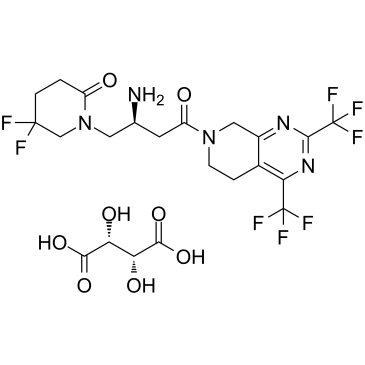
Cas No.: 1374639-74-3
Sample solution is provided at 25 µL, 10mM.
Gemigliptin tartrate is a potent, selective and long-acting dipeptidyl peptidase 4 (DPP4) inhibitor with a Ki of 7.25nM and an IC50 value of 10.3nM [1]. By preventing degradation of GLP-1 via DPP4 inhibition, Gemigliptin increases insulin secretion, reduces glucagon secretion, decreases HbA1c, and prevents β-cell damage [2]. Gemigliptin has been widely used to inhibit renal fibrosis and albuminuria in diabetic mice[3].
In vitro, Gemigliptin (500μM) treatment for 4 hours significantly attenuated the pro-inflammatory response of lipopolysaccharide (LPS)-induced RAW 264.7 macrophages, reduced the production of PGE2 and decreased the expression of COX-2 and iNOS mRNA[4]. Treatment with 500μM Gemigliptin for 24 hours significantly inhibited the proliferation of vascular smooth muscle cells (VSMCs) and induced G1 phase cell cycle arrest in the cells[5]. Treatment with 50μM Gemigliptin for 48 hours significantly altered the morphology of endothelial progenitor cells (EPCs) and enhanced cell viability, accompanied by a decrease in the expression of Caspase-3 and an increase in the expression level of BCL-2[6].
In vivo, Gemigliptin treatment via oral administration at a dose of 100mg/kg/day for 12 weeks significantly improved renal function and alleviated podocyte injury in mice with diabetic nephropathy [7]. Oral administration of Gemigliptin at a dose of 30μg/g/day for 5 weeks significantly alleviated hepatic steatosis and reduced the expression of inflammatory cytokines in a mouse model of non-alcoholic fatty liver disease[8].
References:
[1] Kim S H, Jung E, Yoon M K, et al. Pharmacological profiles of Gemigliptin tartrate, a novel dipeptidyl peptidase-4 inhibitor, in vitro and in vivo[J]. European Journal of Pharmacology, 2016, 788: 54-64.
[2] Gutch M, Joshi A, Kumar S, et al. Gemigliptin: newer promising gliptin for type 2 diabetes mellitus[J]. Indian journal of endocrinology and metabolism, 2017, 21(6): 898-902.
[3] Jung G S, Jeon J H, Choe M S, et al. Renoprotective effect of gemigliptin, a dipeptidyl peptidase-4 inhibitor, in streptozotocin-induced type 1 diabetic mice[J]. Diabetes & Metabolism Journal, 2016, 40(3): 211.
[4] Lee N, Heo Y J, Choi S E, et al. Anti‐inflammatory effects of empagliflozin and gemigliptin on LPS‐stimulated macrophage via the IKK/NF‐κB, MKK7/JNK, and JAK2/STAT1 signalling pathways[J]. Journal of immunology research, 2021, 2021(1): 9944880.
[5] Choi S H, Park S, Oh C J, et al. Dipeptidyl peptidase-4 inhibition by gemigliptin prevents abnormal vascular remodeling via NF-E2-related factor 2 activation[J]. Vascular Pharmacology, 2015, 73: 11-19.
[6] Lee M, Tariq A R, Kim M. Gemigliptin, a potent selective dipeptidyl peptidase 4 inhibitor, protects endothelial progenitor cells by oxidative stress via caspase-3 dependent pathway[J]. Biochemistry and Biophysics Reports, 2024, 38: 101673.
[7] Jung E, Kim J, Kim S H, et al. Gemigliptin improves renal function and attenuates podocyte injury in mice with diabetic nephropathy[J]. European Journal of Pharmacology, 2015, 761: 116-124.
[8] Lee N, Heo Y J, Choi S E, et al. Hepatoprotective effects of gemigliptin and empagliflozin in a murine model of diet-induced non-alcoholic fatty liver disease[J]. Biochemical and biophysical research communications, 2022, 588: 154-160.
| Cell experiment [1]: | |
Cell lines | Endothelial progenitor cells (EPCs) from diabetes mellitus patients |
Preparation Method | EPCs were suspended in the endothelial growth medium-2 (EGM-2) consisting of Endothelium basal medium-2 (EBM-2), 5 % fetal bovine serum (FBS), human epidermal growth factor (hEGF), vascular endothelial growth factor (VEGF), human fibroblast growth factor (hfGF-β), insulin-like growth factor-1 (IGF-1), 1% penicillin-streptomycin (PS) ascorbic acid and heparin. 1×10⁷ EPCs were seeded on 1% gelatin coated culture plates in EGM-2 and incubated in a 5% CO2 incubator at 37°C. Different concentrations of Gemigliptin (0, 10, 20, 50, and 100μM) were added and incubated at 37°C with 5% CO2 for 48h. Cell viability was measured. |
Reaction Conditions | 0, 10, 20, 50, and 100μM; 48h |
Applications | Gemigliptin treatment significantly enhanced cell viability of EPCs in a dose-dependent manner. |
| Animal experiment [2]: | |
Animal models | Male C57BL/6J mice |
Preparation Method | Male C57BL/6J mice (7 weeks old) were housed in an environmentally controlled room (12h light–dark cycle, 50%±10% relative humidity) at 23±2°C at a facility with free access to water and a choline-deficient, L-amino acid-defined, high-fat diet (CDAHFD), which consisted of 60 kcal% fat (mostly from palm oil), 0.1% methionine, and no added choline. After 2 weeks, mice fed CDAHFD were randomly divided into 2 groups (n=8 in each group), including (ⅰ) vehicle: CDAHFD-fed mice with vehicle treatment for 5 weeks; (ⅱ) GEMI: CDAHFD-fed mice with Gemigliptin treatment for 5 weeks (30μg/g per day by oral gavage). Mouse livers were isolated for analysis. |
Dosage form | 30μg/g/day for 5 weeks; p.o. |
Applications | Gemigliptin treatment reduced hepatic steatosis and inflammation in high-fat diet-fed mice. |
References: | |
| Cas No. | 1374639-74-3 | SDF | |
| Canonical SMILES | O=C(O)[C@H](O)[C@@H](O)C(O)=O.O=C1N(C[C@@H](N)CC(N2CCC3=C(C(F)(F)F)N=C(C(F)(F)F)N=C3C2)=O)CC(F)(F)CC1 | ||
| Formula | C22H25F8N5O8 | M.Wt | 639.45 |
| Solubility | DMSO: 100 mg/mL (156.38 mM) | Storage | Store at -20°C |
| General tips | Please select the appropriate solvent to prepare the stock solution according to the
solubility of the product in different solvents; once the solution is prepared, please store it in
separate packages to avoid product failure caused by repeated freezing and thawing.Storage method
and period of the stock solution: When stored at -80°C, please use it within 6 months; when stored
at -20°C, please use it within 1 month. To increase solubility, heat the tube to 37°C and then oscillate in an ultrasonic bath for some time. |
||
| Shipping Condition | Evaluation sample solution: shipped with blue ice. All other sizes available: with RT, or with Blue Ice upon request. | ||
| Prepare stock solution | |||

|
1 mg | 5 mg | 10 mg |
| 1 mM | 1.5638 mL | 7.8192 mL | 15.6384 mL |
| 5 mM | 312.8 μL | 1.5638 mL | 3.1277 mL |
| 10 mM | 156.4 μL | 781.9 μL | 1.5638 mL |
Step 1: Enter information below (Recommended: An additional animal making an allowance for loss during the experiment)
 g
μL
g
μL
Step 2: Enter the in vivo formulation (This is only the calculator, not formulation. Please contact us first if there is no in vivo formulation at the solubility Section.)
Calculation results:
Working concentration: mg/ml;
Method for preparing DMSO master liquid: mg drug pre-dissolved in μL DMSO ( Master liquid concentration mg/mL, Please contact us first if the concentration exceeds the DMSO solubility of the batch of drug. )
Method for preparing in vivo formulation: Take μL DMSO master liquid, next addμL PEG300, mix and clarify, next addμL Tween 80, mix and clarify, next add μL saline, mix and clarify.
Method for preparing in vivo formulation: Take μL DMSO master liquid, next add μL Corn oil, mix and clarify.
Note: 1. Please make sure the liquid is clear before adding the next solvent.
2. Be sure to add the solvent(s) in order. You must ensure that the solution obtained, in the previous addition, is a clear solution before proceeding to add the next solvent. Physical methods such as vortex, ultrasound or hot water bath can be used to aid dissolving.
3. All of the above co-solvents are available for purchase on the GlpBio website.
Quality Control & SDS
- View current batch:
- Purity: >98.00% Appearance: A solid
- COA (Certificate of Analysis)
- SDS (Safety Data Sheet)
- Datasheet
Average Rating: 5 (Based on Reviews and 22 reference(s) in Google Scholar.)