


Human Vitamin D Receptor Reporter Assay System (Synonyms: NR1I1, VDR) |
| Catalog No.GC52504 |
A nuclear receptor cell-based reporter assay
Products are for research use only. Not for human use. We do not sell to patients.
Sample solution is provided at 25 µL, 10mM.
;)
,-1-7$$$37316672.jpg');)
;)
;)
$$$36806353.jpg');)
;33(7)%EF%BC%9A546-561$$$37156877.jpg');)
;)
;)
;)
%201124-1138.$$$35908550.jpg');)
%20766-780.$$$37100057.jpg');)
%20418-432.$$$36893736.jpg');)
%EF%BC%9A-240-255.$$$35108512.jpg');)
533-545$$$36543525.jpg');)
%201-13.$$$36600053.jpg');)
;)
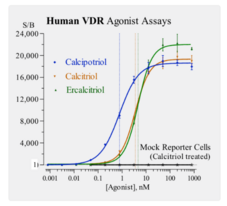
INDIGO's Human Vitamin D Receptor Assay utilizes proprietary Human cells engineered to provide high-level expression of Human VDR (also known as NR1I1). Reporter Cells also incorporate a luciferase reporter gene. Quantifying expressed luciferase activity at the assay endpoint provides a sensitive surrogate measure of changes in VDR activity in treated cells. The principle application of this reporter assay system is in the screening of test samples to quantify functional activity, either agonist or antagonist, that may exert against the Human VDR. The calcitriol receptor, also known as the vitamin D receptor (VDR) is a member of the nuclear receptor family of transcription factors. Upon activation by vitamin D, the VDR forms a heterodimer with the retinoid-X receptor and binds to hormone response elements on DNA resulting in expression or transrepression of specific gene products. Glucocorticoids are known to decrease expression of VDR which is expressed in most tissues of the body and regulate intestinal transport of calcium. This gene encodes the nuclear hormone receptor for vitamin D3. This receptor also functions as a receptor for the secondary bile acid lithocholic acid. The receptor belongs to the family of trans-acting transcriptional regulatory factors and shows similarity of sequence to the steroid and thyroid hormone receptors. Downstream targets of this nuclear hormone receptor are principally involved in mineral metabolism though the receptor regulates a variety of other metabolic pathways, such as those involved in the immune response and cancer. Mutations in this gene are associated with type II vitamin D-resistant rickets. A single nucleotide polymorphism in the initiation codon results in an alternate translation start site three codons downstream. Alternative splicing results in multiple transcript variants encoding the same protein. VDR Reporter Cells are prepared using INDIGO's proprietary CryoMite™ process. This cryo-preservation method yields high cell viability post-thaw, and provides the convenience of immediately dispensing healthy, division-competent reporter cells into assay plates. There is no need for intermediate spin-and-wash steps, viability determinations, or cell titer adjustments.[INDIGO Catalog Nos. IB00701-32, IB00701, IB00702]

Average Rating: 5 (Based on Reviews and 30 reference(s) in Google Scholar.)
GLPBIO products are for RESEARCH USE ONLY. Please make sure your review or question is research based.
Required fields are marked with *