

KF21213 |
Catalog No.GC31217
 One-Click Copy Product Info
|

KF21213 es un ligando altamente selectivo para mapear los receptores de adenosina A2A del SNC.
Products are for research use only. Not for human use. We do not sell to patients.
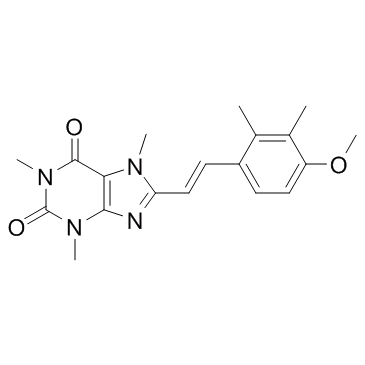
Cas No.: 155271-17-3
Sample solution is provided at 25 µL, 10mM.
_1-3.$$$39978408@51.jpg');)
_1-9.$$$38538795@65.jpg');)
_1-9.$$$39112701@51.jpg');)
_1-7.$$$37316672@70.jpg');)
_366-372.$$$36198801@70.jpg');)
.$$$38565142@65.jpg');)
_1867-1883.$$$33248023@67.jpg');)
_eads6055.$$$39977546@45.jpg');)
_eadm9805.$$$40080571@45.jpg');)
_eadj3020.$$$39666821@45.jpg');)
_1-20.$$$39757301@28.jpg');)
_1-24.$$$38898113@28.jpg');)
_273-287.$$$36806353@46.jpg');)
_1-16.$$$37156877@44.jpg');)
_1-19.$$$37460805@44.jpg');)
_1291-1307.$$$34518654@46.jpg');)
KF21213 is a highly selective ligand for mapping CNS adenosine A2A receptors. KF21213 shows a high affinity for the adenosine A2A receptors (Ki=3.0 nM).
[11C]KF21213 as a PET ligand for mapping adenosine A2A receptors in the central nervous system (CNS). KF21213 shows a high affinity for the adenosine A2A receptors in vitro (Ki=3.0 nM) and a very low affinity for the A1 receptors (Ki>10,000 nM)[1].
The uptake of [11C]KF21213 by the striatum gradually increases for the first 15 min and then decreases. The uptake by the cortex and cerebellum is rapidly decreased after injection. Their levels are compatible with that in the blood. Consequently, the uptake ratios of striatum to cortex and striatum to cerebellum increases up to 8.6±1.6 and 10.5±2.1 (N=4), respectively, by 60 min. The striatal activity level of [11C]KF21213 is retained for the initial 5 min and then gradually decreased with time, whereas that of [11C]KF18446 rapidly decreases.The cerebellar activity of the two ligands rapidly decreases.The striatum-to-cerebellum uptake ratio for [11C]KF21213 gradually increases to 2.4 6 0.5 (N 5 3) by 50-60 min, whereas that for [11C]KF18446 increases for the first 10 min and remains constant (1.4±0.3, N=3, at 25-35 min)[1].
[1]. Wang WF, et al. Carbon-11-labeled KF21213: a highly selective ligand for mapping CNS adenosine A(2A) receptors with positron emission tomography. Nucl Med Biol. 2000 Aug;27(6):541-6.
Kinase experiment: | The in vitro affinity of KF21213 for the adenosine A2A and A1 receptors is determined using the rat striatal membrane and [3H]CGS 21680 as a radioligand and the rat forebrain membrane and N6-[3H]cyclohexyladenosine, respectively. The assay is performed in the dark to prevent photo-isomerization[1]. |
Cell experiment: | Mice[1]Two groups of male ddY mice (30-39 g) are used. In the first group, [11C]KF21213 (1.1 MBq/36 pmol) is intravenously injected. They are killed by cervical dislocation at 5, 15, 30, and 60 min after injection (N=4 each). Blood is collected by heart puncture. The brain is removed and dissected into the striatum, cortex, and cerebellum. The regional brain uptake of radioactivity is measured as the percentage of injected dose per gram tissue (%ID/g). In the other group, [11C]KF21213 (1.1 MBq/21 pmol) is co-injected with one of the following adenosine receptor antagonists: A2A antagonists KF21213, KF17837, KF18446, and SCH 58261 and an A1 antagonist KF15372. The injected dose of KF21213 is 30 nmol and that of other antagonists is 50 nmol. The mice are killed at 15 min after injection (N=9 for control and N=4 for each of the other groups). The regional brain uptake of radioactivity is measured. Rat[1]PET measurement is performed in three rats with a model SHR-2000 camera with Z=2 mode, providing 14 slices at 3.25 mm intervals. The rat (240-300 g) is anesthetized with 0.02% isoflurane throughout the PET study. The anesthetized rat is positioned prone on a stereotaxic head holder made of polymethyl methacrylate. An incision is made on the scalp to locate the bregma, which is positioned at the tenth slice from caudal. After a transmission scan to correct for photon attenuation, the [11C]KF21213 (N=3) (43–56 MBq/1.2-1.9 nmol/kg body weight) or [11C]KF18446 (N=3) (50-55 MBq/1.8-4.9 nmol/kg body weight) is injected through the tail vein, and the time sequential tomographic scanning is performed for 60 min (20 frames by 30 sec and 50 frames by 1 min). |
References: [1]. Wang WF, et al. Carbon-11-labeled KF21213: a highly selective ligand for mapping CNS adenosine A(2A) receptors with positron emission tomography. Nucl Med Biol. 2000 Aug;27(6):541-6. | |
| Cas No. | 155271-17-3 | SDF | |
| Canonical SMILES | O=C(N1C)N(C)C2=C(N(C)C(/C=C/C3=CC=C(OC)C(C)=C3C)=N2)C1=O | ||
| Formula | C19H22N4O3 | M.Wt | 354.4 |
| Solubility | Soluble in DMSO | Storage | Store at -20°C |
| General tips | Please select the appropriate solvent to prepare the stock solution according to the
solubility of the product in different solvents; once the solution is prepared, please store it in
separate packages to avoid product failure caused by repeated freezing and thawing.Storage method
and period of the stock solution: When stored at -80°C, please use it within 6 months; when stored
at -20°C, please use it within 1 month. To increase solubility, heat the tube to 37°C and then oscillate in an ultrasonic bath for some time. |
||
| Shipping Condition | Evaluation sample solution: shipped with blue ice. All other sizes available: with RT, or with Blue Ice upon request. | ||
| Prepare stock solution | |||

|
1 mg | 5 mg | 10 mg |
| 1 mM | 2.8217 mL | 14.1084 mL | 28.2167 mL |
| 5 mM | 564.3 μL | 2.8217 mL | 5.6433 mL |
| 10 mM | 282.2 μL | 1.4108 mL | 2.8217 mL |
Step 1: Enter information below (Recommended: An additional animal making an allowance for loss during the experiment)
 g
μL
g
μL
Step 2: Enter the in vivo formulation (This is only the calculator, not formulation. Please contact us first if there is no in vivo formulation at the solubility Section.)
Calculation results:
Working concentration: mg/ml;
Method for preparing DMSO master liquid: mg drug pre-dissolved in μL DMSO ( Master liquid concentration mg/mL, Please contact us first if the concentration exceeds the DMSO solubility of the batch of drug. )
Method for preparing in vivo formulation: Take μL DMSO master liquid, next addμL PEG300, mix and clarify, next addμL Tween 80, mix and clarify, next add μL saline, mix and clarify.
Method for preparing in vivo formulation: Take μL DMSO master liquid, next add μL Corn oil, mix and clarify.
Note: 1. Please make sure the liquid is clear before adding the next solvent.
2. Be sure to add the solvent(s) in order. You must ensure that the solution obtained, in the previous addition, is a clear solution before proceeding to add the next solvent. Physical methods such as vortex, ultrasound or hot water bath can be used to aid dissolving.
3. All of the above co-solvents are available for purchase on the GlpBio website.
Quality Control & SDS
- View current batch:
- Purity: >98.00% Appearance: A solid
- COA (Certificate of Analysis)
- SDS (Safety Data Sheet)
- Datasheet
Average Rating: 5 (Based on Reviews and 6 reference(s) in Google Scholar.)