

MK-5046 |
Catalog No.GC19413
 One-Click Copy Product Info
|

MK-5046 es un agonista potente del receptor BRS-3 de Bombesina. Es selectivo, también se toma por vía oral. En el ser humano, su IC50 es 27nM y su EC50, 25nM
Products are for research use only. Not for human use. We do not sell to patients.
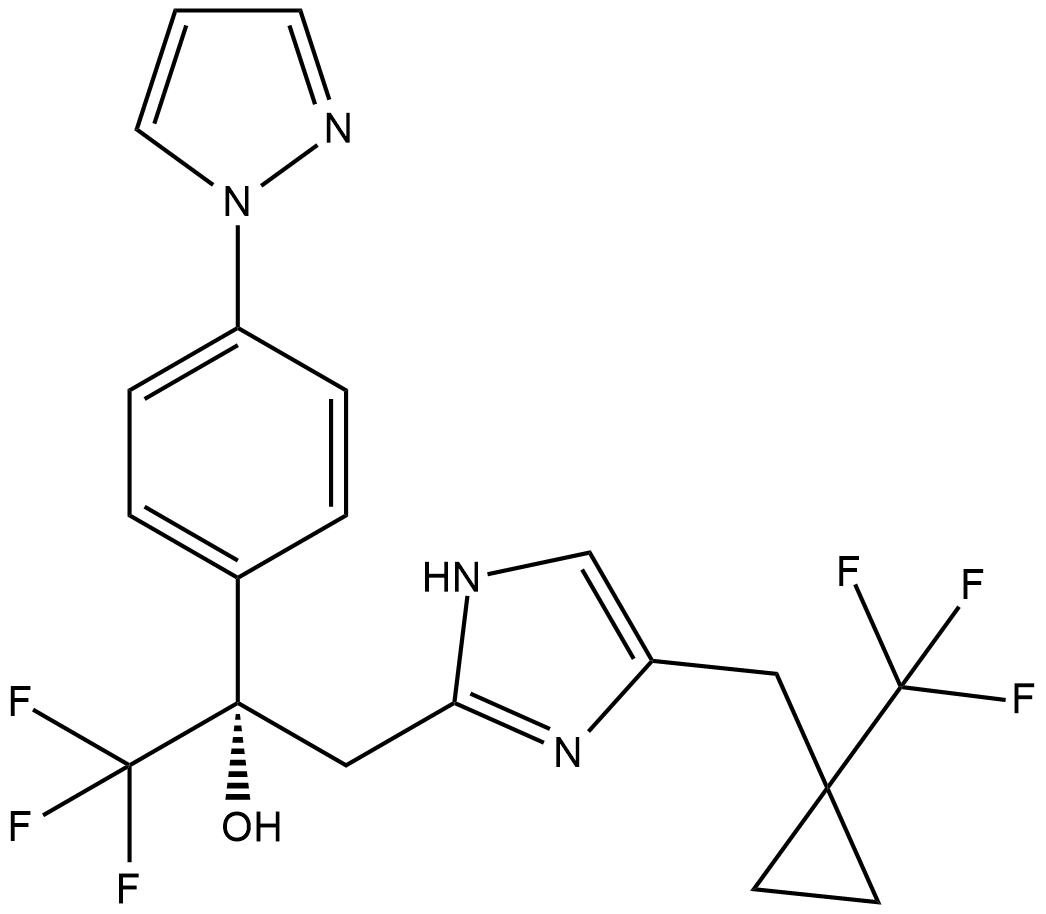
Cas No.: 1022152-70-0
Sample solution is provided at 25 µL, 10mM.
_1-3.$$$39978408@51.jpg');)
_1-9.$$$38538795@65.jpg');)
_1-9.$$$39112701@51.jpg');)
_1-7.$$$37316672@70.jpg');)
_366-372.$$$36198801@70.jpg');)
.$$$38565142@65.jpg');)
_1867-1883.$$$33248023@67.jpg');)
_eads6055.$$$39977546@45.jpg');)
_eadm9805.$$$40080571@45.jpg');)
_eadj3020.$$$39666821@45.jpg');)
_1-20.$$$39757301@28.jpg');)
_1-24.$$$38898113@28.jpg');)
_273-287.$$$36806353@46.jpg');)
_1-16.$$$37156877@44.jpg');)
_1-19.$$$37460805@44.jpg');)
_1291-1307.$$$34518654@46.jpg');)
MK-5046 es un agonista potente del receptor BRS-3 de Bombesina. Es selectivo, también se toma por vía oral. En el ser humano, su IC50 es 27nM y su EC50, 25nM[1]. BRS-3 es un receptor huérfano acoplado a la proteína G. El influye mucho en el equilibrio energético, el metabolismo de la glucosa y la secreción de insulina[2]. MK-5046 se usa para tratar la obesidad, también en estudios de sus vías de señalización[3,4].
Si usas MK-5046 (0.01, 0.1, 1μM) en células BRS-3-H1299, solo cinco minutos. La fosforilación tirosina de HER2 y la fosforilación de ERK, según la dosis[5]. Además, si las células H1299-BRS3 no tienen suero y las pones MK-5046 (10nM) por 24h. Las células se mueven más. Pero ojo, eso se quita con el antagonista Bantag-1 o el inhibidor Verteporfin[6].
Si inyectas MK-5046 bajo la piel en ratones gordos por dieta, dosis de (5, 25, 50mg/kg/día) durante 14 días. Bajan de peso según la dosis. El máximo que pierden ronda el 9%[7]. También, se inyecta por vena en ratones normales anestesiados a 1mg/kg. Sube la temperatura de la grasa marfa interescapular y la temperatura corporal general[8].
References:
[1] SEBHAT I K, FRANKLIN C, LO M M C, et al. Discovery of MK-5046, a potent, selective bombesin receptor subtype-3 agonist for the treatment of obesity[J]. ACS Medicinal Chemistry Letters, 2011, 2(1): 43-47.
[2] FENG Y, GUAN X M, LI J, et al. Bombesin receptor subtype-3 (BRS-3) regulates glucose-stimulated insulin secretion in pancreatic islets across multiple species[J]. Endocrinology, 2011, 152(11): 4106-4115.
[3] GONZÁLEZ N, MORENO P, JENSEN R T. Bombesin receptor subtype 3 as a potential target for obesity and diabetes[J]. Expert Opinion on Therapeutic Targets, 2015, 19(9): 1153-1170.
[4] REITMAN M L, DISHY V, MOREAU A, et al. Pharmacokinetics and pharmacodynamics of MK-5046, a bombesin receptor subtype-3 (BRS-3) agonist, in healthy patients[J]. The Journal of Clinical Pharmacology, 2012, 52(9): 1306-1316.
[5] MOODY T W, RAMOS-ALVAREZ I, MANTEY S A, et al. Bombesin receptor subtype-3 regulates tumor growth by HER2 tyrosine phosphorylation in a reactive oxygen species-dependent manner in lung cancer cells[J]. Targets, 2025, 3(1): 7.
[6] GUO M, ZHANG Y, WU L, et al. Dynamic phosphoproteomics of BRS3 activation reveals the Hippo signaling pathway for cell migration[J]. Journal of Proteome Research, 2023, 22(7): 2364-2376.
[7] GUAN X M, METZGER J M, YANG L, et al. Antiobesity effect of MK-5046, a novel bombesin receptor subtype-3 agonist[J]. The Journal of Pharmacology and Experimental Therapeutics, 2011, 336(2): 356-364.
[8] LATEEF D M, ABREU-VIEIRA G, XIAO C, et al. Regulation of body temperature and brown adipose tissue thermogenesis by bombesin receptor subtype-3[J]. American Journal of Physiology-Endocrinology and Metabolism, 2014, 306(6): E681-E687.
| Experimentos celulares [1]: | |
Líneas celulares | Células H1299-BRS3 hambrientas |
Método de preparación | 5 × 10⁴ células hambrientas se colocaron en la cámara superior con medio libre de FB, meintras que se añadió un medio que contenía un 10% de FBS y medicamentos a la cámara externa como quimioatrayente. Las células hambrientes fueron tratadas con MK-5046 (10nM), o MK-5046 y Bantag-1, o MK-5046 y Verteporfin durante 24h. FDespués de la incubación, se utilizó un 0.5% de violeta cristalina para teñir las células. Las células de la capa superior que no pasaron a través de la membrana se borraron, mientras que las células que pasaron se contaron bajo un microscopio de fluorescencia integrado. Echo Revolve Upside-Down. |
Condiciones de reacción | 10nM; 24h |
Áreas de aplicación | El tratamiento con MK-5046 (10nM) mejoró la migración celular, pero este efecto podría ser revertido por el inhibidor de la vía Bantag-1 o Hippo Verteporfin. |
| Experimentos con animales [2]: | |
Modelos animales | Ratones con obesidad inducida por la dieta (DIO) |
Método de preparación | Los ratones DIO recibieron una infusión subcutánea continua de MK-5046 a dosis de 5, 25 o 50mg/kg/día durante 14 días. El peso corporal se controló durante todo el período del estudio. |
Forma de dosificación | 5, 25, 50mg/kg/día; 14 días; s.c. |
Áreas de aplicación | El tratamiento con MK-5046 (5, 25, 50mg/kg/día) indujo una disminución dependiente de la dosis del peso corporal en ratones, con una perdida de peso máxima de el 9%. |
References: | |
| Cas No. | 1022152-70-0 | SDF | |
| Canonical SMILES | O[C@](CC1=NC(CC2(C(F)(F)F)CC2)=CN1)(C(F)(F)F)C3=CC=C(N4C=CC=N4)C=C3 | ||
| Formula | C20H18F6N4O | M.Wt | 444.37 |
| Solubility | Soluble in DMSO | Storage | Store at -20°C |
| General tips | Please select the appropriate solvent to prepare the stock solution according to the
solubility of the product in different solvents; once the solution is prepared, please store it in
separate packages to avoid product failure caused by repeated freezing and thawing.Storage method
and period of the stock solution: When stored at -80°C, please use it within 6 months; when stored
at -20°C, please use it within 1 month. To increase solubility, heat the tube to 37°C and then oscillate in an ultrasonic bath for some time. |
||
| Shipping Condition | Evaluation sample solution: shipped with blue ice. All other sizes available: with RT, or with Blue Ice upon request. | ||
| Prepare stock solution | |||

|
1 mg | 5 mg | 10 mg |
| 1 mM | 2.2504 mL | 11.2519 mL | 22.5038 mL |
| 5 mM | 450.1 μL | 2.2504 mL | 4.5008 mL |
| 10 mM | 225 μL | 1.1252 mL | 2.2504 mL |
Step 1: Enter information below (Recommended: An additional animal making an allowance for loss during the experiment)
 g
μL
g
μL
Step 2: Enter the in vivo formulation (This is only the calculator, not formulation. Please contact us first if there is no in vivo formulation at the solubility Section.)
Calculation results:
Working concentration: mg/ml;
Method for preparing DMSO master liquid: mg drug pre-dissolved in μL DMSO ( Master liquid concentration mg/mL, Please contact us first if the concentration exceeds the DMSO solubility of the batch of drug. )
Method for preparing in vivo formulation: Take μL DMSO master liquid, next addμL PEG300, mix and clarify, next addμL Tween 80, mix and clarify, next add μL saline, mix and clarify.
Method for preparing in vivo formulation: Take μL DMSO master liquid, next add μL Corn oil, mix and clarify.
Note: 1. Please make sure the liquid is clear before adding the next solvent.
2. Be sure to add the solvent(s) in order. You must ensure that the solution obtained, in the previous addition, is a clear solution before proceeding to add the next solvent. Physical methods such as vortex, ultrasound or hot water bath can be used to aid dissolving.
3. All of the above co-solvents are available for purchase on the GlpBio website.
Quality Control & SDS
- View current batch:
- Purity: >99.00% Appearance: A solid
- COA (Certificate of Analysis)
- SDS (Safety Data Sheet)
- Datasheet
Average Rating: 5 (Based on Reviews and 29 reference(s) in Google Scholar.)