

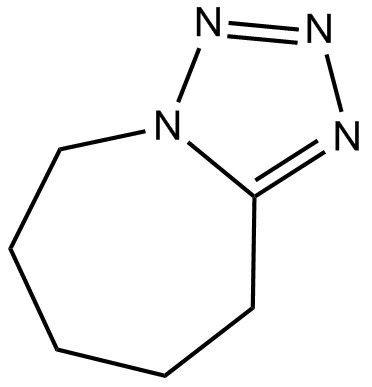
Pentylenetetrazole (Synonyms: α,β-Cyclopentamethylenetetrazole, 1,5-Pentamethylenetetrazole, PTZ, NSC 5729, NSC 66489) |
Catalog No.GC12357
 One-Click Copy Product Info
|

Pentylenetetrazole es un antagonista no selectivo del receptor A del γ-aminobutyric acid (GABA)
Products are for research use only. Not for human use. We do not sell to patients.
Cas No.: 54-95-5
Sample solution is provided at 25 µL, 10mM.
Pentylenetetrazole es un antagonista no selectivo del receptor A del γ-aminobutyric acid (GABA) [1]. El receptor GABAA, un importante receptor neurotransmisor inhibidor amplaimente presente en el sistema nervioso central, media los efectos inhibidores rápidos del GABA al aumentar la permeabilidad de la membrana celular a los iones cloruro, causando hiperpolarización e inhibiendo así la excitabilidad neuronal [2]. Pentylenetetrazole se utiliza a menudo para estudiar el mecanismo de las convulsiones epilépticas, detectar medicamentos antiepilépticos e investigar el estrés oxidativo y las respuestas neuroinflamatorias [3][4].
In vivo, Pentylenetetrazole (35mg/kg; i.p.; cada dos días durante 14 veces) indujo convulsiones epiléticas, aumentó os niveles de marcadores de estrés oxidativo (e.g., malondialdehyde, MDA), disminuyó las actividades de las enzimas antioxidantes (e.g., glutathione, GSH; superóxido dismutasa, SOD; catalasa, CAT) , elevó los niveles de citoquinas inflamatorias (e.g., IL-1β, IL-6, TNF-α) y condujo a respuestas neuroinflamatorias y daño neuronal en el modelo de ratones [5]. La inyección intraperitoneal de ratones Balb-c con Pentylenetetrazole (60mg/kg; i.p.; 24h) disminuyó significativamente los tioles de proteínas (PSH), cysteine (CSH) y los disdulfuros no proteicos mixtos (NPSSC), mientras aumentaba los disulfuros simétricos de proteínas (PSSP), los disulfuros no proteicos (NPSSR), la peroxidación lipídica y los niveles de oxidación de proteínas en el hipocampo del ratón[6]. Pentylenetetrazole (35mg/kg; i.p.; tres veces a la semana) indujo el encendeo en ratas, aumentó significativamente las concentraciones del hipocampo de alanina, arginina, glutamato, aspartato y taurina, mientras que disminuyó los niveles de GABA, lo que llevó a un aumento de más de cuatro veces en la relación Glu/GABA [7].
References:
[1] Huang RQ, Bell-Horner CL, Dibas MI, Covey DF, Drewe JA, Dillon GH. Pentylenetetrazole-induced inhibition of recombinant gamma-aminobutyric acid type A (GABA(A)) receptors: mechanism and site of action. J Pharmacol Exp Ther. 2001;298(3):986-995.
[2] Lambert JJ, Belelli D, Hill-Venning C, Peters JA. Neurosteroids and GABAA receptor function. Trends Pharmacol Sci. 1995;16(9):295-303.
[3] Shimada T, Yamagata K. Pentylenetetrazole-Induced Kindling Mouse Model. J Vis Exp. 2018;(136):56573.
[4] Monteiro ÁB, Alves AF, Ribeiro Portela AC, et al. Pentylenetetrazole: A review. Neurochem Int. 2024;180:105841.
[5] Younis NS, Almostafa MM, Mohamed ME. Geraniol Ameliorates Pentylenetetrazol-Induced Epilepsy, Neuroinflammation, and Oxidative Stress via Modulating the GABAergic Tract: In vitro and in vivo studies. Drug Des Devel Ther. 2024;18:5655-5672.
[6] Patsoukis N, Zervoudakis G, Panagopoulos NT, Georgiou CD, Angelatou F, Matsokis NA. Thiol redox state (TRS) and oxidative stress in the mouse hippocampus after pentylenetetrazol-induced epileptic seizure. Neurosci Lett. 2004;357(2):83-86.
[7] Szyndler J, Maciejak P, Turzyńska D, et al. Changes in the concentration of amino acids in the hippocampus of pentylenetetrazole-kindled rats. Neurosci Lett. 2008;439(3):245-249.
| Experimentos con animales [1]: | |
Modelos animales | Ratones Balb-c macho |
Método de preparación | Los ratones Balb-c machos (de 3 a 6 meses de edad) fueron alojados en pequeños grupos en una habitación con ciclo controlado de luz/oscuridad (12/12h) a 22℃. Se separaron en dos grupos y se trataron de la siguiente manera: En el grupo I (dosis convulsiva única), los animales recibieron i.p. 60 mg/kg de Pentylenetetrazole disuelto en solución salina al 0,9% y fueron decapitados 15 minutos, 30 minutos y 24 horas después de una convulsión tónica clónica. En el grupo II (controles), los animales recibieron i.p. el mismo volumen de solución salina y fueron decapitados 30 minutos después de la administración de solución salina. El cerebro se diseccionó rápidamente y el hipocampo se extirpó y se lavó con tampón fosfato-EDTA helado [10mM tampón de fosfato, pH 7,2, que contiene 1mM EDTA y 1mM del antioxidante BHA (en 0,15% de etanol final)]. Luego, el tejido se homogeneizó en un homogeneizador de vidrio PotterElvehjem y se utilizó para los ensayos posteriores. |
Forma de dosificación | 60 mg/kg; i.p.; 15 minutos, 30 minutos y 24 horas |
Áreas de aplicación | Pentylenetetrazole disminuyó significativamente los tioles de proteínas (PSH), la cisteína (CSH) y los disulfuros mixtos no proteicos (NPSSC), al tiempo que aumentó los disulfuros simétricos de proteínas (PSSP), los disulfuros simétricos no proteicos (NPSSR), la peroxidación de lípidos y los niveles de oxidación de proteínas en el hipocampo ratón. |
References: | |
| Cas No. | 54-95-5 | SDF | |
| Sinónimos | α,β-Cyclopentamethylenetetrazole, 1,5-Pentamethylenetetrazole, PTZ, NSC 5729, NSC 66489 | ||
| Chemical Name | 6,7,8,9-tetrahydro-5H-tetrazolo[1,5-a]azepine | ||
| Canonical SMILES | N12N=NN=C1CCCCC2 | ||
| Formula | C6H10N4 | M.Wt | 138.17 |
| Solubility | DMF: 30 mg/ml,DMSO: 30 mg/ml,Ethanol: 30 mg/ml,PBS (pH 7.2): 3 mg/ml | Storage | Store at -20°C |
| General tips | Please select the appropriate solvent to prepare the stock solution according to the
solubility of the product in different solvents; once the solution is prepared, please store it in
separate packages to avoid product failure caused by repeated freezing and thawing.Storage method
and period of the stock solution: When stored at -80°C, please use it within 6 months; when stored
at -20°C, please use it within 1 month. To increase solubility, heat the tube to 37°C and then oscillate in an ultrasonic bath for some time. |
||
| Shipping Condition | Evaluation sample solution: shipped with blue ice. All other sizes available: with RT, or with Blue Ice upon request. | ||
| Prepare stock solution | |||

|
1 mg | 5 mg | 10 mg |
| 1 mM | 7.2375 mL | 36.1873 mL | 72.3746 mL |
| 5 mM | 1.4475 mL | 7.2375 mL | 14.4749 mL |
| 10 mM | 723.7 μL | 3.6187 mL | 7.2375 mL |
Step 1: Enter information below (Recommended: An additional animal making an allowance for loss during the experiment)
 g
μL
g
μL
Step 2: Enter the in vivo formulation (This is only the calculator, not formulation. Please contact us first if there is no in vivo formulation at the solubility Section.)
Calculation results:
Working concentration: mg/ml;
Method for preparing DMSO master liquid: mg drug pre-dissolved in μL DMSO ( Master liquid concentration mg/mL, Please contact us first if the concentration exceeds the DMSO solubility of the batch of drug. )
Method for preparing in vivo formulation: Take μL DMSO master liquid, next addμL PEG300, mix and clarify, next addμL Tween 80, mix and clarify, next add μL saline, mix and clarify.
Method for preparing in vivo formulation: Take μL DMSO master liquid, next add μL Corn oil, mix and clarify.
Note: 1. Please make sure the liquid is clear before adding the next solvent.
2. Be sure to add the solvent(s) in order. You must ensure that the solution obtained, in the previous addition, is a clear solution before proceeding to add the next solvent. Physical methods such as vortex, ultrasound or hot water bath can be used to aid dissolving.
3. All of the above co-solvents are available for purchase on the GlpBio website.
Quality Control & SDS
- View current batch:
- Purity: >98.00% Appearance: A solid
- COA (Certificate of Analysis)
- SDS (Safety Data Sheet)
- Datasheet
Average Rating: 5 (Based on Reviews and 6 reference(s) in Google Scholar.)