
Risperidone (Synonyms: Apexidone, Psychodal, R 64766) |
| Catalog No.GC12986 |
Inhibidor de SR-2A
Products are for research use only. Not for human use. We do not sell to patients.
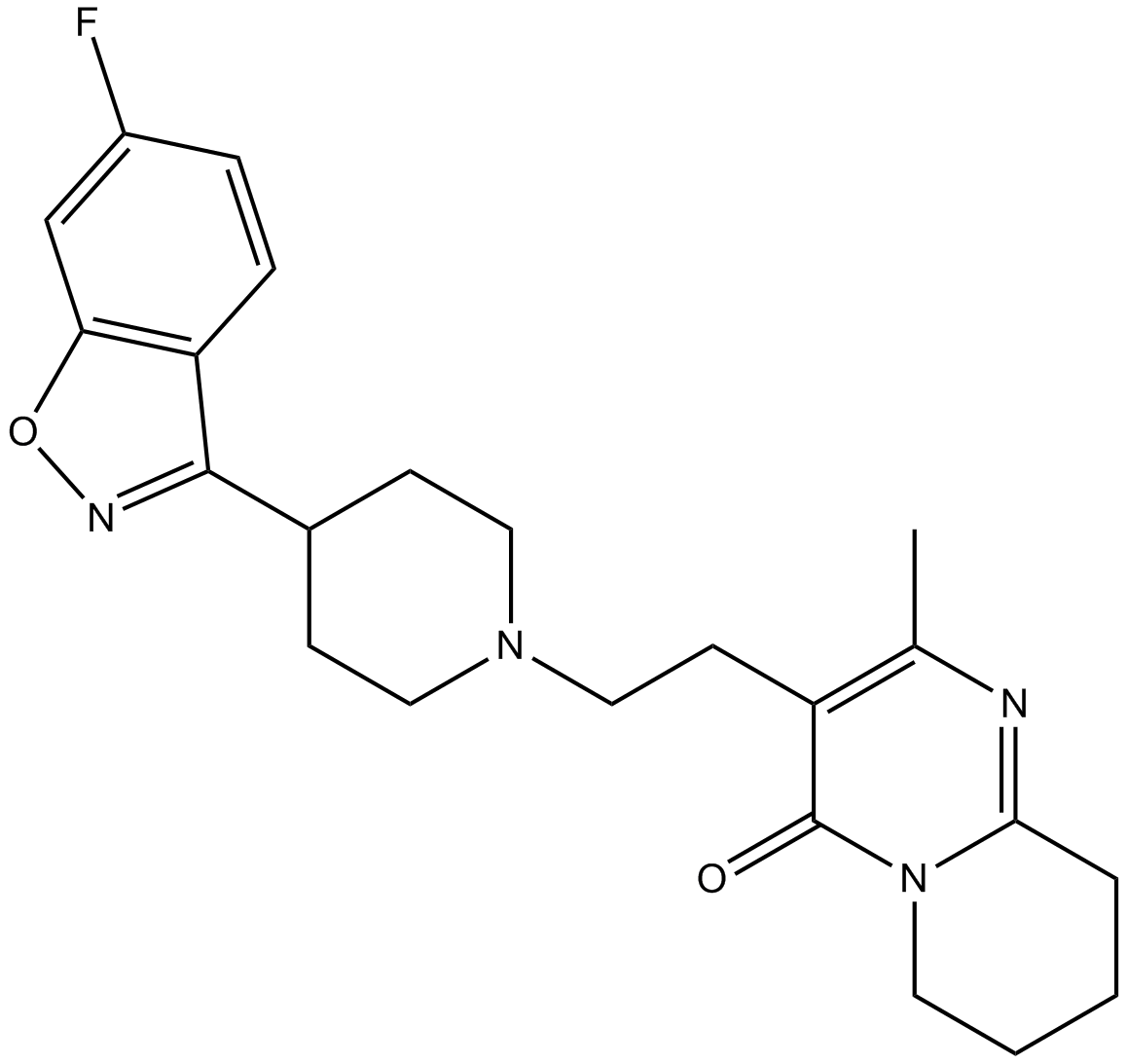
Cas No.: 106266-06-2
Sample solution is provided at 25 µL, 10mM.
Risperidone is a serotonin 5-HT2 receptor blocker, P-Glycoprotein inhibitor and potent dopamine D2 receptor antagonist, with Ki values of 4.8, 5.9nM for 5-HT2A and dopamine D2 receptor, respectively[1]. 5-HT2 receptor and dopamine D2 receptor are both important neurotransmitter receptors involved in modulating emotional and cognitive functions as well as motor and reward processes, and are closely related to the pathogenesis of various neuropsychiatric disorders[2]. Risperidone is commonly used in the research of diseases such as schizophrenia and bipolar disorder[3].
In vitro, treatment of dendritic cells with Risperidone(10⁻⁸ to 10⁻⁵M; 4 days) increases IL-10 and MDC production, decreases IP-10 and IL-12, and induces TNF-α release[4]. Treatment of MC3T3-E1 cells with Risperidone(10-200μM; 48h) inhibited cell proliferation and induced apoptosis in a dose-dependent manner, downregulated BGP, collagen 1, OPG, and RANKL, and upregulated TNF-α gene and protein expression[5].
In vivo, Risperidone (1mg/kg/day; p.o.; 56 days) increased body weight, fatty liver scores, serum ALT/AST, triglycerides, BUN, and creatinine, decreased GLUT4 expression and Akt phosphorylation, and induced renal inflammation in high-fat diet-fed C57BL/6J mice[6]. Risperidone (1-4mg/kg/day; i.g.; 7 days) reversed Aβ1-42-induced cognitive deficits, reduced hippocampal and cortical Aβ1-42, BACE1 and p-Tau levels, and inhibited neuronal apoptosis in ICR mice[7].
References:
[1] Nyberg S, Farde L, Eriksson L, Halldin C, Eriksson B. 5-HT2 and D2 dopamine receptor occupancy in the living human brain. A PET study with risperidone. Psychopharmacology (Berl). 1993;110(3):265-272.
[2] Remington G, Kapur S. D2 and 5-HT2 receptor effects of antipsychotics: bridging basic and clinical findings using PET. J Clin Psychiatry. 1999;60 Suppl 10:15-19.
[3] Bhat AA, Gupta G, Afzal O, et al. Neuropharmacological effect of risperidone: From chemistry to medicine. Chem Biol Interact. 2023;369:110296.
[4] Chen ML, Tsai TC, Wang LK, et al. Risperidone modulates the cytokine and chemokine release of dendritic cells and induces TNF-α-directed cell apoptosis in neutrophils. Int Immunopharmacol. 2012;12(1):197-204.
[5] Zheng L, Yang L, Zhao X, Long N, Li P, Wang Y. Effect of risperidone on proliferation and apoptosis of MC3T3-E1 cells. Braz J Med Biol Res. 2019;52(3):e8098.
[6] Tsai HP, Hou PH, Mao FC, et al. Risperidone Exacerbates Glucose Intolerance, Nonalcoholic Fatty Liver Disease, and Renal Impairment in Obese Mice. Int J Mol Sci. 2021;22(1):409.
[7] Wu L, Feng X, Li T, Sun B, Khan MZ, He L. Risperidone ameliorated Aβ1-42-induced cognitive and hippocampal synaptic impairments in mice. Behav Brain Res. 2017;322(Pt A):145-156.
| Cell experiment [1]: | |
Cell lines | MC3T3-E1 cells |
Preparation Method | MC3T3-E1 subclone 14 was cultured in Dulbecco’s modified Eagle’s medium (DMEM) supplement with 10% fatal bovine serum, and 1% penicillin-streptomycin antibiotics. When cells were confluent to 80–90%, serial passage was performed. Cells were washed twice with D-Hank’s solution and digested with 1ml of 0.25% trypsinEDTA. Next, 10×culture medium was added for stopping digestion and a few T25 flasks were used for reseeding. 10mM Risperidone stock was prepared in DMSO solution. To assess the effects of Risperidone on MC3T3-E1 cell proliferation, CCK-8 kit was used to detect cell proliferation rate in an empty group (only medium, no cells), control group (with medium and cells, but no Risperidone), and experimental group (with medium, cells, and different doses of Risperidone). Briefly, 2×10³ MC3T3-E1 cells per well were seeded in a 96-well plate and incubated for 24h at 37°C in 5% CO2. When cells were 80–90% confluent, the culture medium was replaced with fresh medium with no serum. Subsequently, 10, 50, 100, and 200μM Risperidone was added to the medium in duplicate wells. Cells were cultured for 48h. CCK-8 reagents were added into 96-well plates and incubated for 4h. Absorbance (AB) was measured at 450nm wavelength. Cell viability (%) = [AB of experimental group – AB of empty group] / [AB of control group – AB of empty group] 100%. |
Reaction Conditions | 10-200μM; 48h |
Applications | Treatment of MC3T3-E1 cells with Risperidone inhibited cell proliferation in a dose-dependent manner. |
| Animal experiment [2]: | |
Animal models | C57BL/6J mice |
Preparation Method | C57BL/6J mice were continually fed an HFD diet (diet 592Z, containing 20.4% of protein and modified laboratory with 35.5% lard, with 4.5kcal/g metabolizable energy; PMI Nutrition International) for 10 weeks. To establish obesity, our mice were administered the HFD for 10 weeks longer than the typical duration (i.e., 4 weeks). The groups were subsequently separated to form two subgroups: one receiving 1mg/kg oral Risperidone and the other (control group) receiving saline through daily gavage for the final 56 days of the diet period. During the experiment, mice were separately kept in microisolation cages placed on racks ventilated by air filtered by high-efficiency particulate air filters under temperature and humidity controlled at 22±1°C and 55%±5%, respectively, under a 12:12h light/dark cycle, all with free water and food access. We monitored body weight and food intake on a weekly basis from experiment initiation. At the end of the experiment, we euthanized all mice and harvested their blood and various tissues for further analysis. Furthermore, we evaluated the impacts of orally administered Risperidone on the weight, food intake, adipocyte content, biochemical changes, blood glucose level, fatty liver scores, endocrine profiles, hepatic lipogenesis, insulin signaling expression, and renal pathology of the mice. |
Dosage form | 1mg/kg/day; p.o.; 56 days |
Applications | Risperidone increased body weight, fatty liver scores, serum ALT/AST, triglycerides, BUN, and creatinine, decreased GLUT4 expression and Akt phosphorylation, and induced renal inflammation in high-fat diet-fed C57BL/6J mice. |
References: | |
| Cas No. | 106266-06-2 | SDF | |
| Sinónimos | Apexidone, Psychodal, R 64766 | ||
| Chemical Name | 3-[2-[4-(6-fluoro-1,2-benzoxazol-3-yl)piperidin-1-yl]ethyl]-2-methyl-6,7,8,9-tetrahydropyrido[1,2-a]pyrimidin-4-one | ||
| Canonical SMILES | CC1=C(C(=O)N2CCCCC2=N1)CCN3CCC(CC3)C4=NOC5=C4C=CC(=C5)F | ||
| Formula | C23H27FN4O2 | M.Wt | 410.48 |
| Solubility | ≥ 6.8mg/mL in DMSO with gentle warming | Storage | Store at RT |
| General tips | Please select the appropriate solvent to prepare the stock solution according to the
solubility of the product in different solvents; once the solution is prepared, please store it in
separate packages to avoid product failure caused by repeated freezing and thawing.Storage method
and period of the stock solution: When stored at -80°C, please use it within 6 months; when stored
at -20°C, please use it within 1 month. To increase solubility, heat the tube to 37°C and then oscillate in an ultrasonic bath for some time. |
||
| Shipping Condition | Evaluation sample solution: shipped with blue ice. All other sizes available: with RT, or with Blue Ice upon request. | ||
| Prepare stock solution | |||
|
1 mg | 5 mg | 10 mg |
| 1 mM | 2.4362 mL | 12.1809 mL | 24.3617 mL |
| 5 mM | 487.2 μL | 2.4362 mL | 4.8723 mL |
| 10 mM | 243.6 μL | 1.2181 mL | 2.4362 mL |
Step 1: Enter information below (Recommended: An additional animal making an allowance for loss during the experiment)
Step 2: Enter the in vivo formulation (This is only the calculator, not formulation. Please contact us first if there is no in vivo formulation at the solubility Section.)
Calculation results:
Working concentration: mg/ml;
Method for preparing DMSO master liquid: mg drug pre-dissolved in μL DMSO ( Master liquid concentration mg/mL, Please contact us first if the concentration exceeds the DMSO solubility of the batch of drug. )
Method for preparing in vivo formulation: Take μL DMSO master liquid, next addμL PEG300, mix and clarify, next addμL Tween 80, mix and clarify, next add μL ddH2O, mix and clarify.
Method for preparing in vivo formulation: Take μL DMSO master liquid, next add μL Corn oil, mix and clarify.
Note: 1. Please make sure the liquid is clear before adding the next solvent.
2. Be sure to add the solvent(s) in order. You must ensure that the solution obtained, in the previous addition, is a clear solution before proceeding to add the next solvent. Physical methods such as vortex, ultrasound or hot water bath can be used to aid dissolving.
3. All of the above co-solvents are available for purchase on the GlpBio website.
Quality Control & SDS
- View current batch:
- Purity: >98.00%
- COA (Certificate Of Analysis)
- SDS (Safety Data Sheet)
- Datasheet
Average Rating: 5 (Based on Reviews and 28 reference(s) in Google Scholar.)
GLPBIO products are for RESEARCH USE ONLY. Please make sure your review or question is research based.
Required fields are marked with *


