

SR 144528 (Synonyms: SR144528) |
Catalog No.GC10032
 One-Click Copy Product Info
|

SR 144528 es un antagonista altamente potente, selectivo y oralmente activo para el receptor CB2, con un valor de Ki de 0.6nM
Products are for research use only. Not for human use. We do not sell to patients.
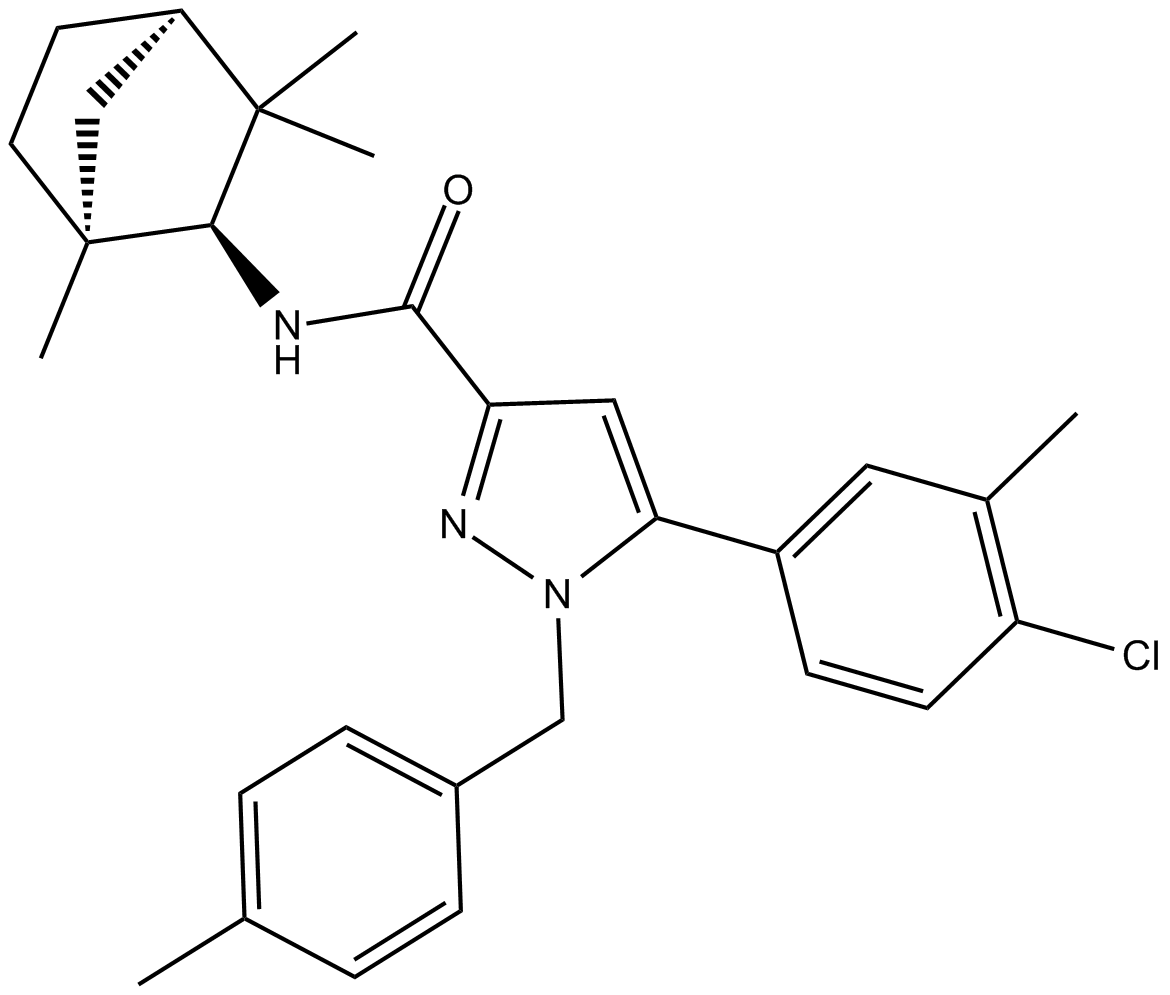
Cas No.: 192703-06-3
Sample solution is provided at 25 µL, 10mM.
_1-3.$$$39978408@51.jpg');)
_1-9.$$$38538795@65.jpg');)
_1-9.$$$39112701@51.jpg');)
_1-7.$$$37316672@70.jpg');)
_366-372.$$$36198801@70.jpg');)
.$$$38565142@65.jpg');)
_1867-1883.$$$33248023@67.jpg');)
_eads6055.$$$39977546@45.jpg');)
_eadm9805.$$$40080571@45.jpg');)
_eadj3020.$$$39666821@45.jpg');)
_1-20.$$$39757301@28.jpg');)
_1-24.$$$38898113@28.jpg');)
_273-287.$$$36806353@46.jpg');)
_1-16.$$$37156877@44.jpg');)
_1-19.$$$37460805@44.jpg');)
_1291-1307.$$$34518654@46.jpg');)
SR 144528 es un antagonista altamente potente, selectivo y oralmente activo para el receptor CB2, con un valor de Ki de 0.6nM [1]. SR 144528 inhibió la actividad microsómica de ACAT in vitro, con un valor de IC50 de 3.6±1.1μM[2]. SR 144528 se ha utilizado para anñalisis comparativos de señalización sesgada y actividad fuera del oibjetivo de los ligandos receptores CB2[3].
In vitro, el pretratamiento SR 144528 a 2μM durante 1h inhibió la apoptosis de macrófagos crudos 264.7 después de un tratamiento de 16h con 7-ketocholesterol (7KC)[2]. El pretratamiento de la microglía con 1µM SR 144528 durante 15 minutos redujo significativamente las secreción inducida por LPS/IFN-γ (16h) de TNF-α, IL-6 y CCL2, así como la activación microglial[4]. El pretratamiento de células Eol-1 eosinófilas con 10µM SR 144528 durante 30 minutos redujo significativamente la activación inducida por OEA (24h) y disminuyó la expresión de mRNA de IL-1β, IL-8, IL-5 e IL-13[5].
In vivo, una dosis única de SR 144528 (1mg/kg) administrada por vía intraperitoneal a ratas Wistar macho durante 30 minutos mejoras la motilkidad gastrointestinal inducida por WIN 55,212-2 (5mg/kg; 24h; i.p.) y el vaciado gástrico[6]. Una sola inyección intraperitoneal de 0.1mg/kg SR 144528 a los 30 minutos resultó en una reducción significativa en la expresión de mRNA del receptor μ-opioid (MOR) en el cerebro de ratones knockout del receptor de cannabinoide CB1 de tipo salvaje (CB1+/+) y CB1 (CB1−/−) [7]. La inyección intraperitoneal de SR 144528 (1mg/kg/día) a ratones C57BL/6J una vez al día durante 1 semana aumentó la menoria de miedo sin memoria de miedo contextual[8].
References:
[1] Rinaldi-Carmona M, Barth F, Millan J, et al. SR 144528, the first potent and selective antagonist of the CB2 cannabinoid receptor[J]. The Journal of pharmacology and experimental therapeutics, 1998, 284(2): 644-650.
[2] Thewke D, Freeman-Anderson N, Pickle T, et al. AM-251 and SR144528 are acyl CoA: cholesterol acyltransferase inhibitors[J]. Biochemical and biophysical research communications, 2009, 381(2): 181-186.
[3] Soethoudt M, Grether U, Fingerle J, et al. Cannabinoid CB2 receptor ligand profiling reveals biased signalling and off-target activity[J]. Nature communications, 2017, 8(1): 13958.
[4] Olabiyi B F, Schmoele A C, Beins E C, et al. Pharmacological blockade of cannabinoid receptor 2 signaling does not affect LPS/IFN-γ-induced microglial activation[J]. Scientific Reports, 2023, 13(1): 11105.
[5] Kwon E K, Choi Y, Sim S, et al. Cannabinoid receptor 2 as a regulator of inflammation induced oleoylethanolamide in eosinophilic asthma[J]. Journal of Allergy and Clinical Immunology, 2024, 153(4): 998-1009. e9.
[6] Abalo R, Cabezos P A, Vera G, et al. The cannabinoid antagonist SR144528 enhances the acute effect of WIN 55,212‐2 on gastrointestinal motility in the rat[J]. Neurogastroenterology & Motility, 2010, 22(6): 694-e206.
[7] Páldy E, Bereczki E, Sántha M, et al. CB2 cannabinoid receptor antagonist SR144528 decreases mu-opioid receptor expression and activation in mouse brainstem: role of CB2 receptor in pain[J]. Neurochemistry international, 2008, 53(6-8): 309-316.
[8] Duphare C, Li Y, Kim J. Roles for Type‐2 Cannabinoid Receptors in the Retrieval and Retention of Fear Memory in Mice[J]. The FASEB Journal, 2017, 31: 988.10-988.10.
| Experimentos celulares [1]: | |
Líneas celulares | Macrófagos en bruto 264,7 |
Método de preparación | Se cultivaron 264,7 macrófagos crudos en RPMI-1640 suplementado con 10% de FBS, 2mM de glutamina, 100U/ml de penicilina y 100μg/ml de estreptomicina a 37°C en una atmósfera humidificada de 5% de CO2 y 95% de aire. Las células se sembraron (2×10⁶/pocillo) en placas de cultivo de 12 pozos. El SR 144528 se añadió a una concentración final de 2 μM, 1 hora antes de la adición de 7KC de una solución de stock de etanol de 2 mg/ml. Los controles se ajustaron para recibir volúmenes equivalentes de DMSO y etanol. Después de 16 horas, se determinó la actividad de la caspasa-3. |
Condiciones de reacción | 2 μM; 1 hora |
Áreas de aplicación | El tratamiento con SR 144528 inhibió la actividad de la caspasa-3 en macrófagos Raw 264.7 después de la estimulación 7KC. |
| Experimentos con animales [2]: | |
Modelos animales | Ratones Rag-2−/− |
Método de preparación | Los tumores fueron inducidos por inoculación subcutánea de 5×10⁶ células de glioma C6 en ratones Rag-2−/− complementados con glucosa al 0,1 % en PBS. Cuando el volumen medio del tumor alcanzó los 250 mm3 (rango, 200 a 300 mm3), los ratones fueron asignados aleatoriamente para recibir inyección intratumoral de vehículo, 50 μg/100 μl SR 144528 (50 μg de SR144528 disuelto en 100 μl de PBS), JWH-133 (50 μg/100 μl) y JWH-133+ SR 144528 (50 μg/100 μl), respectivamente, durante 8 días. El tumor se midió con un calibrador externo, y el volumen se calculó como (4π/3) × (ancho /2)2 × (longitud /2). |
Forma de dosificación | 50 μg/100 μl/día durante 8 días; inyección intratumoral |
Áreas de aplicación | El tratamiento con SR 144528 evitó la regresión tumoral inducida por JWH-133 en ratones. |
References: | |
| Cas No. | 192703-06-3 | SDF | |
| Sinónimos | SR144528 | ||
| Chemical Name | 5-(4-chloro-3-methylphenyl)-1-[(4-methylphenyl)methyl]-N-[(1S,2S,4R)-1,3,3-trimethylbicyclo[2.2.1]hept-2-yl]-1H-pyrazole-3-carboxamide | ||
| Canonical SMILES | C[C@]1(C2)[C@H](NC(C3=NN(CC4=CC=C(C)C=C4)C(C5=CC(C)=C(Cl)C=C5)=C3)=O)C(C)(C)[C@@H]2CC1 | ||
| Formula | C29H34ClN3O | M.Wt | 475.2 |
| Solubility | ≤30mg/ml in ethanol;20mg/ml in DMSO;30mg/ml in dimethyl formamide | Storage | Store at -20°C |
| General tips | Please select the appropriate solvent to prepare the stock solution according to the
solubility of the product in different solvents; once the solution is prepared, please store it in
separate packages to avoid product failure caused by repeated freezing and thawing.Storage method
and period of the stock solution: When stored at -80°C, please use it within 6 months; when stored
at -20°C, please use it within 1 month. To increase solubility, heat the tube to 37°C and then oscillate in an ultrasonic bath for some time. |
||
| Shipping Condition | Evaluation sample solution: shipped with blue ice. All other sizes available: with RT, or with Blue Ice upon request. | ||
| Prepare stock solution | |||

|
1 mg | 5 mg | 10 mg |
| 1 mM | 2.1044 mL | 10.5219 mL | 21.0438 mL |
| 5 mM | 420.9 μL | 2.1044 mL | 4.2088 mL |
| 10 mM | 210.4 μL | 1.0522 mL | 2.1044 mL |
Step 1: Enter information below (Recommended: An additional animal making an allowance for loss during the experiment)
 g
μL
g
μL
Step 2: Enter the in vivo formulation (This is only the calculator, not formulation. Please contact us first if there is no in vivo formulation at the solubility Section.)
Calculation results:
Working concentration: mg/ml;
Method for preparing DMSO master liquid: mg drug pre-dissolved in μL DMSO ( Master liquid concentration mg/mL, Please contact us first if the concentration exceeds the DMSO solubility of the batch of drug. )
Method for preparing in vivo formulation: Take μL DMSO master liquid, next addμL PEG300, mix and clarify, next addμL Tween 80, mix and clarify, next add μL saline, mix and clarify.
Method for preparing in vivo formulation: Take μL DMSO master liquid, next add μL Corn oil, mix and clarify.
Note: 1. Please make sure the liquid is clear before adding the next solvent.
2. Be sure to add the solvent(s) in order. You must ensure that the solution obtained, in the previous addition, is a clear solution before proceeding to add the next solvent. Physical methods such as vortex, ultrasound or hot water bath can be used to aid dissolving.
3. All of the above co-solvents are available for purchase on the GlpBio website.
Quality Control & SDS
- View current batch:
- Purity: >98.00% Appearance: A solid
- COA (Certificate of Analysis)
- SDS (Safety Data Sheet)
- Datasheet
Average Rating: 5 (Based on Reviews and 29 reference(s) in Google Scholar.)