

Valorphin |
Catalog No.GC31126
 One-Click Copy Product Info
|

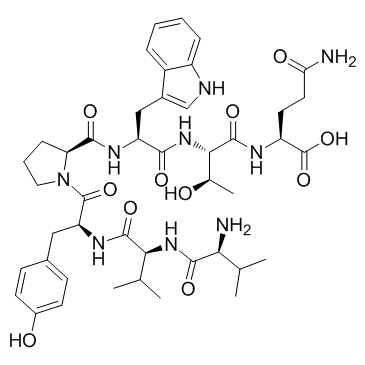
Valorphin es un fragmento endÓgeno de cadena β de hemoglobina (33-39) con actividad analgésica opioide, se une al receptor opioide mu de rata, con una IC50 de 14 nM; Valorphin también muestra actividad antitumoral.
Products are for research use only. Not for human use. We do not sell to patients.
Cas No.: 144313-54-2
Sample solution is provided at 25 µL, 10mM.
_1-3.$$$39978408@51.jpg');)
_1-9.$$$38538795@65.jpg');)
_1-9.$$$39112701@51.jpg');)
_1-7.$$$37316672@70.jpg');)
_366-372.$$$36198801@70.jpg');)
.$$$38565142@65.jpg');)
_1867-1883.$$$33248023@67.jpg');)
_eads6055.$$$39977546@45.jpg');)
_eadm9805.$$$40080571@45.jpg');)
_eadj3020.$$$39666821@45.jpg');)
_1-20.$$$39757301@28.jpg');)
_1-24.$$$38898113@28.jpg');)
_273-287.$$$36806353@46.jpg');)
_1-16.$$$37156877@44.jpg');)
_1-19.$$$37460805@44.jpg');)
_1291-1307.$$$34518654@46.jpg');)
Valorphin is an endogenous hemoglobin β-chain (33-39) fragment with opioid analgesic activity, binds to rat mu-opioid receptor, with an IC50 of 14 nM; Valorphin also shows anti-tumor activity.
Valorphin is a derivative of dihydrovaltrate with opioid analgesic activity, binds to rat mu-opioid receptor, with an IC50 of 14 nM. Valorphin has low affinity for δ-opioid receptor (IC50, 200 nM) and shows no affinity for κ receptor (IC50, >10 μM). Valorphin (>10 μM) decreases spontaneous firing rate of cerebellar rat Purkinje cells[1]. Valorphin (1 μM) treatment 48 h prior to 0.1 μM epirubicin, or 0.1 μM vincristine, or 0.05 μM vincristine, causes 100% tumor cell death[2].
Valorphin exhibits pronounced analgesic activity in mice, rats and rhesus monkeys via s.c, with ED50s of ≤5.2 mg/kg, but barely active after oral administration[1]. Valorphin (1 mg/kg) causes 42% of tumor growth inhibition in female BLRB mice bearing syngeneic mammary carcinoma cells[2].
[1]. Maurer R, et al. Valorphin: a novel chemical structure with opioid activity. Neuropeptides. 1985 Feb;5(4-6):387-90. [2]. Blishchenko EY, et al. Antitumor effect of valorphin in vitro and in vivo: combined action with cytostatic drugs. Cancer Biol Ther. 2005 Jan;4(1):118-24.
|
Cell experiment: |
In all series, the cells are incubated for 48 hours beginning with the hour 0. All substances are dissolved in FBS-supplied RPMI-1640 medium. Negative control cells are incubated in the absence of test substances. The reference samples are incubated with epirubicin or Valorphin in the concentrations equivalent to those applied in the experimental seria and for the corresponding time intervals. The effect is evaluated by staining with MTT dye[2]. |
|
Animal experiment: |
Mice[2]In the basic experiment, 49 mice are randomized in 4 groups: two groups (12 animals each) corresponding to the negative control, the reference group (13 animals) and the experimental group (12 animals). The control and the reference group are treated as in preliminary experiment, the experimental group are injected with the mixture of Valorphin (1 mg/kg) and epirubicin (25 mg/m2), dissolved in 0.9% NaCl solution in distilled water. Three injections (volume 0.2 mL) are made with 6-day intervals. Since no reliable difference in tumor size or lifespan of animals in the two negative control groups are observed, the data obtained in these groups are pooled. At day 20 after the first injection, the size of the tumors are determined. Tumor volumes are calculated, inhibition of tumor growth is determined. Percentages of survival are determined for 1-26 days of treatment. The observation is quitted after the total death of the animals in the negative control group[2]. |
|
References: [1]. Maurer R, et al. Valorphin: a novel chemical structure with opioid activity. Neuropeptides. 1985 Feb;5(4-6):387-90. |
|
| Cas No. | 144313-54-2 | SDF | |
| Canonical SMILES | Val-Val-Tyr-Pro-Trp-Thr-Gln | ||
| Formula | C44H61N9O11 | M.Wt | 892.01 |
| Solubility | 50 mg/mL in DMSO | Storage | Store at -20°C |
| General tips | Please select the appropriate solvent to prepare the stock solution according to the
solubility of the product in different solvents; once the solution is prepared, please store it in
separate packages to avoid product failure caused by repeated freezing and thawing.Storage method
and period of the stock solution: When stored at -80°C, please use it within 6 months; when stored
at -20°C, please use it within 1 month. To increase solubility, heat the tube to 37°C and then oscillate in an ultrasonic bath for some time. |
||
| Shipping Condition | Evaluation sample solution: shipped with blue ice. All other sizes available: with RT, or with Blue Ice upon request. | ||
| Prepare stock solution | |||

|
1 mg | 5 mg | 10 mg |
| 1 mM | 1.1211 mL | 5.6053 mL | 11.2106 mL |
| 5 mM | 224.2 μL | 1.1211 mL | 2.2421 mL |
| 10 mM | 112.1 μL | 560.5 μL | 1.1211 mL |
Step 1: Enter information below (Recommended: An additional animal making an allowance for loss during the experiment)
 g
μL
g
μL
Step 2: Enter the in vivo formulation (This is only the calculator, not formulation. Please contact us first if there is no in vivo formulation at the solubility Section.)
Calculation results:
Working concentration: mg/ml;
Method for preparing DMSO master liquid: mg drug pre-dissolved in μL DMSO ( Master liquid concentration mg/mL, Please contact us first if the concentration exceeds the DMSO solubility of the batch of drug. )
Method for preparing in vivo formulation: Take μL DMSO master liquid, next addμL PEG300, mix and clarify, next addμL Tween 80, mix and clarify, next add μL saline, mix and clarify.
Method for preparing in vivo formulation: Take μL DMSO master liquid, next add μL Corn oil, mix and clarify.
Note: 1. Please make sure the liquid is clear before adding the next solvent.
2. Be sure to add the solvent(s) in order. You must ensure that the solution obtained, in the previous addition, is a clear solution before proceeding to add the next solvent. Physical methods such as vortex, ultrasound or hot water bath can be used to aid dissolving.
3. All of the above co-solvents are available for purchase on the GlpBio website.
Quality Control & SDS
- View current batch:
- Purity: >98.00% Appearance: A solid
- COA (Certificate of Analysis)
- SDS (Safety Data Sheet)
- Datasheet
Average Rating: 5 (Based on Reviews and 35 reference(s) in Google Scholar.)