

ZK-261991 |
Catalog No.GC31816
 One-Click Copy Product Info
|

ZK-261991 es un inhibidor de la tirosina quinasa VEGFR activo por vÍa oral con una IC50 de 5 nM para VEGFR2.
Products are for research use only. Not for human use. We do not sell to patients.
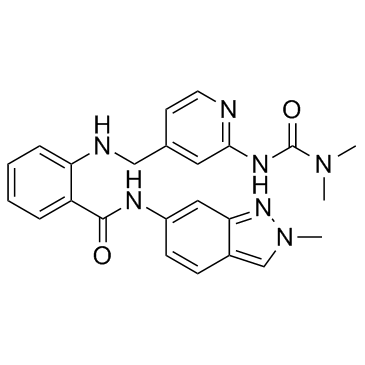
Cas No.: 886563-25-3
Sample solution is provided at 25 µL, 10mM.
_1-3.$$$39978408@51.jpg');)
_1-9.$$$38538795@65.jpg');)
_1-9.$$$39112701@51.jpg');)
_1-7.$$$37316672@70.jpg');)
_366-372.$$$36198801@70.jpg');)
.$$$38565142@65.jpg');)
_1867-1883.$$$33248023@67.jpg');)
_eads6055.$$$39977546@45.jpg');)
_eadm9805.$$$40080571@45.jpg');)
_eadj3020.$$$39666821@45.jpg');)
_1-20.$$$39757301@28.jpg');)
_1-24.$$$38898113@28.jpg');)
_273-287.$$$36806353@46.jpg');)
_1-16.$$$37156877@44.jpg');)
_1-19.$$$37460805@44.jpg');)
_1291-1307.$$$34518654@46.jpg');)
ZK-261991 is an orally active VEGFR tyrosine kinase inhibitor with an IC50 of 5 nM for VEGFR2.
ZK-261991 inhibits cellular receptor autophosphorylation in KDR-PAECs with an IC50 of 2 nM. ZK991 inhibits VEGFR-3 autophosphorylation concentration dependently with an IC50 of 20 nM[1].
ZK991 results in a significantly reduced recruitment of CD11b+ and LYVE-1+ cells into the murine cornea. ZK991 significantly improves the graft survival rate after corneal transplantation[1].
[1]. Deniz Hos, et al. Inflammatory Corneal (Lymph)angiogenesis Is Blocked by VEGFR-Tyrosine Kinase Inhibitor ZK 261991, Resulting in Improved Graft Survival after Corneal Transplantation. Investigative Ophthalmology & Visual Science May 2008, Vol.49, 1836-1842.
Cell experiment: | HLMVECs are cultured in EGM 2-MV medium. For the cytotoxicity assay, cells are seeded in 96-well plates in EGM 2-MV medium at a density of 5×10³ cells/well. Medium is changed every second day, and cells are cultured until reaching confluence. Then the medium is replaced with serum-free medium containing a tyrosine kinase inhibitor (PTK/ZK or ZK991; concentration 20 nM) and left overnight. Control cells receive the substance vehicle. The next day, cytotoxicity assay (WST-1 based) is performed according to the manufacturer's instructions. Colorimetric analysis is performed with an ELISA reader. Subsequent statistical analysis is performed, and graphs are drawn. The number of wells per group is as follows: PTK/ZK control group, n = 30; PTK/ZK 20 nM, n = 30; ZK991 control group, n = 30; ZK991 20 nM, n = 30. |
Animal experiment: | Before corneal neovascularization, each animal is deeply anesthetized. Three 11-0 nylon sutures are placed intrastromally with two stromal incursions extending over 120°C of corneal circumference each. The outer point of suture placement is chosen near the limbus, and the inner suture point is chosen near the corneal center equidistant from the limbus to obtain standardized angiogenic responses. Sutures are left in place for 14 days. The first treatment group receive the tyrosine kinase inhibitor PTK/ZK (75 mg/kg, orally, twice daily), the second treatment group receive the tyrosine kinase inhibitor ZK991 (50 mg/kg, orally, twice daily), and control mice receive equal amounts of the substance vehicle. After 2 weeks, mice are killed and corneas are prepared. The corneal neovascularization assay includes 22 mice in the control group, 11 mice in the PTK/ZK treatment group, and 11 mice in the ZK991 treatment group. |
References: [1]. Deniz Hos, et al. Inflammatory Corneal (Lymph)angiogenesis Is Blocked by VEGFR-Tyrosine Kinase Inhibitor ZK 261991, Resulting in Improved Graft Survival after Corneal Transplantation. Investigative Ophthalmology & Visual Science May 2008, Vol.49, 1836-1842. | |
| Cas No. | 886563-25-3 | SDF | |
| Canonical SMILES | O=C(NC1=CC2=NN(C)C=C2C=C1)C3=CC=CC=C3NCC4=CC(NC(N(C)C)=O)=NC=C4 | ||
| Formula | C24H25N7O2 | M.Wt | 443.5 |
| Solubility | Soluble in DMSO | Storage | Store at -20°C |
| General tips | Please select the appropriate solvent to prepare the stock solution according to the
solubility of the product in different solvents; once the solution is prepared, please store it in
separate packages to avoid product failure caused by repeated freezing and thawing.Storage method
and period of the stock solution: When stored at -80°C, please use it within 6 months; when stored
at -20°C, please use it within 1 month. To increase solubility, heat the tube to 37°C and then oscillate in an ultrasonic bath for some time. |
||
| Shipping Condition | Evaluation sample solution: shipped with blue ice. All other sizes available: with RT, or with Blue Ice upon request. | ||
| Prepare stock solution | |||

|
1 mg | 5 mg | 10 mg |
| 1 mM | 2.2548 mL | 11.274 mL | 22.5479 mL |
| 5 mM | 451 μL | 2.2548 mL | 4.5096 mL |
| 10 mM | 225.5 μL | 1.1274 mL | 2.2548 mL |
Step 1: Enter information below (Recommended: An additional animal making an allowance for loss during the experiment)
 g
μL
g
μL
Step 2: Enter the in vivo formulation (This is only the calculator, not formulation. Please contact us first if there is no in vivo formulation at the solubility Section.)
Calculation results:
Working concentration: mg/ml;
Method for preparing DMSO master liquid: mg drug pre-dissolved in μL DMSO ( Master liquid concentration mg/mL, Please contact us first if the concentration exceeds the DMSO solubility of the batch of drug. )
Method for preparing in vivo formulation: Take μL DMSO master liquid, next addμL PEG300, mix and clarify, next addμL Tween 80, mix and clarify, next add μL saline, mix and clarify.
Method for preparing in vivo formulation: Take μL DMSO master liquid, next add μL Corn oil, mix and clarify.
Note: 1. Please make sure the liquid is clear before adding the next solvent.
2. Be sure to add the solvent(s) in order. You must ensure that the solution obtained, in the previous addition, is a clear solution before proceeding to add the next solvent. Physical methods such as vortex, ultrasound or hot water bath can be used to aid dissolving.
3. All of the above co-solvents are available for purchase on the GlpBio website.
Quality Control & SDS
- View current batch:
- Purity: >98.00% Appearance: A solid
- COA (Certificate of Analysis)
- SDS (Safety Data Sheet)
- Datasheet
Average Rating: 5 (Based on Reviews and 10 reference(s) in Google Scholar.)