

Amikacin (Synonyms: Antibiotic BBK 8, BAY 416551, BBK 8, Lukadin, Potentox) |
رقم الكتالوجGC16285
 One-Click Copy Product Info
|

Amikacin (BAY 41-6551) ، وهو نظير شبه صناعي للكاناميسين ، نشط للغاية ضد معظم البكتيريا سالبة الجرام بما في ذلك السلالات المقاومة للجنتاميسين والتوبراميسين
Products are for research use only. Not for human use. We do not sell to patients.
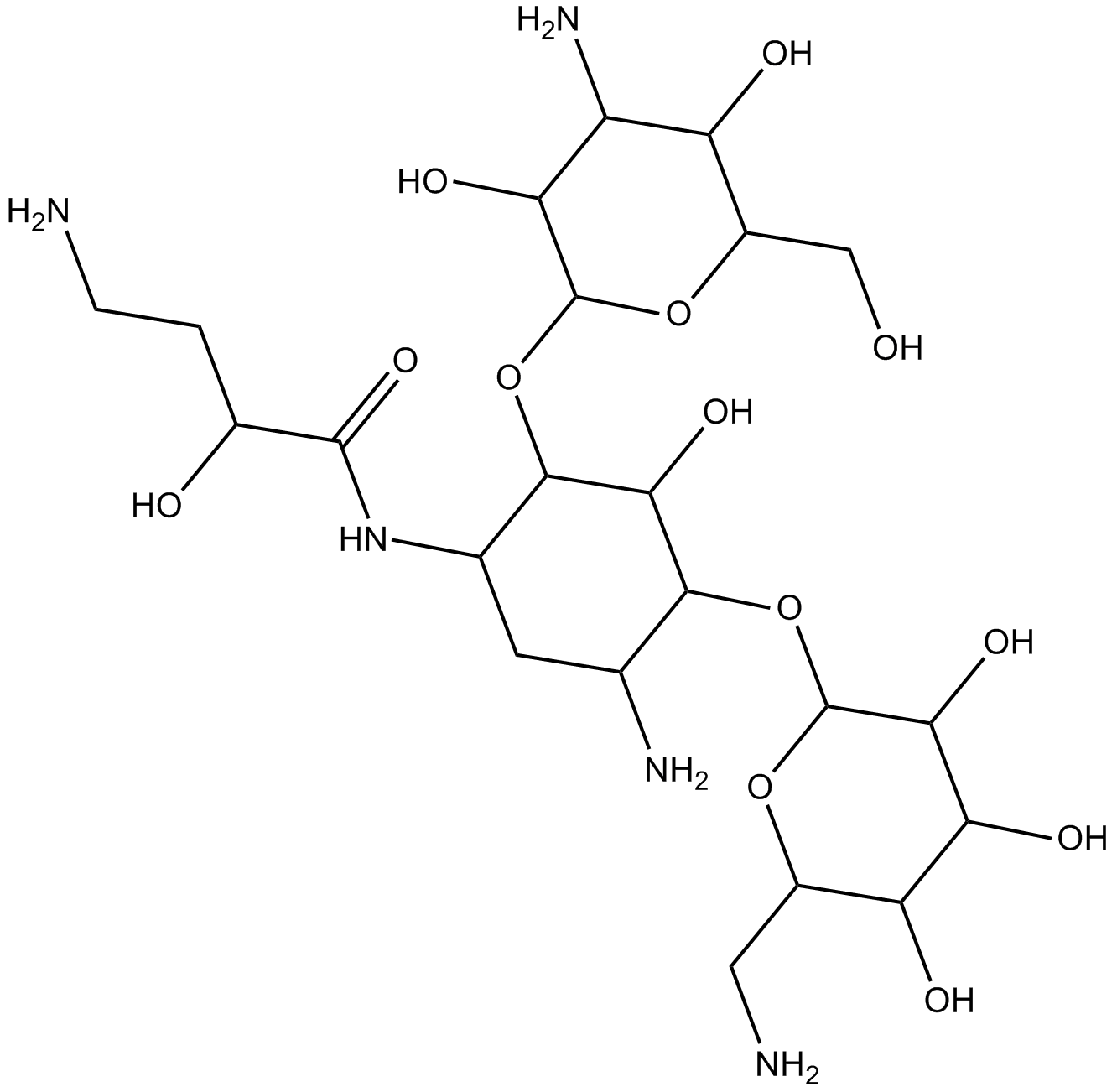
Cas No.: 37517-28-5
Sample solution is provided at 25 µL, 10mM.
Amikacin is an aminoglycoside antibiotic[1]. Amikacin is used to treat a variety of infections caused by Gram-negative bacteria[2]. Amikacin can enter bacterial cells and bind to their ribosomes. By interfering with bacterial protein synthesis, it prevents normal bacterial growth and reproduction, thereby exerting its antibacterial effects [3]. Amikacin is widely used in the treatment of complex urinary tract infections, respiratory infections, and sepsis[4].
In vitro, Amikacin (0.003 - 25mg/mL) treatment of equine joint cells (including chondrocytes, synovial cells, adipose-derived and bone marrow-derived mesenchymal stem cells) induces rapid cell death within 1 hour in a dose-dependent manner. Moreover, the cytotoxicity of Amikacin is not mitigated by the presence of synovial fluid[5]. Amikacin (32mg/L) alone or in combination with 2mg/L Colistin can effectively kill bacteria within biofilms of mature Pseudomonas aeruginosa (PAO1 and CRPAO1) treatment for 24 hours[6].
In vivo, Amikacin (15mg/kg) combined with Imipenem (40mg/kg) administered intraperitoneally every 8 hours is used to treat mice infected with drug-resistant Escherichia coli. The combination of Amikacin and Imipenem significantly reduces the bacterial count in the blood of mice[7]. Amikacin (7.5mg/kg; every 12 hours) combined with Meropenem (200mg/kg; every 8 hours) administered intraperitoneally to mice infected with carbapenem-resistant Enterobacteriaceae (CRE). Compared to Meropenem monotherapy, the combination therapy significantly reduces bacterial density in the thigh muscles of mice and increases survival rates[8].
References:
[1] Ramirez MS, Tolmasky ME. Amikacin: Uses, Resistance, and Prospects for Inhibition. Molecules. 2017 Dec 19;22(12):2267.
[2] Meyer RD. Amikacin. Ann Intern Med. 1981 Sep;95(3):328-32.
[3] Jenkins A, Thomson AH, Brown NM, et al. Amikacin use and therapeutic drug monitoring in adults: do dose regimens and drug exposures affect either outcome or adverse events? A systematic review. J Antimicrob Chemother. 2016 Oct;71(10):2754-9.
[4] Kato H, Hamada Y. Amikacin Therapy in Japanese Pediatric Patients: Narrative Review. Int J Environ Res Public Health. 2022 Feb 10;19(4):1972.
[5] Pezzanite L, Chow L, Soontararak S, et al. Amikacin induces rapid dose-dependent apoptotic cell death in equine chondrocytes and synovial cells in vitro. Equine Vet J. 2020 Sep;52(5):715-724.
[6] Wang Y, Li C, Wang J, et al. The Efficacy of Colistin Combined with Amikacin or Levofloxacin against Pseudomonas aeruginosa Biofilm Infection. Microbiol Spectr. 2022 Oct 26;10(5):e0146822.
[7] Farhan SM, El-Baky RMA, Abdalla S, et al. In Vitro and In Vivo Effect of Amikacin and Imipenem Combinations against Multidrug-Resistant E. coli. Trop Med Infect Dis. 2022 Oct 2;7(10):281.
[8] Hagihara M, Kato H, Yamashita R, et al. In vivo study assessed meropenem and amikacin combination therapy against carbapenem-resistant and carbapenemase-producing Enterobacteriaceae strains. J Infect Chemother. 2020 Jan;26(1):1-7.
| Cell experiment [1]: | |
Cell lines | Equine chondrocytes, synovial cells, bone marrow-derived mesenchymal stem cells (BMD-MSC), and adipose-derived mesenchymal stem cells (AD-MSC). |
Preparation Method | Cells were harvested from three donor horses and plated in triplicate wells for 48 hours prior to the addition of Amikacin(0.003 to 25mg/mL). Cells were maintained in complete DMEM media. |
Reaction Conditions | 0.003 to 25mg/mL; 12h |
Applications | Amikacin induced rapid, dose-dependent cytotoxic effects on all cell types, primarily through apoptosis. Amikacin exposure decreased cellular metabolism and mitochondrial mass, and suppressed cell proliferation. |
| Animal experiment [2]: | |
Animal models | Neutropenic ICR Swiss mice |
Preparation Method | Mice were intramuscularly inoculated with 10⁸cfu/mL of carbapenem-resistant Enterobacteriaceae (CRE) strains, followed by subcutaneous administration of Meropenem (200mg/kg every 8 hours) and Amikacin (7.5mg/kg every 12 hours) either alone or in combination. |
Dosage form | 7.5mg/kg; s.c. |
Applications | The combination therapy of Meropenem and Amikacin significantly reduced bacterial density in the thigh muscles and increased survival rates compared to Meropenem monotherapy. |
References: | |
| Cas No. | 37517-28-5 | SDF | |
| المرادفات | Antibiotic BBK 8, BAY 416551, BBK 8, Lukadin, Potentox | ||
| Chemical Name | (2S)-4-amino-N-[(1R,2S,3S,4R,5S)-5-amino-2-[(2S,3R,4S,5S,6R)-4-amino-3,5-dihydroxy-6-(hydroxymethyl)oxan-2-yl]oxy-4-[(2R,3R,4S,5S,6R)-6-(aminomethyl)-3,4,5-trihydroxyoxan-2-yl]oxy-3-hydroxycyclohexyl]-2-hydroxybutanamide | ||
| Canonical SMILES | C1C(C(C(C(C1NC(=O)C(CCN)O)OC2C(C(C(C(O2)CO)O)N)O)O)OC3C(C(C(C(O3)CN)O)O)O)N | ||
| Formula | C22H43N5O13 | M.Wt | 585.6 |
| الذوبان | 100 mg/mL in Water (Need ultrasonic); DMSO : Insoluble | Storage | Store at -20°C |
| General tips | Please select the appropriate solvent to prepare the stock solution according to the
solubility of the product in different solvents; once the solution is prepared, please store it in
separate packages to avoid product failure caused by repeated freezing and thawing.Storage method
and period of the stock solution: When stored at -80°C, please use it within 6 months; when stored
at -20°C, please use it within 1 month. To increase solubility, heat the tube to 37°C and then oscillate in an ultrasonic bath for some time. |
||
| Shipping Condition | Evaluation sample solution: shipped with blue ice. All other sizes available: with RT, or with Blue Ice upon request. | ||
| Prepare stock solution | |||

|
1 mg | 5 mg | 10 mg |
| 1 mM | 1.7077 mL | 8.5383 mL | 17.0765 mL |
| 5 mM | 341.5 μL | 1.7077 mL | 3.4153 mL |
| 10 mM | 170.8 μL | 853.8 μL | 1.7077 mL |
Step 1: Enter information below (Recommended: An additional animal making an allowance for loss during the experiment)
 g
μL
g
μL
Step 2: Enter the in vivo formulation (This is only the calculator, not formulation. Please contact us first if there is no in vivo formulation at the solubility Section.)
Calculation results:
Working concentration: mg/ml;
Method for preparing DMSO master liquid: mg drug pre-dissolved in μL DMSO ( Master liquid concentration mg/mL, Please contact us first if the concentration exceeds the DMSO solubility of the batch of drug. )
Method for preparing in vivo formulation: Take μL DMSO master liquid, next addμL PEG300, mix and clarify, next addμL Tween 80, mix and clarify, next add μL saline, mix and clarify.
Method for preparing in vivo formulation: Take μL DMSO master liquid, next add μL Corn oil, mix and clarify.
Note: 1. Please make sure the liquid is clear before adding the next solvent.
2. Be sure to add the solvent(s) in order. You must ensure that the solution obtained, in the previous addition, is a clear solution before proceeding to add the next solvent. Physical methods such as vortex, ultrasound or hot water bath can be used to aid dissolving.
3. All of the above co-solvents are available for purchase on the GlpBio website.
Quality Control & SDS
- View current batch:
- Purity: >98.00% Appearance: A solid
- COA (Certificate of Analysis)
- SDS (Safety Data Sheet)
- Datasheet
Average Rating: 5 (Based on Reviews and 34 reference(s) in Google Scholar.)