

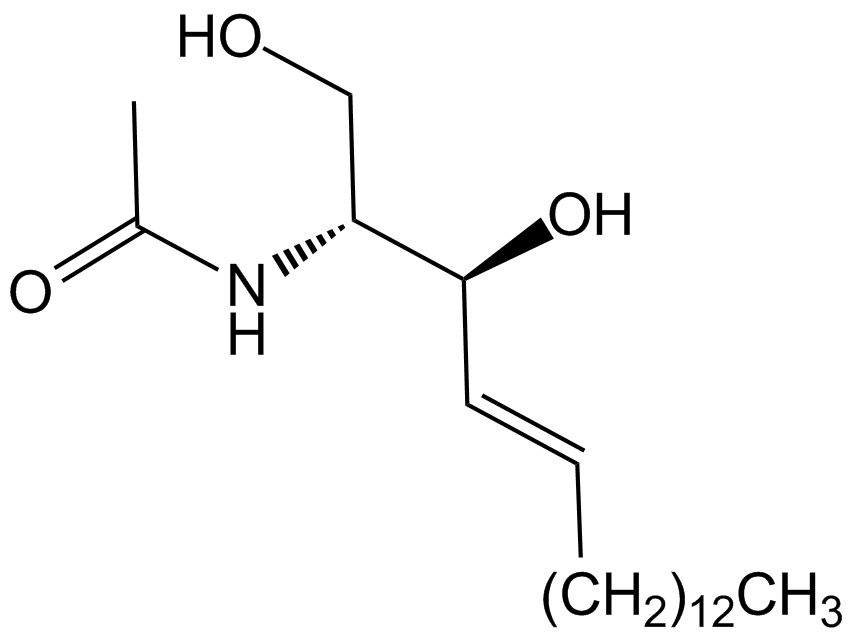
C2 Ceramide (Synonyms: C2 Ceramide (d18:1/2:0), C2 Ceramide ,Ceramide (d18:1/2:0), Cer(18:1/2:0),N-acetoyl-D-erythro-sphingosine) |
رقم الكتالوجGC17011
 One-Click Copy Product Info
|

C2 Ceramide is a short-chain cell-permeable ceramide analogue that inhibits the protein Bcl2 phosphorylation with an IC50 value of 14μmol/L.
Products are for research use only. Not for human use. We do not sell to patients.
Cas No.: 3102-57-6
Sample solution is provided at 25 µL, 10mM.
_1-3.$$$39978408@51.jpg');)
_1-9.$$$38538795@65.jpg');)
_1-9.$$$39112701@51.jpg');)
_1-7.$$$37316672@70.jpg');)
_366-372.$$$36198801@70.jpg');)
.$$$38565142@65.jpg');)
_1867-1883.$$$33248023@67.jpg');)
_eads6055.$$$39977546@45.jpg');)
_eadm9805.$$$40080571@45.jpg');)
_eadj3020.$$$39666821@45.jpg');)
_1-20.$$$39757301@28.jpg');)
_1-24.$$$38898113@28.jpg');)
_273-287.$$$36806353@46.jpg');)
_1-16.$$$37156877@44.jpg');)
_1-19.$$$37460805@44.jpg');)
_1291-1307.$$$34518654@46.jpg');)
C2 Ceramide is a short-chain cell-permeable ceramide analogue that inhibits the protein Bcl2 phosphorylation with an IC50 value of 14μmol/L [1]. C2 Ceramide serves as an effective research tool for tumor cell apoptosis studies because C2 Ceramide can activate apoptosis in nearly all cell types[2].
In vitro, C2 Ceramide exhibited the IC50 value of 39µmol/L toward HEp-2 cells for 24h[3]. C2 Ceramide caused the inhibition of HERG potassium channel current in HEK293 cells with an IC50 value of 19.5μmol/L after 10h treatment[4]. C2 Ceramide (25μmol/L, 1h) inhibited the mRNA levels and promoter activities of MMP-1, MMP-3 and MMP-9 in U87MG glioma cells, and suppressed cell migration[5]. The application of C2 Ceramide at a concentration of 50μmol/L for 60 minutes blocked the production of reactive oxygen species triggered by hydrogen peroxide and prevented the resulting cell death in rat primary astrocytes[6].
In vivo, C2 Ceramide treatment at 2.0mg/kg by intraperitoneal injection with Long Evans rat pups for 25 days alleviated the symptoms of hyperglycemia, hyperlipidemia and mild steatohepatitis, reduced the lipid content in the brain, and increased the ceramide levels in the liver, brain and serum[7]. The administration of 120μmol/L C2 Ceramide by gavage for 12 hours resulted in a significant reduction of mRNA and protein expression levels of HNF-1 and GSTA1 in the liver of adult male Kunming mice with acetaminophen-induced acute liver injury[8].
References:
[1] Ruvolo P P, Deng X, Ito T, et al. Ceramide induces Bcl2 dephosphorylation via a mechanism involving mitochondrial PP2A[J]. Journal of Biological Chemistry, 1999, 274(29): 20296-20300.
[2] Wagenknecht B, Roth W, Gulbins E, et al. C2-ceramide signaling in glioma cells: synergistic enhancement of CD95-mediated, caspase-dependent apoptosis[J]. Cell Death & Differentiation, 2001, 8(6): 595-602.
[3] Oğuz O, Manole F, Bayar Muluk N, et al. Effects of ceramide C2 application on human laryngeal carcinoma cells: a cell culture study[J]. Eur Rev Med Pharmacol Sci, 2023, 27(5 Suppl): 109-120.
[4] Bai Y, Wang J, Shan H, et al. Sphingolipid metabolite ceramide causes metabolic perturbation contributing to HERG K+ channel dysfunction[J]. Cellular Physiology and Biochemistry, 2007, 20(5): 429-440.
[5] Jung J S, Ahn Y H, Moon B I, et al. Exogenous C2 ceramide suppresses matrix metalloproteinase gene expression by inhibiting ROS production and MAPK signaling pathways in PMA-stimulated human astroglioma cells[J]. International Journal of Molecular Sciences, 2016, 17(4): 477.
[6] Jung J S, Choi M J, Ko H M, et al. Short-chain C2 ceramide induces heme oxygenase-1 expression by upregulating AMPK and MAPK signaling pathways in rat primary astrocytes[J]. Neurochemistry international, 2016, 94: 39-47.
[7] de la Monte S M, Tong M, Nguyen V A, et al. Ceramide-mediated insulin resistance and impairment of cognitive-motor functions[J]. Journal of Alzheimer’s Disease, 2010, 21(3): 967-984.
[8] Ma X, Chang Y, Zhang Y, et al. Effects of C2-ceramide and oltipraz on hepatocyte nuclear factor-1 and glutathione S-transferase A1 in acetaminophen-mediated acute mice liver injury[J]. Frontiers in Pharmacology, 2018, 9: 1009.
| Cell experiment [1]: | |
|
Cell lines |
HN4 and HN30 cell lines |
|
Preparation Method |
The HN4 and HN30 cell lines were seeded at a density of 1×10⁴ cells per well into 96-well plates with each well containing 100μL of medium. Cells received treatment with C2 Ceramide at concentrations of 0, 20, 40, and 60μmol/L and combinations of C2 Ceramide with autophagy inhibitor CQ at 5μmol/L, necroptosis inhibitor Nec-1 at 5μmol/L, or MEK inhibitor PD98059 at 10μmol/L for 24 hours starting from 24 hours after cell seeding. A minimum of five wells served as replicates for each experimental group. Following the incubation period, 10μL of CCK-8 reagent from a Cell Counting Kit-8 was added to each well, and cells continued to grow in culture. The microplate reader recorded absorbance at 450nm after adding the CCK-8 reagent for 3 hours. All cells were divided into two groups: a DMSO-treated group and a C2 Ceramide-treated group. The cells underwent treatment for 24 hours before collection. Extract fragmented DNA using DNAiso Reagent following the manufacturer's instructions before performing electrophoresis on 2g/L agarose gels containing 0.5g/L ethidium bromide and visualizing the results with UV transillumination. All experiments were repeated three times. |
|
Reaction Conditions |
0, 20, 40, and 60μmol/L; 24h |
|
Applications |
C2 Ceramide exhibited concentration-dependent cytotoxicity in HN4 and HN30 cell lines. C2 Ceramide induced both caspase-3-independent apoptosis and necroptosis. |
| Animal experiment [2]: | |
|
Animal models |
C57BL/6 mice |
|
Preparation Method |
The 25 C57BL/6 mice were assigned randomly to five groups which included a control group, a model group, and C2 Ceramide low-, medium-, and high-dose groups each containing five mice. The control group remained untreated, and the mouse model of Parkinson’s disease was generated through the injection of mutant A53T α-Syn oligomers into the left striatum of all other groups. The three C2 Ceramide groups received a single intragastric dose of C2 Ceramide at concentrations of 1, 5, and 10μg/g dissolved in saline on the 30th day after injection into the striatum while control and model groups received the same saline volume between days 30 to 90 for 60 days total. Monitor behavioral changes in the mice across all groups. The mouse brain tissue samples were collected by perfusion while the mice remained under anesthesia on the 90th day post striatal injection before examining dopaminergic neuron changes in the midbrain substantia nigra through immunohistochemical staining. ELISA tests showed α-Syn oligomerization and phosphorylation levels in the mouse midbrain while enzyme activities linked to α-Syn phosphorylation underwent analysis. |
|
Dosage form |
1, 5, and 10μg/g for 60 days; i.g. |
|
Applications |
C2 Ceramide (10μg/g) treatment significantly reduced the content of α-Syn oligomers and phosphorylated α-Syn, increased the content of ceramide, and up-regulated the activity of protein phosphatase 2A in the brain tissue of mice. |
|
References: |
|
| Cas No. | 3102-57-6 | SDF | |
| المرادفات | C2 Ceramide (d18:1/2:0), C2 Ceramide ,Ceramide (d18:1/2:0), Cer(18:1/2:0),N-acetoyl-D-erythro-sphingosine | ||
| Chemical Name | N-[(E,2S,3R)-1,3-dihydroxyoctadec-4-en-2-yl]acetamide | ||
| Canonical SMILES | CCCCCCCCCCCCCC=CC(C(CO)NC(=O)C)O | ||
| Formula | C20H39NO3 | M.Wt | 341.53 |
| الذوبان | DMF: >22 mg/ml (from C-8 Ceramide),DMSO: >20 mg/ml (from C-8 Ceramide),Ethanol: >33 mg/ml (from C-8 Ceramide),PBS pH 7.2: <50 µ g/ml (from C-8 Ceramide) | Storage | Desiccate at -20°C |
| General tips | Please select the appropriate solvent to prepare the stock solution according to the
solubility of the product in different solvents; once the solution is prepared, please store it in
separate packages to avoid product failure caused by repeated freezing and thawing.Storage method
and period of the stock solution: When stored at -80°C, please use it within 6 months; when stored
at -20°C, please use it within 1 month. To increase solubility, heat the tube to 37°C and then oscillate in an ultrasonic bath for some time. |
||
| Shipping Condition | Evaluation sample solution: shipped with blue ice. All other sizes available: with RT, or with Blue Ice upon request. | ||
| Prepare stock solution | |||

|
1 mg | 5 mg | 10 mg |
| 1 mM | 2.928 mL | 14.64 mL | 29.28 mL |
| 5 mM | 585.6 μL | 2.928 mL | 5.856 mL |
| 10 mM | 292.8 μL | 1.464 mL | 2.928 mL |
Step 1: Enter information below (Recommended: An additional animal making an allowance for loss during the experiment)
 g
μL
g
μL
Step 2: Enter the in vivo formulation (This is only the calculator, not formulation. Please contact us first if there is no in vivo formulation at the solubility Section.)
Calculation results:
Working concentration: mg/ml;
Method for preparing DMSO master liquid: mg drug pre-dissolved in μL DMSO ( Master liquid concentration mg/mL, Please contact us first if the concentration exceeds the DMSO solubility of the batch of drug. )
Method for preparing in vivo formulation: Take μL DMSO master liquid, next addμL PEG300, mix and clarify, next addμL Tween 80, mix and clarify, next add μL saline, mix and clarify.
Method for preparing in vivo formulation: Take μL DMSO master liquid, next add μL Corn oil, mix and clarify.
Note: 1. Please make sure the liquid is clear before adding the next solvent.
2. Be sure to add the solvent(s) in order. You must ensure that the solution obtained, in the previous addition, is a clear solution before proceeding to add the next solvent. Physical methods such as vortex, ultrasound or hot water bath can be used to aid dissolving.
3. All of the above co-solvents are available for purchase on the GlpBio website.
Quality Control & SDS
- View current batch:
- Purity: >98.00% Appearance: A solid
- COA (Certificate of Analysis)
- SDS (Safety Data Sheet)
- Datasheet
Average Rating: 5 (Based on Reviews and 30 reference(s) in Google Scholar.)