

Clarithromycin (Synonyms: A-56268, Antibiotic A 56268, TE 031) |
رقم الكتالوجGC16754
 One-Click Copy Product Info
|

Clarithromycin is a macrolide antibiotic that functions by inhibiting bacterial protein synthesis. Clarithromycin binds to the 50S subunit of the bacterial ribosome, preventing peptide chain elongation and thereby suppressing bacterial growth.
Products are for research use only. Not for human use. We do not sell to patients.
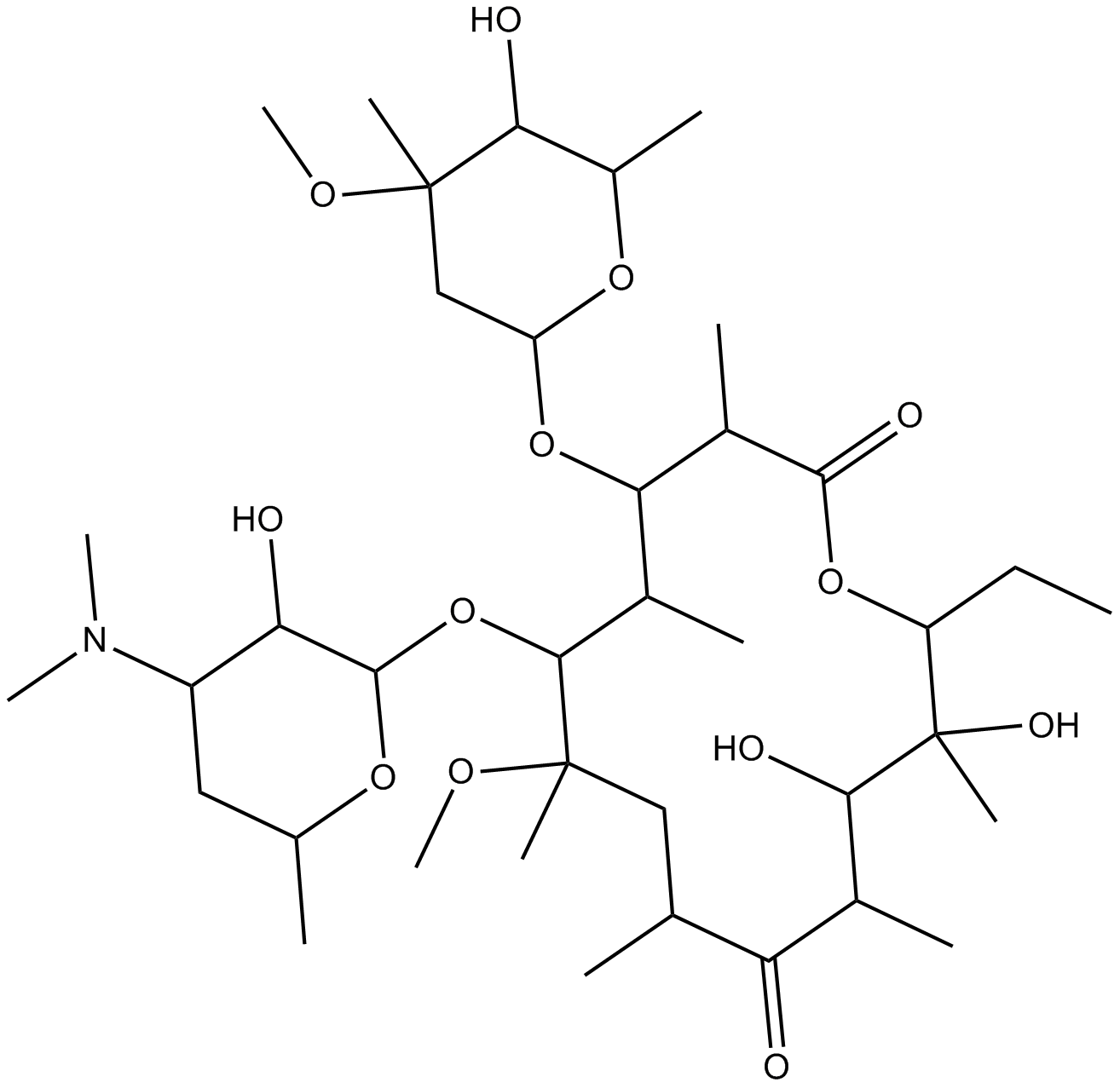
Cas No.: 81103-11-9
Sample solution is provided at 25 µL, 10mM.
_1-3.$$$39978408@51.jpg');)
_1-9.$$$38538795@65.jpg');)
_1-9.$$$39112701@51.jpg');)
_1-7.$$$37316672@70.jpg');)
_366-372.$$$36198801@70.jpg');)
.$$$38565142@65.jpg');)
_1867-1883.$$$33248023@67.jpg');)
_eads6055.$$$39977546@45.jpg');)
_eadm9805.$$$40080571@45.jpg');)
_eadj3020.$$$39666821@45.jpg');)
_1-20.$$$39757301@28.jpg');)
_1-24.$$$38898113@28.jpg');)
_273-287.$$$36806353@46.jpg');)
_1-16.$$$37156877@44.jpg');)
_1-19.$$$37460805@44.jpg');)
_1291-1307.$$$34518654@46.jpg');)
Clarithromycin is a macrolide antibiotic that functions by inhibiting bacterial protein synthesis. Clarithromycin binds to the 50S subunit of the bacterial ribosome, preventing peptide chain elongation and thereby suppressing bacterial growth[1]. Clarithromycin is used to treat upper respiratory tract infections, such as community-acquired pneumonia, acute exacerbation of chronic bronchitis, and sinusitis[2]. Clarithromycin also has anti-inflammatory and immunomodulatory properties, making it a potential treatment for certain non-infectious diseases like diffuse panbronchiolitis[3]. Clarithromycin shows promise in combating cancer development and resistance[4]
In vitro, treatment of rat hippocampal CA3 pyramidal neurons with Clarithromycin (3–300μM) significantly increases neuronal excitability in a dose-dependent manner. Clarithromycin can inhibit the amplitude and frequency of GABA-mPSCs[5]. When combined with Ceftazidime (0.5MIC), Clarithromycin (0.5–2MIC) significantly enhances the bactericidal effect of Ceftazidime against Pseudomonas aeruginosa[6].
In vivo, daily intraperitoneal injections of Clarithromycin (100mg/kg) in combination with Cisplatin (5mg/kg) are administered to BALB/c nude mice with ovarian tumor xenografts. Clarithromycin significantly reduces tumor volume and weight and enhances the antitumor effect of Cisplatin[7]. Daily intraperitoneal injections of Clarithromycin (20mg/kg) are given to 5- to 6-week-old Cricetidae. Clarithromycin significantly reduces arthritis onset and shortens recovery time induced by Borrelia burgdorferi[8].
References:
[1] Schlossberg D. Azithromycin and clarithromycin. Med Clin North Am. 1995 Jul;79(4):803-15.
[2] Williams KN, Bishai WR. Clarithromycin extended-release in community-acquired respiratory tract infections. Expert Opin Pharmacother. 2005 Dec;6(16):2867-76.
[3] Ando M, Ono T, Usagawa Y, et al. The development of diffuse panbronchiolitis during the treatment with long-term, low-dose clarithromycin for chronic sinusitis. J Infect Chemother. 2019 Feb;25(2):147-150.
[4] Petroni G, Bagni G, Iorio J, et al. Clarithromycin inhibits autophagy in colorectal cancer by regulating the hERG1 potassium channel interaction with PI3K. Cell Death Dis. 2020 Mar 2;11(3):161.
[5] Bichler EK, Elder CC, García PS. Clarithromycin increases neuronal excitability in CA3 pyramidal neurons through a reduction in GABAergic signaling. J Neurophysiol. 2017 Jan 1;117(1):93-103.
[6] Bui KQ, Banevicius MA, Nightingale CH, et al. In vitro and in vivo influence of adjunct clarithromycin on the treatment of mucoid Pseudomonas aeruginosa. J Antimicrob Chemother. 2000 Jan;45(1):57-62.
[7] Zhou B, Xia M, Wang B, et al. Clarithromycin synergizes with cisplatin to inhibit ovarian cancer growth in vitro and in vivo. J Ovarian Res. 2019 Nov 8;12(1):107.
[8] Alder J, Mitten M, Jarvis K, et al. Efficacy of clarithromycin for treatment of experimental Lyme disease in vivo. Antimicrob Agents Chemother. 1993 Jun;37(6):1329-33.
| Cell experiment [1]: | |
Cell lines | HCT116 cells (human colorectal cancer cell line) |
Preparation Method | HCT116 cells were cultured in RPMI medium supplemented with 2% L-Glut and 10% fetal bovine serum (FBS) at 37°C, 5% CO₂. HCT116 cells were treated with Clarithromycin at the IC50 value (80μM) for 24 hours. |
Reaction Conditions | 80μM; 24h |
Applications | Clarithromycin induced the formation of numerous intracytoplasmic vacuoles, increased the LC3-II/LC3-I ratio, and decreased p62/SQSTM1 levels in HCT116 cells. It also increased the accumulation of acidic vesicular organelles (AVOs) and reduced Akt phosphorylation. |
| Animal experiment [2]: | |
Animal models | BALB/c-nude mice |
Preparation Method | Mice were subcutaneously injected with 5×10⁶ C13 ovarian cancer cells in the right flank. After tumors reached a mean size of 50 mm3, mice were treated with 100mg/kg Clarithromycin intraperitoneally once a day for four consecutive weeks and 5mg/kg Cisplatin (DDP) intraperitoneally once a week for four weeks, either alone or in combination. |
Dosage form | 100mg/kg; i.p. |
Applications | Combined treatment with Clarithromycin and DDP significantly reduced tumor volume and weight compared to DDP alone. The combination also led to decreased expression of the antioxidant enzyme SOD2 and increased expression of DNA damage markers and the apoptotic protein activated caspase-3. |
References: | |
| Cas No. | 81103-11-9 | SDF | |
| المرادفات | A-56268, Antibiotic A 56268, TE 031 | ||
| Chemical Name | 6-((4-(dimethylamino)-3-hydroxy-6-methyltetrahydro-2H-pyran-2-yl)oxy)-14-ethyl-12,13-dihydroxy-4-((5-hydroxy-4-methoxy-4,6-dimethyltetrahydro-2H-pyran-2-yl)oxy)-7-methoxy-3,5,7,9,11,13-hexamethyloxacyclotetradecane-2,10-dione | ||
| Canonical SMILES | CCC1C(C(C(C(=O)C(CC(C(C(C(C(C(=O)O1)C)OC2CC(C(C(O2)C)O)(C)OC)C)OC3C(C(CC(O3)C)N(C)C)O)(C)OC)C)C)O)(C)O | ||
| Formula | C38H69NO13 | M.Wt | 747.95 |
| الذوبان | ≥ 31.2 mg/mL in DMSO, ≥ 3.24 mg/mL in EtOH with ultrasonic and warming | Storage | Store at -20°C |
| General tips | Please select the appropriate solvent to prepare the stock solution according to the
solubility of the product in different solvents; once the solution is prepared, please store it in
separate packages to avoid product failure caused by repeated freezing and thawing.Storage method
and period of the stock solution: When stored at -80°C, please use it within 6 months; when stored
at -20°C, please use it within 1 month. To increase solubility, heat the tube to 37°C and then oscillate in an ultrasonic bath for some time. |
||
| Shipping Condition | Evaluation sample solution: shipped with blue ice. All other sizes available: with RT, or with Blue Ice upon request. | ||
| Prepare stock solution | |||

|
1 mg | 5 mg | 10 mg |
| 1 mM | 1.337 mL | 6.6849 mL | 13.3699 mL |
| 5 mM | 267.4 μL | 1.337 mL | 2.674 mL |
| 10 mM | 133.7 μL | 668.5 μL | 1.337 mL |
Step 1: Enter information below (Recommended: An additional animal making an allowance for loss during the experiment)
 g
μL
g
μL
Step 2: Enter the in vivo formulation (This is only the calculator, not formulation. Please contact us first if there is no in vivo formulation at the solubility Section.)
Calculation results:
Working concentration: mg/ml;
Method for preparing DMSO master liquid: mg drug pre-dissolved in μL DMSO ( Master liquid concentration mg/mL, Please contact us first if the concentration exceeds the DMSO solubility of the batch of drug. )
Method for preparing in vivo formulation: Take μL DMSO master liquid, next addμL PEG300, mix and clarify, next addμL Tween 80, mix and clarify, next add μL saline, mix and clarify.
Method for preparing in vivo formulation: Take μL DMSO master liquid, next add μL Corn oil, mix and clarify.
Note: 1. Please make sure the liquid is clear before adding the next solvent.
2. Be sure to add the solvent(s) in order. You must ensure that the solution obtained, in the previous addition, is a clear solution before proceeding to add the next solvent. Physical methods such as vortex, ultrasound or hot water bath can be used to aid dissolving.
3. All of the above co-solvents are available for purchase on the GlpBio website.
Quality Control & SDS
- View current batch:
- Purity: >98.00% Appearance: A solid
- COA (Certificate of Analysis)
- SDS (Safety Data Sheet)
- Datasheet
Average Rating: 5 (Based on Reviews and 30 reference(s) in Google Scholar.)