

Clarithromycin (Synonyms: A-56268, Antibiotic A 56268, TE 031) |
Catalog No.GC16754
 One-Click Copy Product Info
|

ClarithromycinClarithromycin est un antibiotique macrolide qui agit en inhibant la synthèse protéique bactérienne. Clarithromycin se lie à la sous-unité 50S du ribosome bactérien, empêchant ainis l'élongation de la chaîne peptidique et supprimant par conséquant la croissance bactérienne.
Products are for research use only. Not for human use. We do not sell to patients.
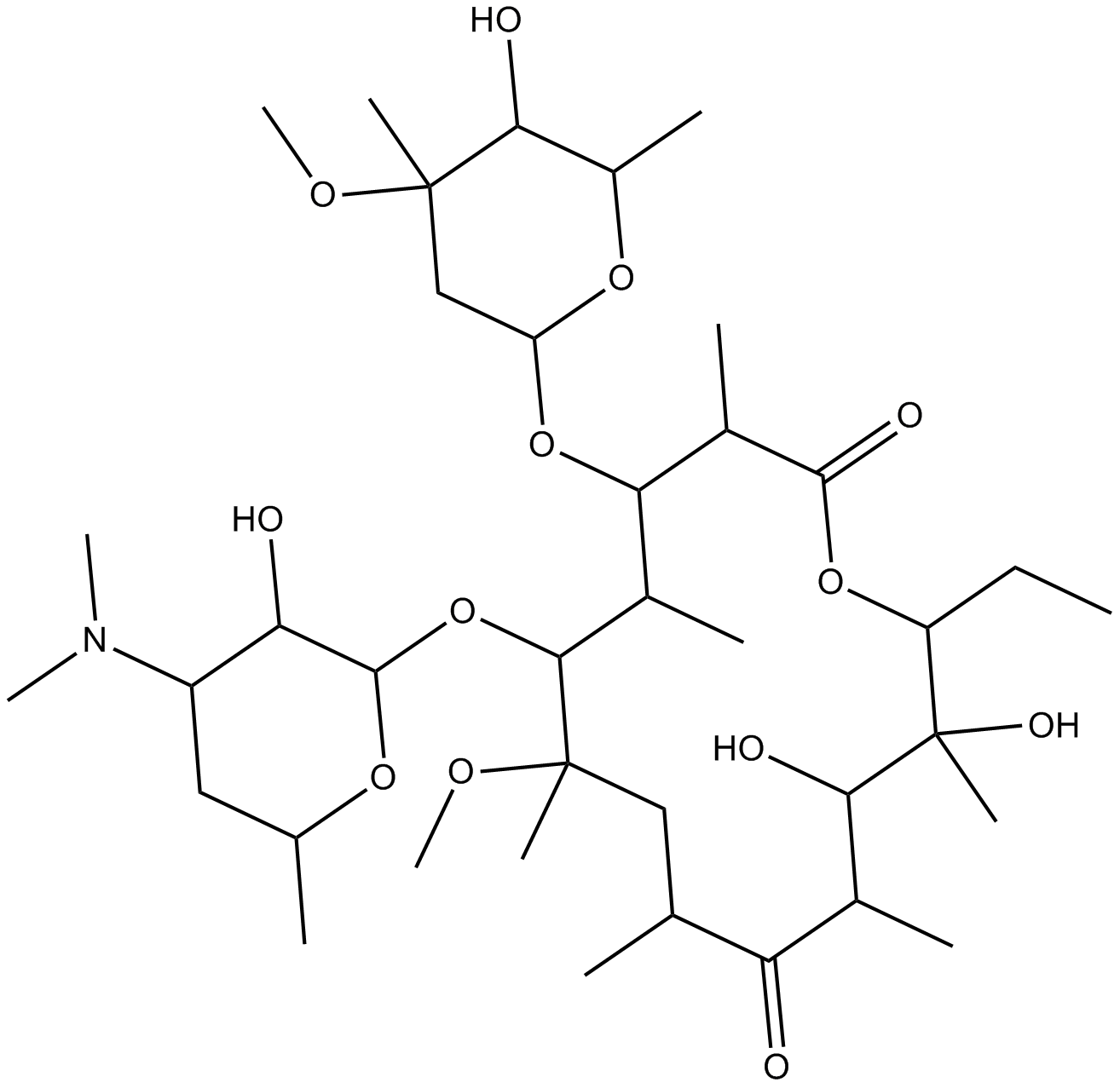
Cas No.: 81103-11-9
Sample solution is provided at 25 µL, 10mM.
_1-3.$$$39978408@51.jpg');)
_1-9.$$$38538795@65.jpg');)
_1-9.$$$39112701@51.jpg');)
_1-7.$$$37316672@70.jpg');)
_366-372.$$$36198801@70.jpg');)
.$$$38565142@65.jpg');)
_1867-1883.$$$33248023@67.jpg');)
_eads6055.$$$39977546@45.jpg');)
_eadm9805.$$$40080571@45.jpg');)
_eadj3020.$$$39666821@45.jpg');)
_1-20.$$$39757301@28.jpg');)
_1-24.$$$38898113@28.jpg');)
_273-287.$$$36806353@46.jpg');)
_1-16.$$$37156877@44.jpg');)
_1-19.$$$37460805@44.jpg');)
_1291-1307.$$$34518654@46.jpg');)
ClarithromycinClarithromycin est un antibiotique macrolide qui agit en inhibant la synthèse protéique bactérienne. Clarithromycin se lie à la sous-unité 50S du ribosome bactérien, empêchant ainis l'élongation de la chaîne peptidique et supprimant par conséquant la croissance bactérienne[1]. Clarithromycin est utilisée dans le traitement des infections des voies respiratoires supérieures, telles que la pneumonie acquise en communauté, l'exacerbation aiguë de la bronchite chronique et la sinusite[2]. Clarithromycin possède également des propriétés anti-inflammatoires et immunomodulatrice, ce qui en fait un traitement potentiel pour certaines maladies non infectieuses comme la panbronchiolite diffuse[3]. Clarithromycin montre des potentialités dans la lutte contre le développement du cancer et la résistance aux traitements[4]
In vitro, le traitement des neurones pyramidaux de la zone CA3 de l'hippocampe de rat avec Clarithromycin (3–300μM) augmente significativement l'excitabilité neuronale de manière dose-dépendante. Clarithromycin inhibe l'amplitude et la fréquence des courants postsynatiques miniatures médiés par les récepteurs GABA (GABA-mPSCs)[5]. En association avec Ceftazidime (0.5 CMI), Clarithromycin (0.5–2CMI) potentialise significativement l'effet bactéricide de Ceftazidime contre Pseudomonas aeruginosa [6].
In vivo, des injections intrapéritonéales quotidiennes de Clarithromycin (100mg/kg) associée à Cisplatin (5mg/kg) ont été administrées à des souris nude BALB/c porteuses de xénogreffes de tumeur ovarienne. Clarithromycin réduit significativement le volume et le poids tumoral et potentialise l'effet antitumoral de Cisplatin[7]. Des injections intrapéritonéales quotidiennes de Clarithromycin (20mg/kg) administrées à des Cricétidés âgés de 5 à 6 semaines réduisent significativement l'apparition de l'arthrite et raccourcissent le temps de récupération induit par Borrelia burgdorferi[8].
References:
[1] Schlossberg D. Azithromycin and clarithromycin. Med Clin North Am. 1995 Jul;79(4):803-15.
[2] Williams KN, Bishai WR. Clarithromycin extended-release in community-acquired respiratory tract infections. Expert Opin Pharmacother. 2005 Dec;6(16):2867-76.
[3] Ando M, Ono T, Usagawa Y, et al. The development of diffuse panbronchiolitis during the treatment with long-term, low-dose clarithromycin for chronic sinusitis. J Infect Chemother. 2019 Feb;25(2):147-150.
[4] Petroni G, Bagni G, Iorio J, et al. Clarithromycin inhibits autophagy in colorectal cancer by regulating the hERG1 potassium channel interaction with PI3K. Cell Death Dis. 2020 Mar 2;11(3):161.
[5] Bichler EK, Elder CC, García PS. Clarithromycin increases neuronal excitability in CA3 pyramidal neurons through a reduction in GABAergic signaling. J Neurophysiol. 2017 Jan 1;117(1):93-103.
[6] Bui KQ, Banevicius MA, Nightingale CH, et al. In vitro and in vivo influence of adjunct clarithromycin on the treatment of mucoid Pseudomonas aeruginosa. J Antimicrob Chemother. 2000 Jan;45(1):57-62.
[7] Zhou B, Xia M, Wang B, et al. Clarithromycin synergizes with cisplatin to inhibit ovarian cancer growth in vitro and in vivo. J Ovarian Res. 2019 Nov 8;12(1):107.
[8] Alder J, Mitten M, Jarvis K, et al. Efficacy of clarithromycin for treatment of experimental Lyme disease in vivo. Antimicrob Agents Chemother. 1993 Jun;37(6):1329-33.
| Expériences cellulaires [1]: | |
Lignées cellulaires | Cellules HCT116 (lignée cellulaire de cancer colorectal humain) |
Méthode de préparation | Cellules HCT116 ont été cultivées dans du milieu RPMI supplémenté avec 2% de L-Glut et 10% de sérum foetal bovin(SFB) à 37°C sous 5% de CO₂. Cellules HCT116 ont été traitées avec Clarithromycin à la valeur d' IC50 (80μM) pendant 24 heures. |
Conditions de réaction | 80μM; 24h |
Domaines d'application | Clarithromycin a induit la formation de nombreuses vacuoles intracytoplasmiques, augmenté le rapport LC3-II/LC3-I et diminué les niveaux de p62/SQSTM1 dans les cellules HCT116.Elle a également accru l'accumulation d'organelles vésiculaires acides (OVA) et réduit la phosphorylation de l'Akt. |
| Expériences animales [2]: | |
Modèles animaux | Souris nude BALB/c |
Méthode de préparation | Les souris ont reçu une injection sous-cutanée de 5×10⁶ cellules de cancer ovarien C13 au niveau du flanc droit. Lorsque les tumeurs ont atteint une taille moyenne de 50 mm3, les souris ont été traitées avec 100mg/kg de Clarithromycin par voie intrapéritonéale un fois par jour pendant quatre semaines consécutives, et 5mg/kg de Cisplatin (DDP) par voie intrapéritonéale une fois par semaine pendant quatre semaines, soit en monothérapie soit en combinaison. |
Forme de dosage | 100mg/kg; i.p |
Domaines d'application | Le traitement combiné par Clarithromycin et DDP a significativement réduit le volume et le poids tumoral par rapport à DDP seul. La combinaison a également entraîné une diminution de l'expression de l'enzyme antioxydante SOD2 et une augmentation de l'expression des marqueurs de dommages à l'ADN ainsi que de la caspase-3 activée, une protéine apoptotique. |
References: | |
| Cas No. | 81103-11-9 | SDF | |
| Synonymes | A-56268, Antibiotic A 56268, TE 031 | ||
| Chemical Name | 6-((4-(dimethylamino)-3-hydroxy-6-methyltetrahydro-2H-pyran-2-yl)oxy)-14-ethyl-12,13-dihydroxy-4-((5-hydroxy-4-methoxy-4,6-dimethyltetrahydro-2H-pyran-2-yl)oxy)-7-methoxy-3,5,7,9,11,13-hexamethyloxacyclotetradecane-2,10-dione | ||
| Canonical SMILES | CCC1C(C(C(C(=O)C(CC(C(C(C(C(C(=O)O1)C)OC2CC(C(C(O2)C)O)(C)OC)C)OC3C(C(CC(O3)C)N(C)C)O)(C)OC)C)C)O)(C)O | ||
| Formula | C38H69NO13 | M.Wt | 747.95 |
| Solubility | ≥ 31.2 mg/mL in DMSO, ≥ 3.24 mg/mL in EtOH with ultrasonic and warming | Storage | Store at -20°C |
| General tips | Please select the appropriate solvent to prepare the stock solution according to the
solubility of the product in different solvents; once the solution is prepared, please store it in
separate packages to avoid product failure caused by repeated freezing and thawing.Storage method
and period of the stock solution: When stored at -80°C, please use it within 6 months; when stored
at -20°C, please use it within 1 month. To increase solubility, heat the tube to 37°C and then oscillate in an ultrasonic bath for some time. |
||
| Shipping Condition | Evaluation sample solution: shipped with blue ice. All other sizes available: with RT, or with Blue Ice upon request. | ||
| Prepare stock solution | |||

|
1 mg | 5 mg | 10 mg |
| 1 mM | 1.337 mL | 6.6849 mL | 13.3699 mL |
| 5 mM | 267.4 μL | 1.337 mL | 2.674 mL |
| 10 mM | 133.7 μL | 668.5 μL | 1.337 mL |
Step 1: Enter information below (Recommended: An additional animal making an allowance for loss during the experiment)
 g
μL
g
μL
Step 2: Enter the in vivo formulation (This is only the calculator, not formulation. Please contact us first if there is no in vivo formulation at the solubility Section.)
Calculation results:
Working concentration: mg/ml;
Method for preparing DMSO master liquid: mg drug pre-dissolved in μL DMSO ( Master liquid concentration mg/mL, Please contact us first if the concentration exceeds the DMSO solubility of the batch of drug. )
Method for preparing in vivo formulation: Take μL DMSO master liquid, next addμL PEG300, mix and clarify, next addμL Tween 80, mix and clarify, next add μL saline, mix and clarify.
Method for preparing in vivo formulation: Take μL DMSO master liquid, next add μL Corn oil, mix and clarify.
Note: 1. Please make sure the liquid is clear before adding the next solvent.
2. Be sure to add the solvent(s) in order. You must ensure that the solution obtained, in the previous addition, is a clear solution before proceeding to add the next solvent. Physical methods such as vortex, ultrasound or hot water bath can be used to aid dissolving.
3. All of the above co-solvents are available for purchase on the GlpBio website.
Quality Control & SDS
- View current batch:
- Purity: >98.00% Appearance: A solid
- COA (Certificate of Analysis)
- SDS (Safety Data Sheet)
- Datasheet
Average Rating: 5 (Based on Reviews and 30 reference(s) in Google Scholar.)