

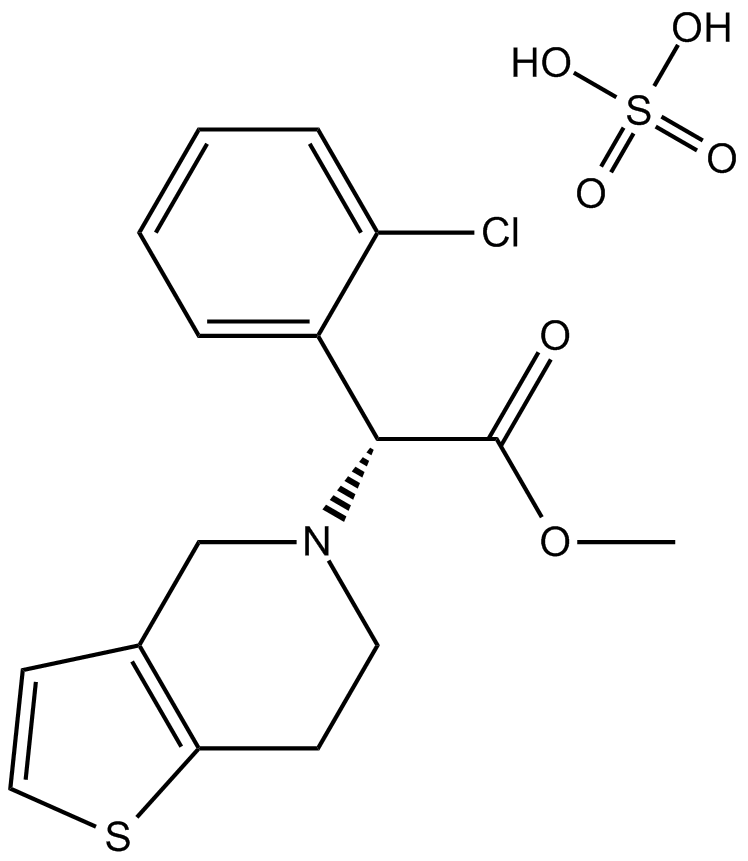
Clopidogrel hydrogen sulfate (Synonyms: SR 25990C) |
رقم الكتالوجGC15964
 One-Click Copy Product Info
|

كبريتات الهيدروجين كلوبيدوقرل هو عامل مضاد للصفيحات لمنع تجلط الدم
Products are for research use only. Not for human use. We do not sell to patients.
Cas No.: 120202-66-6
Sample solution is provided at 25 µL, 10mM.
_1-3.$$$39978408@51.jpg');)
_1-9.$$$38538795@65.jpg');)
_1-9.$$$39112701@51.jpg');)
_1-7.$$$37316672@70.jpg');)
_366-372.$$$36198801@70.jpg');)
.$$$38565142@65.jpg');)
_1867-1883.$$$33248023@67.jpg');)
_eads6055.$$$39977546@45.jpg');)
_eadm9805.$$$40080571@45.jpg');)
_eadj3020.$$$39666821@45.jpg');)
_1-20.$$$39757301@28.jpg');)
_1-24.$$$38898113@28.jpg');)
_273-287.$$$36806353@46.jpg');)
_1-16.$$$37156877@44.jpg');)
_1-19.$$$37460805@44.jpg');)
_1291-1307.$$$34518654@46.jpg');)
Clopidogrel hydrogen sulfate is an orally effective purine-type P2Y12 receptor antagonist. The IC50 values for cytochrome P450 (CYP) subtypes CYP2B6 and CYP2C19 are 18.2nM and 524nM, respectively [1-2]. The P2Y12 receptor combines with the Gq pathway and promotes the release of intracellular calcium ions, thereby regulating the shape changes and aggregation process of platelets [3]. Clopidogrel hydrogen sulfate is a potent antithrombotic drug that can inhibit platelet aggregation triggered by adenosine diphosphate (ADP) [4].
In vitro, Clopidogrel hydrogen sulfate (0.5, 1.5mM; 24, 48h) upregulated the mRNA expression levels of TRIB3 and CHOP in GES-1 cells in a concentration- and time-dependent manner [5]. Clopidogrel hydrogen sulfate (1, 10 and 100μM; 24h) treatment concentration-dependently increased the cytotoxicity and intracellular ROS levels of HepG2 cells (expressing human CYP3A4) [6].
In the body, Clopidogrel hydrogen sulfate (1.25, 2.5, 3.75 and 5mg/kg; twice; gavage) can significantly inhibit thrombosis formation in a dose-dependent manner in the mouse arterial thrombosis model. When combined with acetylsalicylic acid (0.15mg/kg), it can enhance the antithrombotic effect of Clopidogrel hydrogen sulfate, while acetylsalicylic acid (0.6mg/kg) can weaken its antithrombotic effect [7]. 24 hours before the ischemia-reperfusion surgery, oral administration of Clopidogrel hydrogen sulfate (25mg/kg/day) significantly reduced the plasma levels of blood urea nitrogen (BUN) and creatinine in mice with renal ischemia-reperfusion injury (IRI), increased the expression of Bcl-2 and Bcl-xL, caspase-3 and caspase-8, and decreased the number of CD41-positive cells [8].
References:
[1] Laine L, Hennekens C. Proton pump inhibitor and clopidogrel interaction: fact or fiction?. Am J Gastroenterol. 2010;105(1):34-41.
[2] Katsunobu Hagihara, et al. Comparison of human cytochrome P450 inhibition by the thienopyridines prasugrel, Clopidogrel, and ticlopidine. Drug Metab Pharmacokinet. 2008;23(6):412-20.
[3] Dorsam R T, Murugappan S, Ding Z, et al. Clopidogrel: interactions with the P2Y12 receptor and clinical relevance[J]. Hematology, 2003, 8(6): 359-365.
[4] Herbert JM, Savi P. P2Y12, a new platelet ADP receptor, target of clopidogrel. Semin Vasc Med. 2003;3(2):113-122.
[5] Wu HL, Duan ZT, Jiang ZD, Cao WJ, Wang ZB, Hu KW, Gao X, Wang SK, He BS, Zhang ZY, Xie HG. Increased endoplasmic reticulum stress response is involved in clopidogrel-induced apoptosis of gastric epithelial cells. PLoS One. 2013 Sep 13;8(9):e74381.
[6] Zahno A, Bouitbir J, Maseneni S, Lindinger PW, Brecht K, Krähenbühl S. Hepatocellular toxicity of clopidogrel: mechanisms and risk factors. Free Radic Biol Med. 2013;65:208-216.
[7] Ni R, Vaezzadeh N, Zhou J, Weitz JI, Cattaneo M, Gross PL. Effect of Different Doses of Acetylsalicylic Acid on the Antithrombotic Activity of Clopidogrel in a Mouse Arterial Thrombosis Model. Arterioscler Thromb Vasc Biol. 2018 Oct;38(10):2338-2344.
[8] Hu H, Batteux F, Chéreau C, et al. Clopidogrel protects from cell apoptosis and oxidative damage in a mouse model of renal ischaemia–reperfusion injury[J]. The Journal of pathology, 2011, 225(2): 265-275.
| Cell experiment [1]: | |
Cell lines | GES-1 cells |
Preparation Method | GES-1 cells were plated in 60-mm dishes (3ml, 1×10⁶/well) and incubated for 24h at 37°C. After 24-h treatment with Clopidogrel hydrogen sulfate, the cells were collected and washed twice with ice-cold PBS, and then were re-suspended in binding buffer at a concentration of 1×10⁶ cells/ml and incubated with 10µl of PI (50µg/ml) solution and 5µl of FITC-conjugated AV (17.6µg/ml) at 37°C for 5min in the dark to achieve double staining. After staining, 400µl of binding buffer were added to the cells, and then analyzed by flow cytometry. |
Reaction Conditions | 1.5mM; 24h |
Applications | Clopidogrel hydrogen sulfate significantly inhibits the proliferation of GES-1 cells and induces apoptosis. |
| Animal experiment [2]: | |
Animal models | C57BL/6J mice |
Preparation Method | Clopidogrel hydrogen sulfate were dissolved in diluted apple jelly and acetylsalicylic acid (ASA) were dissolved in distilled water. Age-matched C57BL/6J male mice weighing at least 25g were used at 8 to 12 weeks of age. Anesthesia was initiated with an intraperitoneal injection of 125mg/kg of ketamine, 12.5mg/kg of xylazine, and 0.25mg/kg of atropine and maintained with Nembutal. All mice received 100μL of vehicle or an equal volume of ASA, Clopidogrel hydrogen sulfate or both by gavage using 20-gauge animal feeding needles. ASA was given only once, 4 hours before study, whereas clopidogrel was given twice: 24 and 4 hours before study. ASA and clopidogrel were given at doses up to 5mg/kg body weight. Blood samples were collected via carotid artery cannulation into 3.2% sodium citrate at a ratio of 9:1 (vol:vol). Blood was diluted and recalcified with 1.5mM CaCl2, and platelet aggregation, quantified by area under the curve (AUC), in whole blood was recorded for 6min after using a Multiplate Analyzer. |
Dosage form | 1.25, 2.5, 3.75, or 5mg/kg; twice; gavage |
Applications | Clopidogrel hydrogen sulfate can significantly inhibit thrombosis formation in a dose-dependent manner in a mouse model of arterial thrombosis. When used in combination with acetylsalicylic acid (0.15mg/kg), it can enhance the antithrombotic effect of Clopidogrel hydrogen sulfate, while acetylsalicylic acid (0.6mg/kg) will weaken its antithrombotic effect. |
References: | |
| Cas No. | 120202-66-6 | SDF | |
| المرادفات | SR 25990C | ||
| Chemical Name | methyl (2S)-2-(2-chlorophenyl)-2-(6,7-dihydro-4H-thieno[3,2-c]pyridin-5-yl)acetate;sulfuric acid | ||
| Canonical SMILES | COC(=O)C(C1=CC=CC=C1Cl)N2CCC3=C(C2)C=CS3.OS(=O)(=O)O | ||
| Formula | C16H16ClNO2S.H2SO4 | M.Wt | 419.9 |
| الذوبان | ≥ 100mg/ml in DMSO, ≥ 50 mg/mL in EtOH with ultrasonic, ≥ 48.6 mg/mL in Water | Storage | Store at -20°C |
| General tips | Please select the appropriate solvent to prepare the stock solution according to the
solubility of the product in different solvents; once the solution is prepared, please store it in
separate packages to avoid product failure caused by repeated freezing and thawing.Storage method
and period of the stock solution: When stored at -80°C, please use it within 6 months; when stored
at -20°C, please use it within 1 month. To increase solubility, heat the tube to 37°C and then oscillate in an ultrasonic bath for some time. |
||
| Shipping Condition | Evaluation sample solution: shipped with blue ice. All other sizes available: with RT, or with Blue Ice upon request. | ||
| Prepare stock solution | |||

|
1 mg | 5 mg | 10 mg |
| 1 mM | 2.3815 mL | 11.9076 mL | 23.8152 mL |
| 5 mM | 476.3 μL | 2.3815 mL | 4.763 mL |
| 10 mM | 238.2 μL | 1.1908 mL | 2.3815 mL |
Step 1: Enter information below (Recommended: An additional animal making an allowance for loss during the experiment)
 g
μL
g
μL
Step 2: Enter the in vivo formulation (This is only the calculator, not formulation. Please contact us first if there is no in vivo formulation at the solubility Section.)
Calculation results:
Working concentration: mg/ml;
Method for preparing DMSO master liquid: mg drug pre-dissolved in μL DMSO ( Master liquid concentration mg/mL, Please contact us first if the concentration exceeds the DMSO solubility of the batch of drug. )
Method for preparing in vivo formulation: Take μL DMSO master liquid, next addμL PEG300, mix and clarify, next addμL Tween 80, mix and clarify, next add μL saline, mix and clarify.
Method for preparing in vivo formulation: Take μL DMSO master liquid, next add μL Corn oil, mix and clarify.
Note: 1. Please make sure the liquid is clear before adding the next solvent.
2. Be sure to add the solvent(s) in order. You must ensure that the solution obtained, in the previous addition, is a clear solution before proceeding to add the next solvent. Physical methods such as vortex, ultrasound or hot water bath can be used to aid dissolving.
3. All of the above co-solvents are available for purchase on the GlpBio website.
Quality Control & SDS
- View current batch:
- Purity: >99.00% Appearance: A solid
- COA (Certificate of Analysis)
- SDS (Safety Data Sheet)
- Datasheet
Average Rating: 5 (Based on Reviews and 12 reference(s) in Google Scholar.)