

Dihydroartemisinin (Synonyms: DHQHS 2, Dihydroqinghaosu) |
رقم الكتالوجGN10056
 One-Click Copy Product Info
|

Dihydroartemisinin (DHA) is an active metabolite of artemisinin and its derivatives (ARTs) and is an effective drug widely used in the clinic to treat malaria.
Products are for research use only. Not for human use. We do not sell to patients.
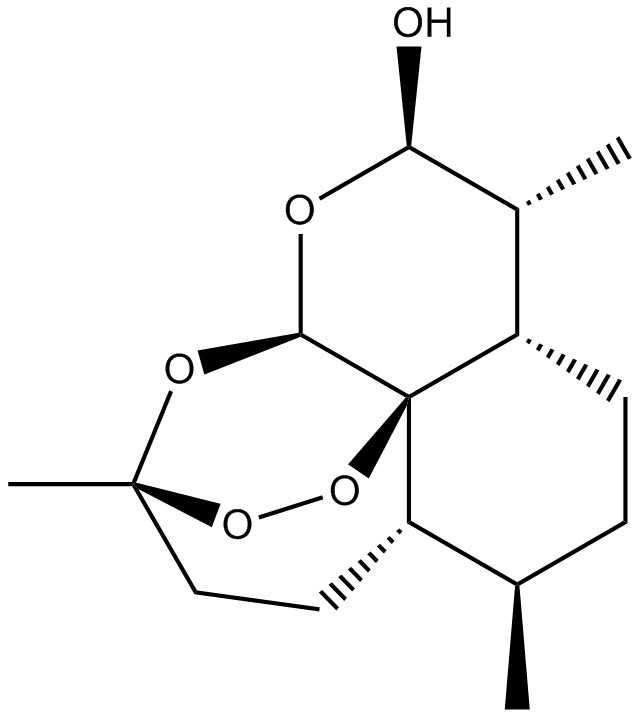
Cas No.: 71939-50-9
Sample solution is provided at 25 µL, 10mM.
_1-3.$$$39978408@51.jpg');)
_1-9.$$$38538795@65.jpg');)
_1-9.$$$39112701@51.jpg');)
_1-7.$$$37316672@70.jpg');)
_366-372.$$$36198801@70.jpg');)
.$$$38565142@65.jpg');)
_1867-1883.$$$33248023@67.jpg');)
_eads6055.$$$39977546@45.jpg');)
_eadm9805.$$$40080571@45.jpg');)
_eadj3020.$$$39666821@45.jpg');)
_1-20.$$$39757301@28.jpg');)
_1-24.$$$38898113@28.jpg');)
_273-287.$$$36806353@46.jpg');)
_1-16.$$$37156877@44.jpg');)
_1-19.$$$37460805@44.jpg');)
_1291-1307.$$$34518654@46.jpg');)
Dihydroartemisinin (DHA) is an active metabolite of artemisinin and its derivatives (ARTs) and is an effective drug widely used in the clinic to treat malaria[1]. Dihydroartemisinin exerts its anticancer effects through multiple molecular mechanisms, including inhibiting proliferation, inducing apoptosis, inhibiting tumor metastasis and angiogenesis, promoting immune function, inducing autophagy and endoplasmic reticulum stress[2]. Dihydroartemisinin can exert its cytotoxic effects through Fe(II)-mediated endoperoxide cleavage[3].
In vitro, Dihydroartemisinin (2.5-120μM) treated esophageal cancer cells (Eca109 and Ec9706 cells) for 48 and 72h, reducing cell viability in a dose-dependent manner, with IC50 values of 76.86μM and 93.81μM, respectively, and inducing cell apoptosis and cell cycle arrest[4]. Dihydroartemisinin (0-80µM) treatment of gastric cancer cells (SGC-7901, BGC823, and MGC803 cells) for 48 and 72h reduced cell viability in a dose-dependent manner and induced cell G1 arrest, apoptosis, and senescence[5].
In vivo, Dihydroartemisinin (20mg/kg) was intraperitoneally injected into mice inoculated with human hepatoma cells (HepG2) for 4 weeks, which significantly inhibited tumor growth and induced apoptosis of tumor tissue cells[6]. Dihydroartemisinin (20mg/kg) was intraperitoneally injected into colon cancer mice for 30 days, which significantly inhibited colon tumor formation, induced apoptosis of tumor tissue cells, and increased the expression of peroxisome proliferator-activated receptor γ (PPARγ)[7].
References:
[1] Zhang X G, Li G X, Zhao S S, et al. A review of dihydroartemisinin as another gift from traditional Chinese medicine not only for malaria control but also for schistosomiasis control[J]. Parasitology research, 2014, 113: 1769-1773.
[2] Dai X, Zhang X, Chen W, et al. Dihydroartemisinin: a potential natural anticancer drug[J]. International journal of biological sciences, 2021, 17(2): 603.
[3] Antoine T, Fisher N, Amewu R, et al. Rapid kill of malaria parasites by artemisinin and semi-synthetic endoperoxides involves ROS-dependent depolarization of the membrane potential[J]. Journal of antimicrobial chemotherapy, 2014, 69(4): 1005-1016.
[4] Du X X, Li Y J, Wu C L, et al. Initiation of apoptosis, cell cycle arrest and autophagy of esophageal cancer cells by dihydroartemisinin[J]. Biomedicine & Pharmacotherapy, 2013, 67(5): 417-424.
[5] Sun H, Meng X, Han J, et al. Anti-cancer activity of DHA on gastric cancer—an in vitro and in vivo study[J]. Tumor Biology, 2013, 34: 3791-3800.
[6] Zhang C Z, Zhang H, Yun J, et al. Dihydroartemisinin exhibits antitumor activity toward hepatocellular carcinoma in vitro and in vivo[J]. Biochemical pharmacology, 2012, 83(9): 1278-1289.
[7] Lu Z, Peng J H, Zhang R, et al. Dihydroartemisinin inhibits colon cancer cell viability by inducing apoptosis through up-regulation of PPARγ expression[J]. Saudi journal of biological sciences, 2018, 25(2): 372-376.
| Cell experiment [1]: | |
|
Cell lines |
Eca109 and Ec9706 cells |
|
Preparation Method |
Eca109 (4×10³ cells/well) and Ec9706 (5×10³ cells/well) cells were seeded in 96-well plates and cultured overnight. Cells were treated with 2.5-120μM Dihydroartemisinin. Cells treated with DMSO served as untreated controls. After incubation for 48 and 72h, cell viability was measured using the MTT assay. |
|
Reaction Conditions |
2.5-120μM; 48 and 72h |
|
Applications |
Dihydroartemisinin reduced the viability of Eca109 and Ec9706 cells in a dose-dependent manner, with IC50 values of 76.86μM and 93.81μM, respectively. |
| Animal experiment [2]: | |
|
Animal models |
Nude mice |
|
Preparation Method |
HepG2 cells were suspended in sterile PBS and injected subcutaneously into the right flank of the mice. Mice were checked daily for tumor development. Mice were randomized into three groups of 6 mice/group. The Dihydroartemisinin group was given 20mg/kg Dihydroartemisinin, once daily for five consecutive days per week for 4 weeks. The control group was given normal saline, and the DMSO group received an equal volume of solvent control. After treatment at various time intervals, mouse body weight and tumor size were measured. Finally, tumors were excised, weighed and fixed in 4% of PFA. Paraffin-embedded tissues were then sectioned at 4nm and ready for immunohistochemitry and TUNEL assay. |
|
Dosage form |
20mg/kg; i.p. |
|
Applications |
Dihydroartemisinin significantly inhibited the growth of HepG2 xenograft tumors and induced apoptosis in tumor tissues. |
|
References: |
|
| Cas No. | 71939-50-9 | SDF | |
| المرادفات | DHQHS 2, Dihydroqinghaosu | ||
| Chemical Name | (3R,5aS,6R,8aS,9R,10R,12R,12aR)-3,6,9-trimethyldecahydro-3H-3,12-epoxy[1,2]dioxepino[4,3-i]isochromen-10-ol | ||
| Canonical SMILES | [H][C@@]1(C([H])([H])C2([H])[H])[C@]3([C@@]([C@@]4([H])C([H])([H])[H])([H])C([H])([H])C([H])([H])[C@@]1([H])C([H])([H])[H])OO[C@@]2(C([H])([H])[H])O[C@@]3([H])O[C@@]4([H])O[H] | ||
| Formula | C15H24O5 | M.Wt | 284.35 |
| الذوبان | ≥ 14.05mg/mL in DMSO | Storage | Store at 2-8°C |
| General tips | Please select the appropriate solvent to prepare the stock solution according to the
solubility of the product in different solvents; once the solution is prepared, please store it in
separate packages to avoid product failure caused by repeated freezing and thawing.Storage method
and period of the stock solution: When stored at -80°C, please use it within 6 months; when stored
at -20°C, please use it within 1 month. To increase solubility, heat the tube to 37°C and then oscillate in an ultrasonic bath for some time. |
||
| Shipping Condition | Evaluation sample solution: shipped with blue ice. All other sizes available: with RT, or with Blue Ice upon request. | ||
| Prepare stock solution | |||

|
1 mg | 5 mg | 10 mg |
| 1 mM | 3.5168 mL | 17.584 mL | 35.1679 mL |
| 5 mM | 703.4 μL | 3.5168 mL | 7.0336 mL |
| 10 mM | 351.7 μL | 1.7584 mL | 3.5168 mL |
Step 1: Enter information below (Recommended: An additional animal making an allowance for loss during the experiment)
 g
μL
g
μL
Step 2: Enter the in vivo formulation (This is only the calculator, not formulation. Please contact us first if there is no in vivo formulation at the solubility Section.)
Calculation results:
Working concentration: mg/ml;
Method for preparing DMSO master liquid: mg drug pre-dissolved in μL DMSO ( Master liquid concentration mg/mL, Please contact us first if the concentration exceeds the DMSO solubility of the batch of drug. )
Method for preparing in vivo formulation: Take μL DMSO master liquid, next addμL PEG300, mix and clarify, next addμL Tween 80, mix and clarify, next add μL saline, mix and clarify.
Method for preparing in vivo formulation: Take μL DMSO master liquid, next add μL Corn oil, mix and clarify.
Note: 1. Please make sure the liquid is clear before adding the next solvent.
2. Be sure to add the solvent(s) in order. You must ensure that the solution obtained, in the previous addition, is a clear solution before proceeding to add the next solvent. Physical methods such as vortex, ultrasound or hot water bath can be used to aid dissolving.
3. All of the above co-solvents are available for purchase on the GlpBio website.
Quality Control & SDS
- View current batch:
- Purity: >98.00% Appearance: A solid
- COA (Certificate of Analysis)
- SDS (Safety Data Sheet)
- Datasheet
Average Rating: 5 (Based on Reviews and 30 reference(s) in Google Scholar.)