
الصفحة الرئيسية>>Signaling Pathways>> Membrane Transporter/Ion Channel>> nAChR>>EVP-6124 hydrochloride

EVP-6124 hydrochloride

رقم الكتالوجGC11091

A partial agonist of α7 subunit-containing nAChRs

Products are for research use only. Not for human use. We do not sell to patients.
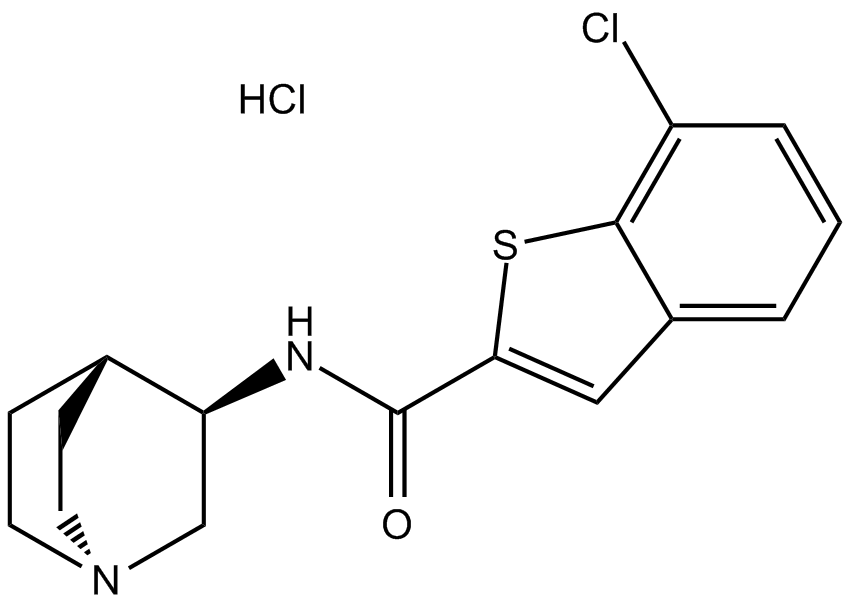
EVP-6124 hydrochloride التركيب الكيميائي

Cas No.: 550999-74-1

الحجم السعر المخزون الكميّة
10mM (in 1mL DMSO)
163٫00
متوفر
1mg
86٫00
متوفر
5mg
207٫00
متوفر
10mg
300٫00
متوفر
25mg
505٫00
متوفر

Tel:(909) 407-4943 Email: sales@glpbio.com


مراجعات العميل

بناء على آراء العملاء.

Sample solution is provided at 25 µL, 10mM.

Description of EVP-6124 hydrochloride

EVP-6124 Hydrochloride is a hydrochloride form of EVP-6124. EVP-6124 is partial agonist of α7 neuronal nicotinic acetylcholine receptors (nAChRs) that was proved high-affinity in vitro and in vivo. [1]
EVP-6124 was proved to show selectivity for α7 but low-affinity of α4β2 nAChRs in some binding and functional experiments. EVP-6124 had good brain penetration and an adequate exposure time. [1,2]
Co-administration of EVP-6124 and the selective nAChRs antagonist could contribute to the release of DA, ACH, and Glu. This could be used to treat cognitive impairment and possibly other dimensions of psychopathology. Co-administration of donepezil at 0.1 mg/kg, p.o. and EVP-6124 at 0.03 mg/kg proved to be fully restored memory while each of these did not improve memory in this task. [1] Pretreatment with the selective α7 nAChR antagonist, methyllycaconitine (MLA, 1.0 mg/kg), significantly blocked cortical DA and Glu efflux induced by EVP-6124 (0.1 mg/kg). [2,3]
References:
1. Jos Prickaerts, Nick P. van Goethem, et al. EVP-6124, a novel and selective α7 nicotinic acetylcholine receptor partial agonist, improves memory performance by potentiating the acetylcholine response of α7 nicotinic acetylcholine receptors. Neuropharmacology, 2012,62 (2): 1099-1110.
2. Mei Huang, Anna R. Felix, et al. Chaya Bhuvaneswaran, Dana Hilt, Gerhard K?nig, Herbert Y. Meltzer, The alpha-7 receptor agonist EVP-6124 increases dopamine and glutamate efflux in rat medial prefrontal cortex and nucleus accumbens. Biochemical Pharmacology, 2011, 82 (8): 1040.
3. Mei Huang, Anna R. Felix, et al. The novel α7 nicotinic acetylcholine receptor agonist EVP-6124 enhances dopamine, acetylcholine, and glutamate efflux in rat cortex and nucleus accumbens. Psychopharmacology, 2014, 231:4541-4551.

Protocol of EVP-6124 hydrochloride

Animal experiment:

Rats[1] Twenty-four 2.5-month-old male Wistar rats (average body weight: 329 g) are used. Before testing EVP-6124, the effects of scopolamine alone at 0.03, 0.1, or 0.3 mg/kg, i.p. in the ORT are determined (n=8 per treatment). Scopolamine (0.1 mg/kg, i.p.) injected 30 min before T1 resulted in a robust deficit at T2 when a 1 h interval is used. The d2 index is not significantly different from the chance level of performance; and there are no changes in exploratory behavior for 0.1 mg/kg, i.p. of scopolamine compared with saline. Subsequently, the ability of Encenicline (EVP-6124) to reverse the memory impairment induced by 0.1 mg/kg of scopolamine is tested. First, scopolamine and then Encenicline (EVP-6124) (0.03, 0.1, 0.3, and 1.0 mg/kg, p.o.) are administered 30 min before T1. For the control treatments, animals received either deionized water (p.o.) plus saline (i.p.) or deionized water (p.o.) plus 0.1 mg/kg scopolamine (i.p.).Mice[2]Adult male mice (3-6 months old) are used throughout this study. Encenicline (EVP-6124) is injected i.p. (0.4 mg/kg) at Zeitgeber time (ZT0) in awake mice (9 mice total for this experiment), in the animal facility. Mice are then immediately returned to their home cage with their siblings and left undisturbed for 4 hr (ZT4). During this time, they are closely monitored to check for possible behavioral effects of Encenicline (EVP-6124) injection. All of the 9 injected mice nested and are immobile in the hour following the injection.

References:

[1]. Prickaerts J, et al. EVP-6124, a novel and selective α7 nicotinic acetylcholine receptor partial agonist, improves memory performance by potentiating the acetylcholine response of α7 nicotinic acetylcholine receptors. Neuropharmacology. 2012 Feb;62(2):109
[2]. Thomas Papouin, et al. Septal Cholinergic Neuromodulation Tunes the Astrocyte-Dependent Gating of Hippocampal NMDA Receptors to Wakefulness. Neuron. 2017 May 17;94:1-15.
[3]. Papouin T, et al. Septal Cholinergic Neuromodulation Tunes the Astrocyte-Dependent Gating of Hippocampal NMDA Receptors to Wakefulness. Neuron. 2017 May 17;94(4):840-854.e7.
[4]. Maehara S, et al. Pharmacological characterization of a novel potent, selective, and orally active phosphodiesterase 2A inhibitor, PDM-631. Eur J Pharmacol. 2017 Sep 15;811:110-116.

Chemical Properties of EVP-6124 hydrochloride

Cas No. 550999-74-1 SDF
Chemical Name N-[(3R)-1-azabicyclo[2.2.2]octan-3-yl]-7-chloro-1-benzothiophene-2-carboxamide;hydrochloride
Canonical SMILES C1CN2CCC1C(C2)NC(=O)C3=CC4=C(S3)C(=CC=C4)Cl.Cl
Formula C16H18Cl2N2OS M.Wt 357.3
الذوبان ≥ 17.9 mg/mL in DMSO, ≥ 100.4 mg/mL in EtOH with gentle warming Storage Store at -20°C
General tips Please select the appropriate solvent to prepare the stock solution according to the solubility of the product in different solvents; once the solution is prepared, please store it in separate packages to avoid product failure caused by repeated freezing and thawing.Storage method and period of the stock solution: When stored at -80°C, please use it within 6 months; when stored at -20°C, please use it within 1 month.
To increase solubility, heat the tube to 37°C and then oscillate in an ultrasonic bath for some time.
Shipping Condition Evaluation sample solution: shipped with blue ice. All other sizes available: with RT, or with Blue Ice upon request.

Complete Stock Solution Preparation Table of EVP-6124 hydrochloride

Prepare stock solution
1 mg 5 mg 10 mg
1 mM 2.7988 mL 13.9938 mL 27.9877 mL
5 mM 559.8 μL 2.7988 mL 5.5975 mL
10 mM 279.9 μL 1.3994 mL 2.7988 mL
  • حاسبة المولارية

  • حاسبة التخفيف

  • Molecular Weight Calculator

كتلة
=
تركيز
x
مقدار
x
ميغاواط *


** عند إعداد حلول المخزون، دائمًا استخدم الوزن الجزيئي الخاص بالدفعة للمنتج على ملصق القارورة MSDS / CoA (متوفر عبر الإنترنت).

احسب

In vivo Formulation Calculator (Clear solution) of EVP-6124 hydrochloride

Step 1: Enter information below (Recommended: An additional animal making an allowance for loss during the experiment)

mg/kg g μL

Step 2: Enter the in vivo formulation (This is only the calculator, not formulation. Please contact us first if there is no in vivo formulation at the solubility Section.)

% DMSO % % Tween 80 % ddH2O
%DMSO %

Calculation results:

Working concentration: mg/ml;

Method for preparing DMSO master liquid: mg drug pre-dissolved in μL DMSO ( Master liquid concentration mg/mL, Please contact us first if the concentration exceeds the DMSO solubility of the batch of drug. )

Method for preparing in vivo formulation: Take μL DMSO master liquid, next addμL PEG300, mix and clarify, next addμL Tween 80, mix and clarify, next add μL ddH2O, mix and clarify.

Method for preparing in vivo formulation: Take μL DMSO master liquid, next add μL Corn oil, mix and clarify.

Note: 1. Please make sure the liquid is clear before adding the next solvent.
2. Be sure to add the solvent(s) in order. You must ensure that the solution obtained, in the previous addition, is a clear solution before proceeding to add the next solvent. Physical methods such as vortex, ultrasound or hot water bath can be used to aid dissolving.
3. All of the above co-solvents are available for purchase on the GlpBio website.

Product Documents

Quality Control & SDS

View current batch:

مراجعات

Review for EVP-6124 hydrochloride

Average Rating: 5 ★★★★★ (Based on Reviews and 30 reference(s) in Google Scholar.)

5 Star
100%
4 Star
0%
3 Star
0%
2 Star
0%
1 Star
0%
Review for EVP-6124 hydrochloride

GLPBIO products are for RESEARCH USE ONLY. Please make sure your review or question is research based.

Required fields are marked with *

You may receive emails regarding this submission. Any emails will include the ability to opt-out of future communications.