
Fenofibrate |
| رقم الكتالوجGC12250 |
الفينوفيبرات هو ناهض PPARα انتقائي مع EC50 من 30 ميكرومتر
Products are for research use only. Not for human use. We do not sell to patients.
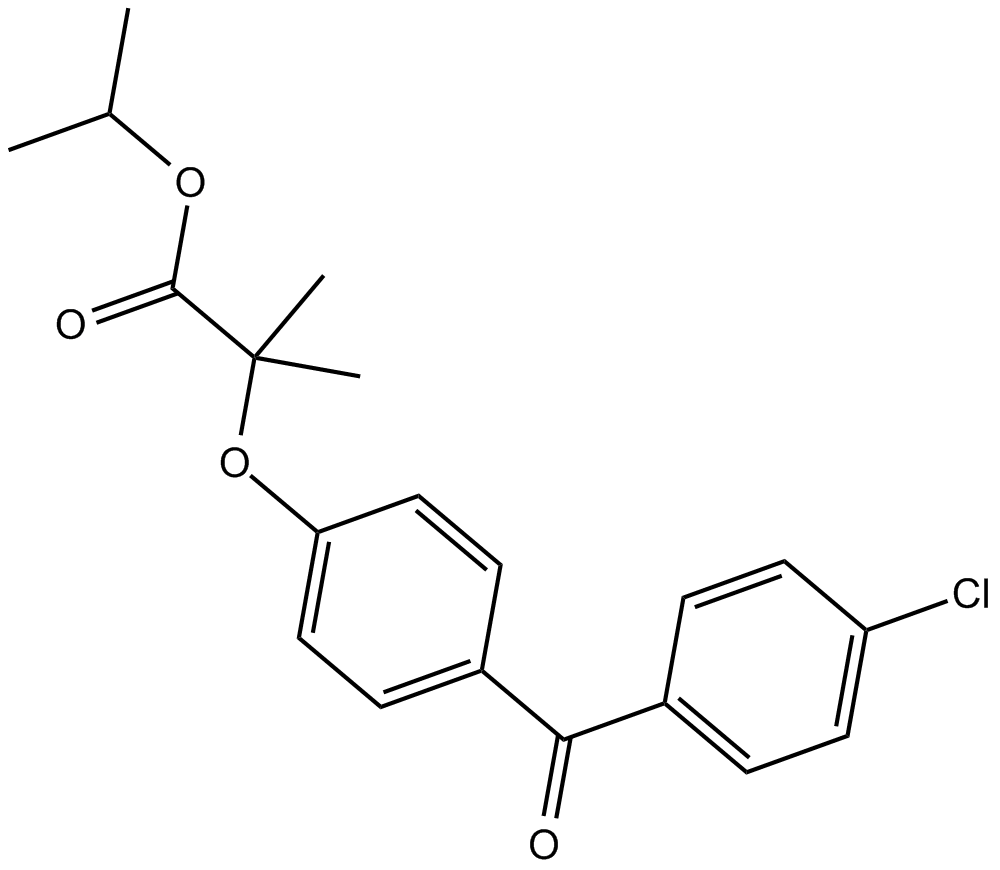
Cas No.: 49562-28-9
Sample solution is provided at 25 µL, 10mM.
Fenofibrate is a PPARα agonist with an EC50 of 30 μM.
Fenofibrate is a relatively potent inhibitor of CYP2B6 (IC50=0.7±0.2 μM) and CYP2C19 (IC50=0.2±0.1 μM). Fenofibrate is also a moderate inhibitor of CYP2C8 (IC50=4.8±1.7 μM) and CYP2C9 (IC50=9.7 μM)[1]. Fenofibrate binds to and inhibits cytochrome P450 epoxygenase (CYP)2C with higher affinity than to PPARα. Fenofibrate is a well-known PPARα agonist, but an in vitro assessment of 209 frequently prescribed drugs and related xenobiotics suggests that Fenofibrate is also a potent inhibitor of cytochrome P450 epoxygenase (CYP)2C. The affinity of Fenofibrate to CYP2C is >10 times higher (EC50=2.39±0.4 μM) than to PPARα (EC50=30 μM). Fenofibrate at a low dose inhibits CYP2C8 activity without PPARα activation[2].
Daily intake of Fenofibrate at this low dose (10 μg/g/day) inhibits retinal and choroidal neovascularization induced by CYP2C8 overexpression by 29% (P=0.021) and 36% (P=1.2×10⁻⁹) respectively[2].
References:
[1]. Schelleman H, et al. Pharmacoepidemiologic and in vitro evaluation of potential drug-drug interactions of sulfonylureas with fibrates and statins. Br J Clin Pharmacol. 2014 Sep;78(3):639-48.
[2]. Gong Y, et al. Fenofibrate Inhibits Cytochrome P450 Epoxygenase 2C Activity to Suppress Pathological Ocular Angiogenesis. EBioMedicine. 2016 Sep 30. pii: S2352-3964(16)30448-0.

| Cell experiment [1]: | |
|
Cell lines |
MCF-7 and Panc-1 cells |
|
Preparation method |
The solubility of this compound in DMSO is > 12.8 mg/mL. General tips for obtaining a higher concentration: Please warm the tube at 37 °C for 10 minutes and/or shake it in the ultrasonic bath for a while. Stock solution can be stored below - 20 °C for several months. |
|
Reacting condition |
24, 48 and 72 hrs |
|
Applications |
At 24th, 48th and 72th hrs, the IC50 values of Fenofibrate were 96.6, 46.5 and 9.2 μg/mL on Panc-1 cells, and 93.5, 55.9 and 8 μg/mL on MCF-7 cells, respectively. Compared with the untreated solvent control, MCF-7 and Panc-1 cells treated with 1/2 IC50, IC50 and 2 IC50 of Fenofibrate for 24 hrs exhibited a significant increase in the relative activity of caspase 3/7. |
| Animal experiment [1]: | |
|
Animal models |
Mice bearing Ehrlich ascites carcinoma (EAC) |
|
Dosage form |
200 mg/kg/day; p.o.; for 18 days |
|
Applications |
In an EAC mouse model, Fenofibrate significantly reduced tumor weight and volume, without affecting the relative heart weight. However, Fenofibrate treatment significantly decreased the body weight and increased the relative liver weight. In addition, a marked decrease in the carcinoembryonic antigen (CEA) level was also observed in the Fenofibrate treatment group. |
|
Other notes |
Please test the solubility of all compounds indoor, and the actual solubility may slightly differ with the theoretical value. This is caused by an experimental system error and it is normal. |
|
References: [1]. Sabaa M, ELFayoumi HM, Elshazly S, Youns M, Barakat W. Anticancer activity of salicin and fenofibrate. Naunyn Schmiedebergs Arch Pharmacol. 2017 Jul 21. |
|
| Cas No. | 49562-28-9 | SDF | |
| Chemical Name | propan-2-yl 2-[4-(4-chlorobenzoyl)phenoxy]-2-methylpropanoate | ||
| Canonical SMILES | CC(C)OC(=O)C(C)(C)OC1=CC=C(C=C1)C(=O)C2=CC=C(C=C2)Cl | ||
| Formula | C20H21ClO4 | M.Wt | 360.83 |
| الذوبان | ≥ 12.75mg/mL in DMSO | Storage | Store at RT |
| General tips | Please select the appropriate solvent to prepare the stock solution according to the
solubility of the product in different solvents; once the solution is prepared, please store it in
separate packages to avoid product failure caused by repeated freezing and thawing.Storage method
and period of the stock solution: When stored at -80°C, please use it within 6 months; when stored
at -20°C, please use it within 1 month. To increase solubility, heat the tube to 37°C and then oscillate in an ultrasonic bath for some time. |
||
| Shipping Condition | Evaluation sample solution: shipped with blue ice. All other sizes available: with RT, or with Blue Ice upon request. | ||
| Prepare stock solution | |||
|
1 mg | 5 mg | 10 mg |
| 1 mM | 2.7714 mL | 13.8569 mL | 27.7139 mL |
| 5 mM | 554.3 μL | 2.7714 mL | 5.5428 mL |
| 10 mM | 277.1 μL | 1.3857 mL | 2.7714 mL |
Step 1: Enter information below (Recommended: An additional animal making an allowance for loss during the experiment)
Step 2: Enter the in vivo formulation (This is only the calculator, not formulation. Please contact us first if there is no in vivo formulation at the solubility Section.)
Calculation results:
Working concentration: mg/ml;
Method for preparing DMSO master liquid: mg drug pre-dissolved in μL DMSO ( Master liquid concentration mg/mL, Please contact us first if the concentration exceeds the DMSO solubility of the batch of drug. )
Method for preparing in vivo formulation: Take μL DMSO master liquid, next addμL PEG300, mix and clarify, next addμL Tween 80, mix and clarify, next add μL ddH2O, mix and clarify.
Method for preparing in vivo formulation: Take μL DMSO master liquid, next add μL Corn oil, mix and clarify.
Note: 1. Please make sure the liquid is clear before adding the next solvent.
2. Be sure to add the solvent(s) in order. You must ensure that the solution obtained, in the previous addition, is a clear solution before proceeding to add the next solvent. Physical methods such as vortex, ultrasound or hot water bath can be used to aid dissolving.
3. All of the above co-solvents are available for purchase on the GlpBio website.
Quality Control & SDS
- View current batch:
- Purity: >99.00%
- COA (Certificate Of Analysis)
- SDS (Safety Data Sheet)
- Datasheet
Average Rating: 5 (Based on Reviews and 3 reference(s) in Google Scholar.)
GLPBIO products are for RESEARCH USE ONLY. Please make sure your review or question is research based.
Required fields are marked with *