

Ganoderic Acid A |
رقم الكتالوجGN10109
 One-Click Copy Product Info
|

Ganoderic Acid A is a triterpenoid compound derived from Ganoderma lucidumand exhibits multiple biological activities.
Products are for research use only. Not for human use. We do not sell to patients.
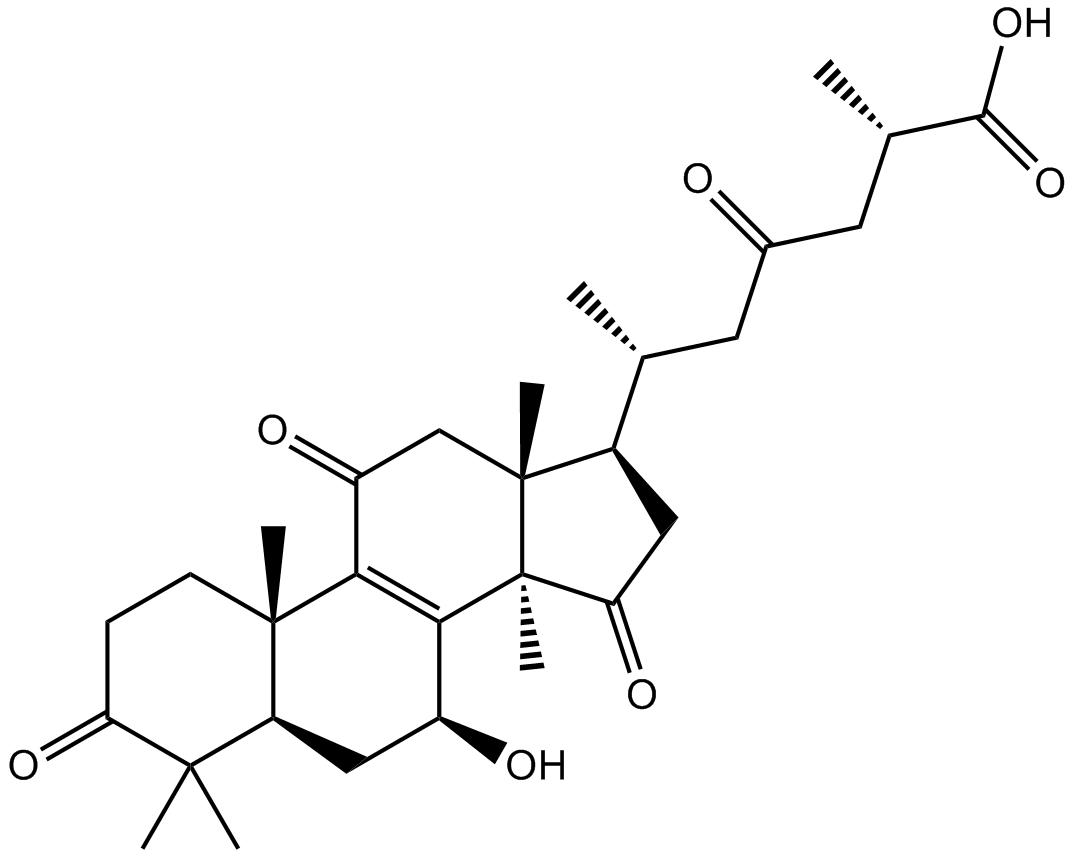
Cas No.: 81907-62-2
Sample solution is provided at 25 µL, 10mM.
_1-3.$$$39978408@51.jpg');)
_1-9.$$$38538795@65.jpg');)
_1-9.$$$39112701@51.jpg');)
_1-7.$$$37316672@70.jpg');)
_366-372.$$$36198801@70.jpg');)
.$$$38565142@65.jpg');)
_1867-1883.$$$33248023@67.jpg');)
_eads6055.$$$39977546@45.jpg');)
_eadm9805.$$$40080571@45.jpg');)
_eadj3020.$$$39666821@45.jpg');)
_1-20.$$$39757301@28.jpg');)
_1-24.$$$38898113@28.jpg');)
_273-287.$$$36806353@46.jpg');)
_1-16.$$$37156877@44.jpg');)
_1-19.$$$37460805@44.jpg');)
_1291-1307.$$$34518654@46.jpg');)
Ganoderic Acid A is a triterpenoid compound derived from Ganoderma lucidumand exhibits multiple biological activities[1-2]. Ganoderic Acid A possesses inhibitory effects against cancer, oxidation, and aging, among others[3-4].
In vitro, concurrent treatment of BV2 microglial cells with Ganoderic Acid A (50μg/ml) and LPS (0.5μg/ml) for 24 hours significantly suppressed LPS-induced proliferation and activation of BV2 microglia, and promoted the polarization of microglia from the pro-inflammatory M1 phenotype to the anti-inflammatory M2 phenotype[5]. Treatment of MC3T3-E1 cells (induced with 1mM H₂O₂) and primary osteoblasts (induced with 250μM H₂O₂) with Ganoderic Acid A (5–80μM) for 24 hours significantly promoted osteogenic differentiation and mineralization nodule formation, and upregulated the protein expression of osteogenesis-related markers RUNX2, OPN, and β-catenin[6].
In vivo, intraperitoneal administration of Ganoderic Acid A (20–40mg/kg) 1 hour before Ovalbumin (0.1g) challenge in OVA-sensitized BALB/c mice significantly alleviated airway hyperresponsiveness and reduced the total number of inflammatory cells in bronchoalveolar lavage fluid[7]. Daily administration of Ganoderic Acid A (20mg/kg/d) via intraperitoneal injection or topical application for 6 days in Imiquimod (62.5mg per mouse)-induced psoriasiform dermatitis BALB/c mice significantly ameliorated skin erythema, thickening, and scaling, and lowered the Psoriasis Area and Severity Index (PASI) score[8].
References:
[1] Sui Q, Zhu C, Shi S, et al. Ganoderic acid A: an in-depth review of pharmacological effects and molecular docking analysis. J Ethnopharmacol. 2025 Jun 12;349:119868.
[2] Ma F, Wang J, Jiang W, et al. Ganoderic Acid A: A Potential Natural Neuroprotective Agent for Neurological Disorders: A Review. Int J Med Mushrooms. 2024;26(2):11-23.
[3] Zhang X, Huang S, Xu H, et al. Research progress on plant-derived natural compounds regulating the MAPK signaling pathway for the prevention and therapy of Alzheimer's disease. Front Pharmacol. 2025 Sep 19;16:1666082.
[4] Song Z, Wang C, Ding F, et al. Ganoderic Acid A Enhances Tumor Suppression Function of Oxaliplatin via Inducing the Cytotoxicity of T Cells. Anticancer Agents Med Chem. 2023;23(7):832-838.
[5] Jia Y, Zhang D, Yin H, et al. Ganoderic Acid A Attenuates LPS-Induced Neuroinflammation in BV2 Microglia by Activating Farnesoid X Receptor. Neurochem Res. 2021 Jul;46(7):1725-1736.
[6] Zhao J, Fan Y, Li H, et al. Ganoderic Acid A Prevented Osteoporosis by Modulating the PIK3CA/p-Akt/TWIST1 Signaling Pathway. Food Sci Nutr. 2025 Apr 14;13(4):e70177.
[7] Lu X, Xu C, Yang R, et al. Ganoderic Acid A Alleviates OVA-Induced Asthma in Mice. Inflammation. 2021 Oct;44(5):1908-1915.
[8] Xiao C, Chen J, Zhou X, et al. Ganoderic acid A alleviate psoriasis by inhibiting GSDMD-mediated pyroptosis. Tissue Cell. 2025 Dec;97:103078.
| Cell experiment [1]: | |
|
Cell lines |
BV2 microglial cells (murine microglial cell line) |
|
Preparation Method |
BV2 cells were cultured in DMEM high glucose medium supplemented with 10% fetal bovine serum (FBS) and 1% penicillin-streptomycin at 37°C under 5% CO₂. Cells were treated with Ganoderic Acid A at 50μg/mL concurrently with LPS (0.5μg/mL) for 24 hours. |
|
Reaction Conditions |
50μg/mL; 24h |
|
Applications |
Ganoderic Acid A significantly suppressed LPS-induced BV2 microglial proliferation and activation. Ganoderic Acid A promoted the polarization of microglia from pro-inflammatory M1 to anti-inflammatory M2 phenotype. |
| Animal experiment [2]: | |
|
Animal models |
Female BALB/c mice |
|
Preparation Method |
Mice were sensitized by intraperitoneal injection of 10mg Ovalbumin (OVA) + 1mg aluminum hydroxide in saline on days 1, 7, and 14. From day 21, they received daily OVA aerosol challenges (0.1g OVA in 10ml saline, 30min) for 7 days. Ganoderic Acid A (20 or 40mg/kg) was administered intraperitoneally 1 hour before each OVA challenge. Lung tissues and serum were collected after the final challenge for analysis. |
|
Dosage form |
20 or 40mg/kg; i.p.; Daily for 7 days. |
|
Applications |
Ganoderic Acid A significantly attenuated OVA-induced airway hyperreactivity (AHR), reduced inflammatory cell infiltration (eosinophils, lymphocytes, neutrophils) in serum and lung tissue, and decreased levels of Th2 cytokines (IL-4, IL-5, IL-13) and IgE in serum. Ganoderic Acid A also suppressed TLR4/NF-κB signaling pathway activation, as evidenced by reduced expression of TLR4, MyD88, p-NF-κB, and p-IκBα in lung tissues. |
|
References: |
|
| Cas No. | 81907-62-2 | SDF | |
| Chemical Name | (2R,6R)-6-[(5R,7S,10S,13R,14R,15S,17R)-7,15-dihydroxy-4,4,10,13,14-pentamethyl-3,11-dioxo-2,5,6,7,12,15,16,17-octahydro-1H-cyclopenta[a]phenanthren-17-yl]-2-methyl-4-oxoheptanoic acid | ||
| Canonical SMILES | CC(CC(=O)CC(C)C(=O)O)C1CC(C2(C1(CC(=O)C3=C2C(CC4C3(CCC(=O)C4(C)C)C)O)C)C)O | ||
| Formula | C30H42O7 | M.Wt | 514.65 |
| الذوبان | DMF: 5mg/mL,DMSO: 1 mg/mL,Ethanol: 3 mg/mL | Storage | 4°C, away from moisture and light |
| General tips | Please select the appropriate solvent to prepare the stock solution according to the
solubility of the product in different solvents; once the solution is prepared, please store it in
separate packages to avoid product failure caused by repeated freezing and thawing.Storage method
and period of the stock solution: When stored at -80°C, please use it within 6 months; when stored
at -20°C, please use it within 1 month. To increase solubility, heat the tube to 37°C and then oscillate in an ultrasonic bath for some time. |
||
| Shipping Condition | Evaluation sample solution: shipped with blue ice. All other sizes available: with RT, or with Blue Ice upon request. | ||
| Prepare stock solution | |||

|
1 mg | 5 mg | 10 mg |
| 1 mM | 1.9431 mL | 9.7153 mL | 19.4307 mL |
| 5 mM | 388.6 μL | 1.9431 mL | 3.8861 mL |
| 10 mM | 194.3 μL | 971.5 μL | 1.9431 mL |
Step 1: Enter information below (Recommended: An additional animal making an allowance for loss during the experiment)
 g
μL
g
μL
Step 2: Enter the in vivo formulation (This is only the calculator, not formulation. Please contact us first if there is no in vivo formulation at the solubility Section.)
Calculation results:
Working concentration: mg/ml;
Method for preparing DMSO master liquid: mg drug pre-dissolved in μL DMSO ( Master liquid concentration mg/mL, Please contact us first if the concentration exceeds the DMSO solubility of the batch of drug. )
Method for preparing in vivo formulation: Take μL DMSO master liquid, next addμL PEG300, mix and clarify, next addμL Tween 80, mix and clarify, next add μL saline, mix and clarify.
Method for preparing in vivo formulation: Take μL DMSO master liquid, next add μL Corn oil, mix and clarify.
Note: 1. Please make sure the liquid is clear before adding the next solvent.
2. Be sure to add the solvent(s) in order. You must ensure that the solution obtained, in the previous addition, is a clear solution before proceeding to add the next solvent. Physical methods such as vortex, ultrasound or hot water bath can be used to aid dissolving.
3. All of the above co-solvents are available for purchase on the GlpBio website.
Quality Control & SDS
- View current batch:
- Purity: >98.00% Appearance: A solid
- COA (Certificate of Analysis)
- SDS (Safety Data Sheet)
- Datasheet
Average Rating: 5 (Based on Reviews and 30 reference(s) in Google Scholar.)