


Ginsenoside F1 (Synonyms: GF1, Panaxoside A Progenin) |
| رقم الكتالوجGN10032 |
Products are for research use only. Not for human use. We do not sell to patients.
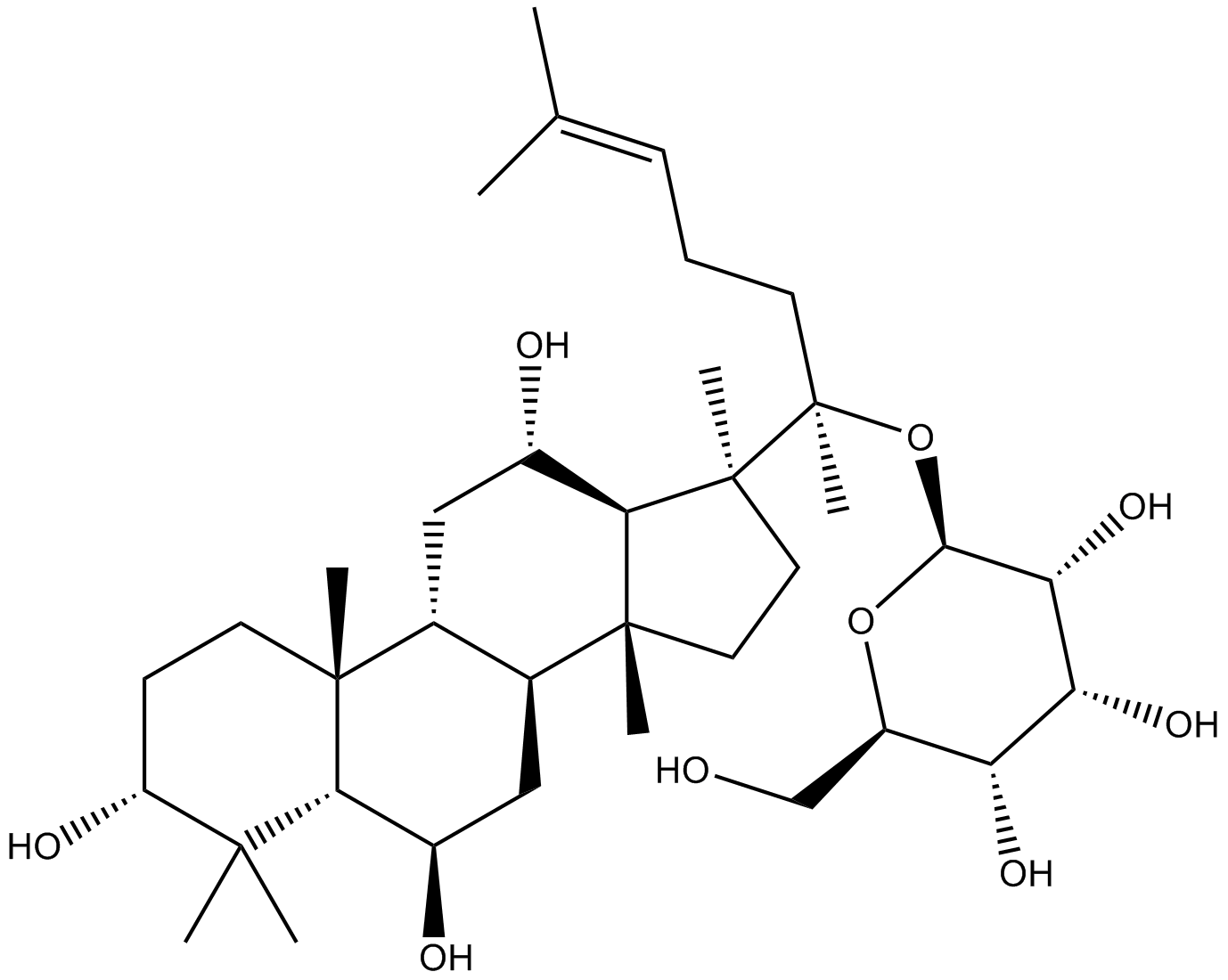
Cas No.: 53963-43-2
Sample solution is provided at 25 µL, 10mM.
منتجات GlpBio المذكورة في الأوراق ذات السمعة الطيبة
;)
,-1-7$$$37316672.jpg');)
;)
;)
$$$36806353.jpg');)
;33(7)%EF%BC%9A546-561$$$37156877.jpg');)
;)
;)
;)
%201124-1138.$$$35908550.jpg');)
%20766-780.$$$37100057.jpg');)
%20418-432.$$$36893736.jpg');)
%EF%BC%9A-240-255.$$$35108512.jpg');)
533-545$$$36543525.jpg');)
%201-13.$$$36600053.jpg');)
;)
Product Documents
Quality Control & SDS
- View current batch:
- Purity: >98.00%
- COA (Certificate Of Analysis)
- SDS (Safety Data Sheet)
- Datasheet
| Cas No. | 53963-43-2 | SDF | |
| المرادفات | GF1, Panaxoside A Progenin | ||
| Chemical Name | (2R,3S,4R,5R,6S)-2-(hydroxymethyl)-6-[(2R)-6-methyl-2-[(6R,10R,12S,13R,14R,17S)-3,6,12-trihydroxy-4,4,10,14,17-pentamethyl-2,3,5,6,7,8,9,11,12,13,15,16-dodecahydro-1H-cyclopenta[a]phenanthren-17-yl]hept-5-en-2-yl]oxyoxane-3,4,5-triol | ||
| Canonical SMILES | CC(=CCCC(C)(C1(CCC2(C1C(CC3C2CC(C4C3(CCC(C4(C)C)O)C)O)O)C)C)OC5C(C(C(C(O5)CO)O)O)O)C | ||
| Formula | C36H62O9 | M.Wt | 638.87 |
| الذوبان | ≥ 31.95mg/mL in DMSO with ultrasonic | Storage | Store at 2-8°C,protect from light |
| General tips | Please select the appropriate solvent to prepare the stock solution according to the
solubility of the product in different solvents; once the solution is prepared, please store it in
separate packages to avoid product failure caused by repeated freezing and thawing.Storage method
and period of the stock solution: When stored at -80°C, please use it within 6 months; when stored
at -20°C, please use it within 1 month. To increase solubility, heat the tube to 37°C and then oscillate in an ultrasonic bath for some time. |
||
| Shipping Condition | Evaluation sample solution: shipped with blue ice. All other sizes available: with RT, or with Blue Ice upon request. | ||
Complete Stock Solution Preparation Table
| Prepare stock solution | |||

|
1 mg | 5 mg | 10 mg |
| 1 mM | 1.5653 mL | 7.8263 mL | 15.6526 mL |
| 5 mM | 0.3131 mL | 1.5653 mL | 3.1305 mL |
| 10 mM | 0.1565 mL | 0.7826 mL | 1.5653 mL |
In vivo Formulation Calculator (Clear solution)
Step 1: Enter information below (Recommended: An additional animal making an allowance for loss during the experiment)
 g
μL
g
μL
Step 2: Enter the in vivo formulation (This is only the calculator, not formulation. Please contact us first if there is no in vivo formulation at the solubility Section.)
Calculation results:
Working concentration: mg/ml;
Method for preparing DMSO master liquid: mg drug pre-dissolved in μL DMSO ( Master liquid concentration mg/mL, Please contact us first if the concentration exceeds the DMSO solubility of the batch of drug. )
Method for preparing in vivo formulation: Take μL DMSO master liquid, next addμL PEG300, mix and clarify, next addμL Tween 80, mix and clarify, next add μL ddH2O, mix and clarify.
Method for preparing in vivo formulation: Take μL DMSO master liquid, next add μL Corn oil, mix and clarify.
Note: 1. Please make sure the liquid is clear before adding the next solvent.
2. Be sure to add the solvent(s) in order. You must ensure that the solution obtained, in the previous addition, is a clear solution before proceeding to add the next solvent. Physical methods such as vortex, ultrasound or hot water bath can be used to aid dissolving.
3. All of the above co-solvents are available for purchase on the GlpBio website.
Related Products
- GC11929 Melperone hydrochloride
- GC45227 β-CGRP (human) (trifluoroacetate salt)
- GC42491 5-bromo-2-chloro-4-Methoxypyrimidine
- GC48031 RCS-4 N-(4-hydroxypentyl) metabolite-d5
- GC42103 25H-NBOMe (hydrochloride)
- GC35833 Dehydroeburicoic acid monoacetate
- GC45088 Trimethoprim-PEG-amine (trifluoroacetate salt)
- GC61171 Pentosan Polysulfate Sodium (W/W 43%)
- GC40635 δ2-Avermectin B1a
- GC40397 9(E),11(E)-Conjugated Linoleic Acid
- GC32276 Ftaxilide
- GC13367 KT195
- GC40912 Glycohyocholic Acid
- GC11791 Lagosin
- GC30211 2,2':5',2''-Terthiophene (α-Terthiophene)
- GC39038 Medicagol
مراجعات
Average Rating: 5 ★★★★★ (Based on Reviews and 30 reference(s) in Google Scholar.)
GLPBIO products are for RESEARCH USE ONLY. Please make sure your review or question is research based.
Required fields are marked with *