

HSP990 (NVP-HSP990) (Synonyms: NVP-HSP990) |
رقم الكتالوجGC11973
 One-Click Copy Product Info
|

HSP990 (NVP-HSP990) هو مثبط قوي وانتقائي Hsp90 ، مع قيم IC50 0.6 و 0.8 و 8.5 نانومتر لـ Hsp90α ؛ ، Hsp90β ؛ ، و Grp94 ، على التوالي.
Products are for research use only. Not for human use. We do not sell to patients.
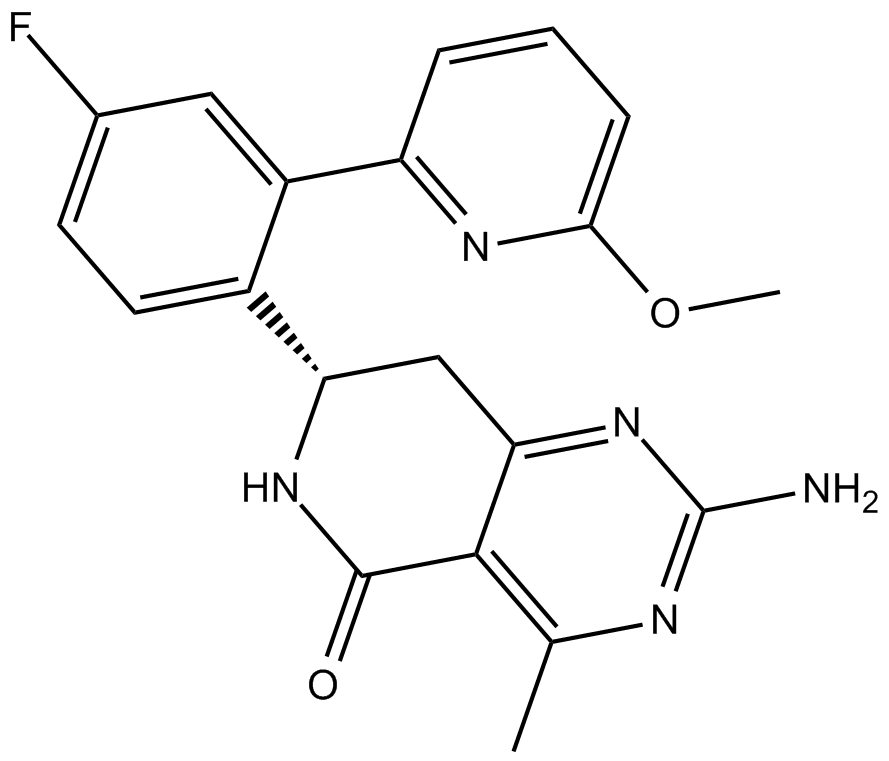
Cas No.: 934343-74-5
Sample solution is provided at 25 µL, 10mM.
_1-3.$$$39978408@51.jpg');)
_1-9.$$$38538795@65.jpg');)
_1-9.$$$39112701@51.jpg');)
_1-7.$$$37316672@70.jpg');)
_366-372.$$$36198801@70.jpg');)
.$$$38565142@65.jpg');)
_1867-1883.$$$33248023@67.jpg');)
_eads6055.$$$39977546@45.jpg');)
_eadm9805.$$$40080571@45.jpg');)
_eadj3020.$$$39666821@45.jpg');)
_1-20.$$$39757301@28.jpg');)
_1-24.$$$38898113@28.jpg');)
_273-287.$$$36806353@46.jpg');)
_1-16.$$$37156877@44.jpg');)
_1-19.$$$37460805@44.jpg');)
_1291-1307.$$$34518654@46.jpg');)
HSP990 (NVP-HSP990) is a potent and selective inhibitor of HSP90 with IC50 values of 0.6, 0.8 and 8.5 nM for Hsp90α, Hsp90β and Grp94, respectively [1].
Heat shock protein 90 (HSP90) is a chaperone protein that stabilizes proteins against heat stress, assists proteins to fold properly and aids in protein degradation. Also, HSP90 stabilizes proteins required for tumor growth.
HSP990 (NVP-HSP990) is a potent and selective HSP90 inhibitor. NVP-HSP990 bound to the N-terminal ATP-binding domain of Hsp90. NVP-HSP990 inhibited TRAP1 ATPase activity by 90% with IC50 value of 320 nM. In GTL-16 cells, NVP-HSP990 destabilized the Hsp90-p23 complex in a concentration- and time-dependent way. Also, NVP-HSP990 decreased c-Met with EC50 value of 37 nM and induced Hsp70 with EC50 value of 20 nM. NVP-HSP990 inhibited ERK and AKT phosphorylation with EC50 values of 11 and 6 nM respectively and thus inhibited ERK and AKT activation. In five human tumor cell lines, NVP-HSP990 inhibited cell growth with GI50 values of 4-40 nM [1]. In glioma tumor-initiating cells, NVP-HSP990 inhibited cell growth with IC50 value of 10-500 nM in a dose-dependent way and reduced CDK2 and CDK4, thus disrupting cell-cycle control [2].
In the GTL-16 gastric cancer mice model, NVP-HSP990 exhibited antitumor efficacy [1].
References:
[1]. Menezes DL, Taverna P, Jensen MR, et al. The novel oral Hsp90 inhibitor NVP-HSP990 exhibits potent and broad-spectrum antitumor activities in vitro and in vivo. Mol Cancer Ther, 2012, 11(3): 730-739.
[2]. Fu J, Koul D, Yao J, et al. Novel HSP90 inhibitor NVP-HSP990 targets cell-cycle regulators to ablate Olig2-positive glioma tumor-initiating cells. Cancer Res, 2013, 73(10): 3062-3074.
|
Kinase experiment: |
His-tagged Hsp90α N-terminal domain protein (N-Hsp90α-His) is diluted to 2× the final concentration in the assay buffer consisting of 50 mM Hepes, pH 7, 6 mM MgCl2, 20 mM KCl and 0.1% BSA. The Hsp90 is dispensed into 96 well polypropylene plates at 50 µL per well. In a separate polypropylene plate, test compounds (NVP-HSP990) are diluted to 40× their final concentration in 100% DMSO. Serial dilutions in DMSO are made in 3-fold increments. 2.5 µL of diluted compounds are transferred to the 50 µL of Hsp90 and mixed. Background wells receive 25 µM (final concentration) radicicol. Biotin-radicicol is diluted into assay buffer at 2× the final concentration and 50 µL are added to the Hsp90/compound plate. DMSO is at a final concentration of 2.5%. Samples are incubated at room temperature for 2 hours before 50 µL are transferred to NeutrAvidin-coated plates. Plates are incubated 1 hour, washed 3× with DELFIA wash buffer (5 mM Tris, pH 7.5, 0.1% Tween 20, 0.1% sodium azide, 0.9% NaCl), and then 50 µL per well of 3 nM Eu-anti-His diluted into DELFIA assay buffer are added. The plates are next incubated 2 hours at room temperature, washed 4×, and then 50 µL enhancement solution are added. Plates are gently shaken for 7-10 minutes before reading in a VICTOR2 instrument[2]. |
|
Cell experiment: |
GTL-16 Cells (1 × 10³) are plated into 96 well tissue culture plates and cultured at 37°C, 5% CO2. Serially diluted compounds (NVP-HSP990) are added to the cells and are incubated for 72 hrs. at 37°C, 5% CO2. Cell proliferation is determined using Cell Viability assay[2]. |
|
Animal experiment: |
Human tumor xenograft models GTL-16, NCI-H1975, BT474, and MV4;11 are implanted subcutaneously with 50% Matrigel in nude or severe combined immunodeficient mice. Mice are randomized into cohorts (10 mice/group for efficacy) when tumors reach 200 to 500 mm3. NVP-HSP990 is administered orally in a vehicle of 100% polyethylene glycol (PEG400). Tumor caliper measurements are converted into tumor volumes using the formula: [length × (width)2]/2. Relative tumor inhibition is calculated as %T/C = 100 × dT/dC, where, dT or dC = difference of mean tumor volume of drug treatment (T) or vehicle (C) on the final day of the study and the randomization volume. Statistical comparisons are conducted using a one-way ANOVA, followed by the Dunn or Tukey post hoc test. Differences are statistically significant at P < 0.05[1]. |
|
References: [1]. Menezes DL, et al. The novel oral Hsp90 inhibitor NVP-HSP990 exhibits potent and broad-spectrum antitumor activities in vitro and in vivo. Mol Cancer Ther. 2012 Mar;11(3):730-9. |
|
| Cas No. | 934343-74-5 | SDF | |
| المرادفات | NVP-HSP990 | ||
| Chemical Name | (7R)-2-amino-7-[4-fluoro-2-(6-methoxypyridin-2-yl)phenyl]-4-methyl-7,8-dihydro-6H-pyrido[4,3-d]pyrimidin-5-one | ||
| Canonical SMILES | CC1=NC(=NC2=C1C(=O)NC(C2)C3=C(C=C(C=C3)F)C4=NC(=CC=C4)OC)N | ||
| Formula | C20H18FN5O2 | M.Wt | 379.39 |
| الذوبان | ≥ 12.3mg/mL in DMSO | Storage | Store at -20°C |
| General tips | Please select the appropriate solvent to prepare the stock solution according to the
solubility of the product in different solvents; once the solution is prepared, please store it in
separate packages to avoid product failure caused by repeated freezing and thawing.Storage method
and period of the stock solution: When stored at -80°C, please use it within 6 months; when stored
at -20°C, please use it within 1 month. To increase solubility, heat the tube to 37°C and then oscillate in an ultrasonic bath for some time. |
||
| Shipping Condition | Evaluation sample solution: shipped with blue ice. All other sizes available: with RT, or with Blue Ice upon request. | ||
| Prepare stock solution | |||

|
1 mg | 5 mg | 10 mg |
| 1 mM | 2.6358 mL | 13.1791 mL | 26.3581 mL |
| 5 mM | 527.2 μL | 2.6358 mL | 5.2716 mL |
| 10 mM | 263.6 μL | 1.3179 mL | 2.6358 mL |
Step 1: Enter information below (Recommended: An additional animal making an allowance for loss during the experiment)
 g
μL
g
μL
Step 2: Enter the in vivo formulation (This is only the calculator, not formulation. Please contact us first if there is no in vivo formulation at the solubility Section.)
Calculation results:
Working concentration: mg/ml;
Method for preparing DMSO master liquid: mg drug pre-dissolved in μL DMSO ( Master liquid concentration mg/mL, Please contact us first if the concentration exceeds the DMSO solubility of the batch of drug. )
Method for preparing in vivo formulation: Take μL DMSO master liquid, next addμL PEG300, mix and clarify, next addμL Tween 80, mix and clarify, next add μL saline, mix and clarify.
Method for preparing in vivo formulation: Take μL DMSO master liquid, next add μL Corn oil, mix and clarify.
Note: 1. Please make sure the liquid is clear before adding the next solvent.
2. Be sure to add the solvent(s) in order. You must ensure that the solution obtained, in the previous addition, is a clear solution before proceeding to add the next solvent. Physical methods such as vortex, ultrasound or hot water bath can be used to aid dissolving.
3. All of the above co-solvents are available for purchase on the GlpBio website.
Quality Control & SDS
- View current batch:
- Purity: >98.00% Appearance: A solid
- COA (Certificate of Analysis)
- SDS (Safety Data Sheet)
- Datasheet
Average Rating: 5 (Based on Reviews and 33 reference(s) in Google Scholar.)