

MPP dihydrochloride |
رقم الكتالوجGC11881
 One-Click Copy Product Info
|

مضاد صامت لمستقبلات ERα
Products are for research use only. Not for human use. We do not sell to patients.
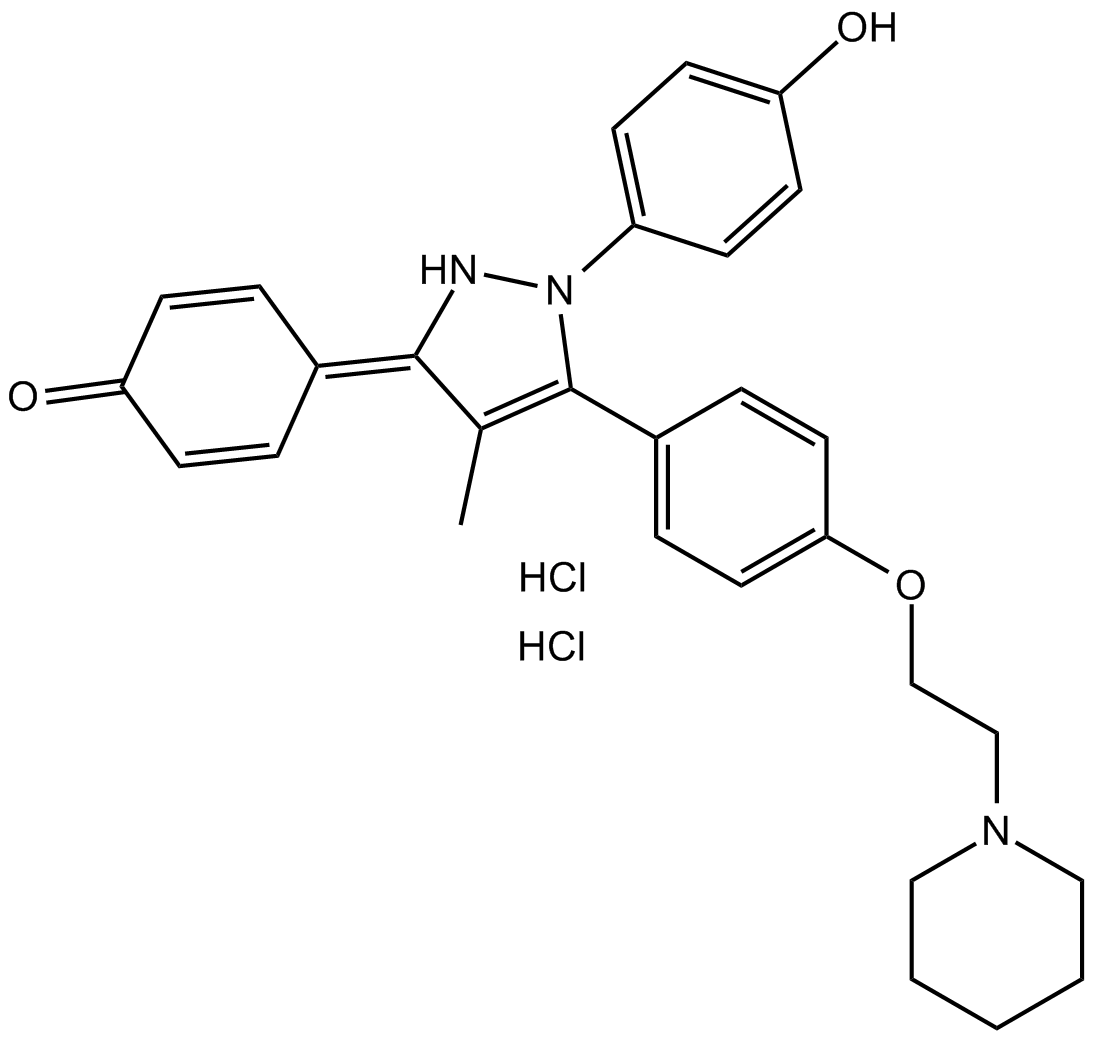
Cas No.: 911295-24-4
Sample solution is provided at 25 µL, 10mM.
MPP dihydrochloride is a selective estrogen receptor α (ERα) antagonist [1]. MPP dihydrochloride blocks estrogen signaling, thereby inducing cell apoptosis [2]. MPP dihydrochloride is used to treat cancer [3].
In MCF-7 cells, MPP dihydrochloride (5μM, 15μM, 20μM; 1h) treatment dose-dependently enhanced silibinin-induced growth inhibition of cells [4]. In SKOV3 cells, MPP dihydrochloride (20μM; 24h) treatment significantly increased the number of cells [5]. In SKOV3 and OV2008 Cells, MPP dihydrochloride (10pM, 100pM, 1000pM; 24h) treatment significantly inhibited cell growth in both cell lines [6]. In ectopic endometrial stromal cells (eESCs), MPP dihydrochloride (2.7nM; 48h) treatment increases the autophagy level in eESCs [7].
In SKOV3 cell subcutaneous tumor mice model, MPP dihydrochloride (1mg/kg; ip; 35d) treatments reduce in vivo tumor cell growth in mice [6]. In SERT+ mice, MPP dihydrochloride (2mg/kg; sc; 14d) attenuates the development of pulmonary hypertension (PH) in normoxic and hypoxic female SERT+ mice [8]. In C57/BL6 mice, MPP dihydrochloride (200μg/kg; ip; 7d) treatment significantly reduced the expression of rictor, p-AKT(Ser473)/AKT, p-cofilin (Ser3), and profilin-1 [9].
References:
[1]. Tskitishvili E, Pequeux C, Munaut C, et al. Estrogen receptors and estetrol-dependent neuroprotective actions: a pilot study. The Journal of Endocrinology. 2016 Nov 17; 232(1): 85.
[2]. Liu X, Fan XL, Zhao Y, et al. Estrogen provides neuroprotection against activated microglia‐induced dopaminergic neuronal injury through both estrogen receptor‐α and estrogen receptor‐β in microglia. Journal of neuroscience research. 2005 Sep 1; 81(5): 653-665.
[3]. Karaboğa Arslan AK, Yerer MB. α-Chaconine and α-Solanine inhibit RL95-2 endometrium cancer cell proliferation by reducing expression of Akt (Ser473) and ERα (Ser167). Nutrients. 2018 May 25; 10(6): 672.
[4]. Zheng N, Zhang P, Huang H, et al. ERα down-regulation plays a key role in silibinin-induced autophagy and apoptosis in human breast cancer MCF-7 cells. Journal of pharmacological sciences. 2015 Jul 1; 128(3): 97-107.
[5]. Yan Y, Jiang X, Zhao Y, et al. Role of GPER on proliferation, migration and invasion in ligand‐independent manner in human ovarian cancer cell line SKOV3. Cell biochemistry and function. 2015 Dec; 33(8): 552-559.
[6]. Chan KK, Leung TH, Chan DW, et al. Targeting estrogen receptor subtypes (ERa and ERb) with selective ER modulators in ovarian cancer. J. Endocrinol. 2014; 221: 325-336.
[7]. Zhang B, Zhou WJ, Gu CJ, et al. The ginsenoside PPD exerts anti-endometriosis effects by suppressing estrogen receptor-mediated inhibition of endometrial stromal cell autophagy and NK cell cytotoxicity. Cell death & disease. 2018 May 14; 9(5): 574.
[8]. Wright AF, Ewart MA, Mair K, et al. Oestrogen receptor alpha in pulmonary hypertension. Cardiovascular research. 2015 May 1; 106(2): 206-216.
[9]. Xing FZ, Zhao YG, Zhang YY, et al. Nuclear and membrane estrogen receptor antagonists induce similar mTORC 2 activation‐reversible changes in synaptic protein expression and actin polymerization in the mouse hippocampus. CNS neuroscience & therapeutics. 2018 Jun; 24(6): 495-507.
| Cell experiment [1]: | |
Cell lines | MCF-7 cells |
Preparation Method | MCF-7 cells were seeded into 96-well cell culture plates at a density of 5 × 10³cells/well and cultured for 24h. Cells were cultured for 24h and then incubated with different concentrations of MPP (a specific ERα antagonist MPP dihydrochloride) for 1h, and then silibinin 200μM was added and cultured for 24h. The cells were rinsed twice with ice-cold PBS and incubated with 100μL of 0.5mg/mL MTT solution at 37℃ for 3h. |
Reaction Conditions | 5μM, 15μM, 20μM; 1h |
Applications | MPP dihydrochloride treatment dose-dependently enhanced silibinin-induced growth inhibition of MCF-7 cells. |
| Animal experiment [2]: | |
Animal models | SKOV3 cell subcutaneous tumor mice model |
Preparation Method | A group of 4-week-old female BALB/c nude mice were anesthetized and bilaterally ovariectomized. SKOV3 cells were harvested and resuspended in matrix gel. Cells (5×10⁶) were inoculated s.c. into the right flank of the ovariectomized mice. Mice bearing xenografts of around 5mm diameter were divided randomly into three groups of five mice each. Each group was treated with a vehicle solution, DPN (1mg/kg per day) or MPP dihydrochloride (1mg/kg per day), by an i.p. injection every day. |
Dosage form | 1mg/kg; ip; 35d |
Applications | MPP dihydrochloride treatments reduce in vivo tumor cell growth in mice. |
References: | |
| Cas No. | 911295-24-4 | SDF | |
| Chemical Name | 4-(1-(4-hydroxyphenyl)-4-methyl-5-(4-(2-(piperidin-1-yl)ethoxy)phenyl)-1H-pyrazol-3(2H)-ylidene)cyclohexa-2,5-dienone dihydrochloride | ||
| Canonical SMILES | OC1=CC=C(C=C1)N(C(C(C=C2)=CC=C2OCCN3CCCCC3)=C/4C)NC4=C(C=C5)\C=CC5=O.Cl.Cl | ||
| Formula | C29H31N3O3.2HCl | M.Wt | 542.5 |
| الذوبان | <54.25mg/ml in DMSO | Storage | Store at -20°C |
| General tips | Please select the appropriate solvent to prepare the stock solution according to the
solubility of the product in different solvents; once the solution is prepared, please store it in
separate packages to avoid product failure caused by repeated freezing and thawing.Storage method
and period of the stock solution: When stored at -80°C, please use it within 6 months; when stored
at -20°C, please use it within 1 month. To increase solubility, heat the tube to 37°C and then oscillate in an ultrasonic bath for some time. |
||
| Shipping Condition | Evaluation sample solution: shipped with blue ice. All other sizes available: with RT, or with Blue Ice upon request. | ||
| Prepare stock solution | |||

|
1 mg | 5 mg | 10 mg |
| 1 mM | 1.8433 mL | 9.2166 mL | 18.4332 mL |
| 5 mM | 368.7 μL | 1.8433 mL | 3.6866 mL |
| 10 mM | 184.3 μL | 921.7 μL | 1.8433 mL |
Step 1: Enter information below (Recommended: An additional animal making an allowance for loss during the experiment)
 g
μL
g
μL
Step 2: Enter the in vivo formulation (This is only the calculator, not formulation. Please contact us first if there is no in vivo formulation at the solubility Section.)
Calculation results:
Working concentration: mg/ml;
Method for preparing DMSO master liquid: mg drug pre-dissolved in μL DMSO ( Master liquid concentration mg/mL, Please contact us first if the concentration exceeds the DMSO solubility of the batch of drug. )
Method for preparing in vivo formulation: Take μL DMSO master liquid, next addμL PEG300, mix and clarify, next addμL Tween 80, mix and clarify, next add μL saline, mix and clarify.
Method for preparing in vivo formulation: Take μL DMSO master liquid, next add μL Corn oil, mix and clarify.
Note: 1. Please make sure the liquid is clear before adding the next solvent.
2. Be sure to add the solvent(s) in order. You must ensure that the solution obtained, in the previous addition, is a clear solution before proceeding to add the next solvent. Physical methods such as vortex, ultrasound or hot water bath can be used to aid dissolving.
3. All of the above co-solvents are available for purchase on the GlpBio website.
Quality Control & SDS
- View current batch:
- Purity: >98.00% Appearance: A solid
- COA (Certificate of Analysis)
- SDS (Safety Data Sheet)
- Datasheet
Average Rating: 5 (Based on Reviews and 4 reference(s) in Google Scholar.)