

MPP dihydrochloride |
Catalog No.GC11881
 One-Click Copy Product Info
|

MPP dihydrochloride es un antagonista selectiva receptor α (ERα).
Products are for research use only. Not for human use. We do not sell to patients.
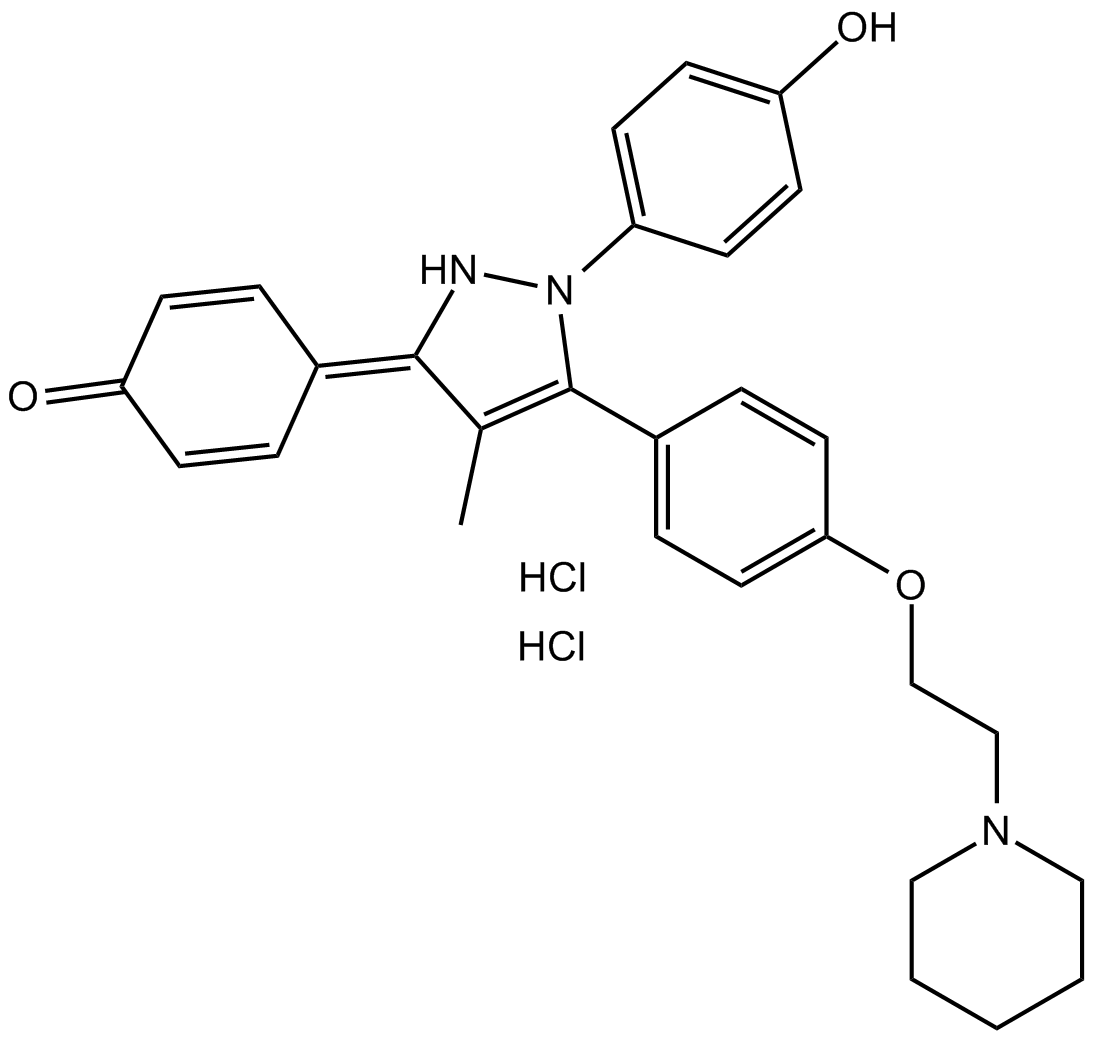
Cas No.: 911295-24-4
Sample solution is provided at 25 µL, 10mM.
MPP dihydrochloride es un antagonista selectiva receptor α (ERα)[1]. MPP dihydrochloride bloquea una señalización del estrógeno, por eso induciendo así la apoptosis célulares [2]. MPP dihydrochloride se utliza para tratar el cáncer [3].
En lascelulares MCF-7 , MPP dihydrochloride (5μM, 15μM, 20μM; 1h) tratamiento aumentó la inhibición del crecimiento de las célulares inducida por la silibinina dependiente de la dosis [4]. En las célulares SKOV3, el tratamiento de MPP dihydrocorihlde (20μM; 24h) aumentó significativamente el número de célulares. [5]. En las célulares SKOV3 y OV2008, el tratamiento de MPP dihydrocorihlde (10pM, 100pM, 1000pM; 24h) significativamente el crecimiento célulares en ambas líneas célulares [6]. En las célulares estroma endometrial ectópico (eESCs), el tratamiento de MPP dihydrochloride (2.7nM; 48h) aumenta el nivel de autofagia en los eESCs [7].
In SKOV3 cell subcutaneous tumor mice model, MPP dihydrochloride (1mg/kg; ip; 35d) treatments reduce in vivo tumor cell growth in mice [6]. En el modelo de ratones tumorales subcutáneo de célulares SKOV3, el tratamiento de MPP dihydrochloride (1mg/kg; ip; 35d) reducen el crecimiento de célulares tumorales in vivo en ratones [6]. En ratones SERT+ , MPP dihydrochloride (2mg/kg; sc; 14d) atenúa el desarrollo de la hipertensión pulmonar (PH) en ratones SERT+ hembra normóxicas e hipóxicas [8]. En ratones C57/BL6, el tratamiento MPP dihydrochloride (200μg/kg; ip; 7d) redujo significativamente la expresión de rictor, p-AKT(Ser473)/AKT, p-cofilin (Ser3), y profilin-1 [9].
References:
[1]. Tskitishvili E, Pequeux C, Munaut C, et al. Estrogen receptors and estetrol-dependent neuroprotective actions: a pilot study. The Journal of Endocrinology. 2016 Nov 17; 232(1): 85.
[2]. Liu X, Fan XL, Zhao Y, et al. Estrogen provides neuroprotection against activated microglia‐induced dopaminergic neuronal injury through both estrogen receptor‐α and estrogen receptor‐β in microglia. Journal of neuroscience research. 2005 Sep 1; 81(5): 653-665.
[3]. Karaboğa Arslan AK, Yerer MB. α-Chaconine and α-Solanine inhibit RL95-2 endometrium cancer cell proliferation by reducing expression of Akt (Ser473) and ERα (Ser167). Nutrients. 2018 May 25; 10(6): 672.
[4]. Zheng N, Zhang P, Huang H, et al. ERα down-regulation plays a key role in silibinin-induced autophagy and apoptosis in human breast cancer MCF-7 cells. Journal of pharmacological sciences. 2015 Jul 1; 128(3): 97-107.
[5]. Yan Y, Jiang X, Zhao Y, et al. Role of GPER on proliferation, migration and invasion in ligand‐independent manner in human ovarian cancer cell line SKOV3. Cell biochemistry and function. 2015 Dec; 33(8): 552-559.
[6]. Chan KK, Leung TH, Chan DW, et al. Targeting estrogen receptor subtypes (ERa and ERb) with selective ER modulators in ovarian cancer. J. Endocrinol. 2014; 221: 325-336.
[7]. Zhang B, Zhou WJ, Gu CJ, et al. The ginsenoside PPD exerts anti-endometriosis effects by suppressing estrogen receptor-mediated inhibition of endometrial stromal cell autophagy and NK cell cytotoxicity. Cell death & disease. 2018 May 14; 9(5): 574.
[8]. Wright AF, Ewart MA, Mair K, et al. Oestrogen receptor alpha in pulmonary hypertension. Cardiovascular research. 2015 May 1; 106(2): 206-216.
[9]. Xing FZ, Zhao YG, Zhang YY, et al. Nuclear and membrane estrogen receptor antagonists induce similar mTORC 2 activation‐reversible changes in synaptic protein expression and actin polymerization in the mouse hippocampus. CNS neuroscience & therapeutics. 2018 Jun; 24(6): 495-507.
| Experimentos celulares [1]: | |
Líneas celulares | MCF-7 célulares |
Método de preparación | Las MCF-7 célulares se sembraron en placas de cultivo célular de 96 hoyos a una de 5 × 10³ célulares/hoyos y se cultivaron durante 24 horas.Célulares se cultivaron durante 24 horas y luego cultivaron con diversos concentraciones de MPP (una especial ERα antagonista MPP dihydrochloride) durante 1 hora, y luego silibinina 200μM se agregado y se cultivaron durante 24 horas. Las célulares se enjuagaron dos veces con helado PBS y incubado con 100μL de 0.5mg/mL MTT de solución a 37℃ durante 3 horas. |
Condiciones de reacción | 5μM, 15μM, 20μM; 1h |
Áreas de aplicación | El tratamiento de MPP dihydrochloride mejoró la inhibición del crecimiento inducida por la silibinina de las MCF-7 célulares dependiente de la dosis. |
| Experimentos con animales [2]: | |
Modelos animales | Modelo de ratones con tumor subcutáneo de célulares SKOV3 |
Método de preparación | Un grupo de ratones desnudos BALB/c hembra de 4 semanas de edad fueron anestesiaban y se les practicaba una ovariectomía bilateral. Las células SKOV3 se recolectaron y resusoenderon en gel de matriz. Las célulares (5×10⁶) se inoculadas s.c. en el flanco derecho de las ratones ovariectomizados . Los ratones que llevaban xenoinjertos de alrededor de 5mm de diámetro aleatoriamente en tres grupos de cinco ratones cada uno.Cada grupo fue tratado con una solución para vehículos, DPN (1mg/kg por día) o MPP dihydrochloride (1mg/kg por día), |
Forma de dosificación | 1mg/kg; ip; 35d |
Áreas de aplicación | Los tratamientos de MPP dihydrochloride reducen el crecimiento de célulares tumorales vido en ratones. |
References: | |
| Cas No. | 911295-24-4 | SDF | |
| Chemical Name | 4-(1-(4-hydroxyphenyl)-4-methyl-5-(4-(2-(piperidin-1-yl)ethoxy)phenyl)-1H-pyrazol-3(2H)-ylidene)cyclohexa-2,5-dienone dihydrochloride | ||
| Canonical SMILES | OC1=CC=C(C=C1)N(C(C(C=C2)=CC=C2OCCN3CCCCC3)=C/4C)NC4=C(C=C5)\C=CC5=O.Cl.Cl | ||
| Formula | C29H31N3O3.2HCl | M.Wt | 542.5 |
| Solubility | <54.25mg/ml in DMSO | Storage | Store at -20°C |
| General tips | Please select the appropriate solvent to prepare the stock solution according to the
solubility of the product in different solvents; once the solution is prepared, please store it in
separate packages to avoid product failure caused by repeated freezing and thawing.Storage method
and period of the stock solution: When stored at -80°C, please use it within 6 months; when stored
at -20°C, please use it within 1 month. To increase solubility, heat the tube to 37°C and then oscillate in an ultrasonic bath for some time. |
||
| Shipping Condition | Evaluation sample solution: shipped with blue ice. All other sizes available: with RT, or with Blue Ice upon request. | ||
| Prepare stock solution | |||

|
1 mg | 5 mg | 10 mg |
| 1 mM | 1.8433 mL | 9.2166 mL | 18.4332 mL |
| 5 mM | 368.7 μL | 1.8433 mL | 3.6866 mL |
| 10 mM | 184.3 μL | 921.7 μL | 1.8433 mL |
Step 1: Enter information below (Recommended: An additional animal making an allowance for loss during the experiment)
 g
μL
g
μL
Step 2: Enter the in vivo formulation (This is only the calculator, not formulation. Please contact us first if there is no in vivo formulation at the solubility Section.)
Calculation results:
Working concentration: mg/ml;
Method for preparing DMSO master liquid: mg drug pre-dissolved in μL DMSO ( Master liquid concentration mg/mL, Please contact us first if the concentration exceeds the DMSO solubility of the batch of drug. )
Method for preparing in vivo formulation: Take μL DMSO master liquid, next addμL PEG300, mix and clarify, next addμL Tween 80, mix and clarify, next add μL saline, mix and clarify.
Method for preparing in vivo formulation: Take μL DMSO master liquid, next add μL Corn oil, mix and clarify.
Note: 1. Please make sure the liquid is clear before adding the next solvent.
2. Be sure to add the solvent(s) in order. You must ensure that the solution obtained, in the previous addition, is a clear solution before proceeding to add the next solvent. Physical methods such as vortex, ultrasound or hot water bath can be used to aid dissolving.
3. All of the above co-solvents are available for purchase on the GlpBio website.
Quality Control & SDS
- View current batch:
- Purity: >98.00% Appearance: A solid
- COA (Certificate of Analysis)
- SDS (Safety Data Sheet)
- Datasheet
Average Rating: 5 (Based on Reviews and 4 reference(s) in Google Scholar.)