

NKH 477 (Synonyms: Adehl, Colforsin Dapropate, Colforsin Daropate) |
رقم الكتالوجGC12640
 One-Click Copy Product Info
|

ينشط NKH 477 (Colforsin dapropate hydrochloride) بشكل مباشر الوحدة التحفيزية في adenylate cyclase ويزيد من cAMP داخل الخلايا.
Products are for research use only. Not for human use. We do not sell to patients.
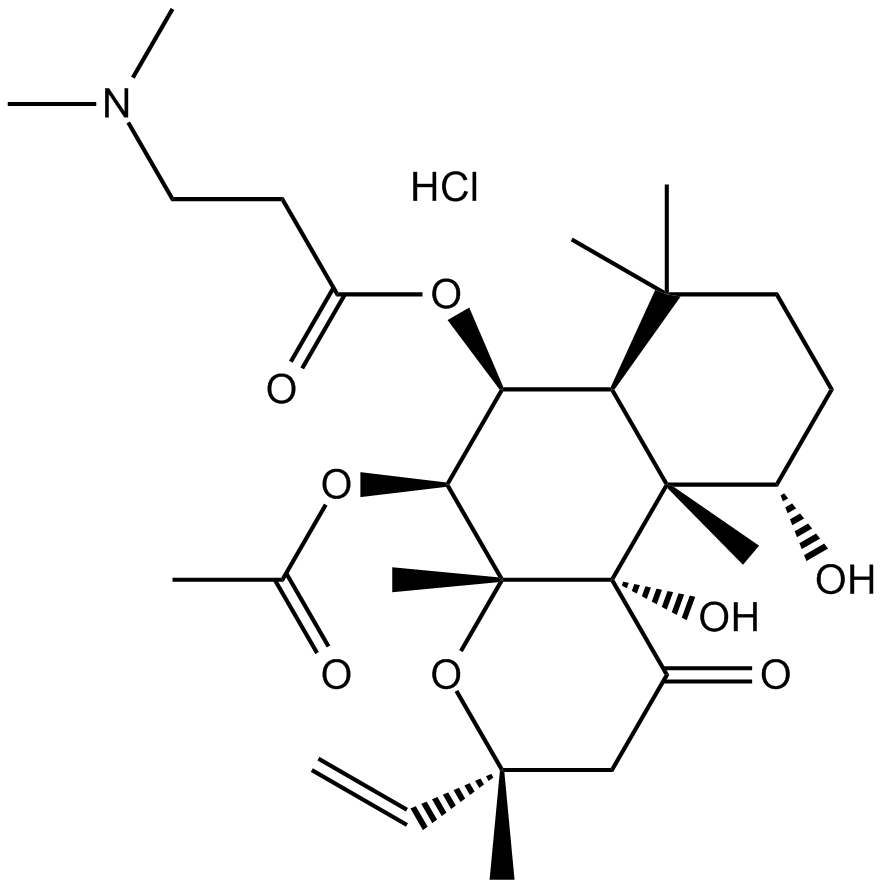
Cas No.: 138605-00-2
Sample solution is provided at 25 µL, 10mM.
_1-3.$$$39978408@51.jpg');)
_1-9.$$$38538795@65.jpg');)
_1-9.$$$39112701@51.jpg');)
_1-7.$$$37316672@70.jpg');)
_366-372.$$$36198801@70.jpg');)
.$$$38565142@65.jpg');)
_1867-1883.$$$33248023@67.jpg');)
_eads6055.$$$39977546@45.jpg');)
_eadm9805.$$$40080571@45.jpg');)
_eadj3020.$$$39666821@45.jpg');)
_1-20.$$$39757301@28.jpg');)
_1-24.$$$38898113@28.jpg');)
_273-287.$$$36806353@46.jpg');)
_1-16.$$$37156877@44.jpg');)
_1-19.$$$37460805@44.jpg');)
_1291-1307.$$$34518654@46.jpg');)
NKH 477 is a novel water-soluble forskolin derivative [1]. NKH 477 upregulates cAMP by activating adenylate cyclase, which is used to enhance myocardial contraction and dilate blood vessels [2]. NKH 477 is often used in the research and treatment of cardiovascular diseases such as heart failure [3-4].
In MCF7, HT29, A431, WiDr, RKO, A375, H630, Du145, SW480, and SW620 cells, NKH 477 (100μM; 48h) inhibits the proliferation of cancer cell lines [5]. In endothelial cells, NKH477 (0.1-1.0μM; 1h) increases cAMP in a concentration-dependent manner [2]. In CellSensorTM CRE-bla CHO-K1 cells, NKH 477 (30nM; 5h) induces CRE-conjugated β-lactamase activity in a concentration-dependent manner [6]. In endothelial cells, NKH477 (0.01-0.3μM; 1h) attenuated the phasic and the tonic increases in both [Ca2+]i and force induced by 10μM noradrenaline, in a concentration-dependent manner [7].
In specific pathogen-free Lewis rats and brown-norway rats, NKH 477 (1, 2, 3mg/kg; po; 10d) significantly prolonged allograft survival and reduced histopathological rejection in a dose-dependent manner [8]. In sprague-dawley rats, acute or chronic administration of NKH 477 (1.5mg/kg, ip, 9d) to rats significantly reduced their locomotion and upright behavior [9].
References:
[1]. Hosono M, Takahira T, Fujita A, et al. Cardiovascular and adenylate cyclase stimulant properties of NKH477, a novel water-soluble forskolin derivative. Journal of cardiovascular pharmacology. 1992 Apr 1; 19(4): 625-634.
[2]. Shafiq J, Suzuki S, Itoh T, Kuriyama H. Mechanisms of vasodilation induced by NKH477, a water-soluble forskolin derivative, in smooth muscle of the porcine coronary artery. Circulation research. 1992 Jul; 71(1): 70-81.
[3]. Fujita A, Takahira T, Hosono M, et al. Improvement of drug-induced cardiac failure by NKH477, a novel forskolin derivative, in the dog heart-lung preparation. The Japanese Journal of Pharmacology. 1992;58(4):375-381.
[4]. Hosoda S, Motomiya T, Katagiri T, et al. Acute Effect of NKH477, a Novel Forskolin Derivative, in Patients with Acute Heart Failure A Multicenter Placebo-Controlled Double-Blind Trial. Rinsho yakuri/Japanese Journal of Clinical Pharmacology and Therapeutics. 1997 Jun 30; 28(2): 583-602.
[5]. Faris Q. Alenzi, Mohamed L. Salem, Waleed G, et al. NKH477 inhibits proliferation and induces apoptosis in a panel of cancer cell lines. Journal of Personalized Medicine. 2010; 24(03): 182-187.
[6]. Xia M, Guo V, Huang R, et al. A cell-based β-lactamase reporter gene assay for the CREB signaling pathway. Current chemical genomics. 2009 Mar 17; 3: 7.
[7]. Ito S, Suzuki S, Itoh T. Effects of a water‐soluble forskolin derivative (NKH477) and a membrane‐permeable cyclic AMP analogue on noradrenaline‐induced Ca2+ mobilization in smooth muscle of rabbit mesenteric artery. British journal of pharmacology. 1993 Nov; 110(3): 1117-1125.
[8]. Nakashima S, Morikawa M, Komatsu K, et al. Antiproliferative effects of NKH477, a forskolin derivative, on cytokine profile in rat lung allografts. The Journal of heart and lung transplantation. 2005 Apr 1; 24(4): 462-469.
[9]. Kofman O, Bersudsky Y. Behavioural effects of NKH-477, a forskolin analogue, on locomotion and rearing in rats. International Journal of Neuropsychopharmacology. 2000 Mar 1; 3(1): 27-33.
| Cell experiment [1]: | |
|
Cell lines |
MCF7, HT29, A431, WiDr, RKO, A375, H630, Du145, SW480, and SW620 cells |
|
Preparation Method |
Cell culture media for the cell lines used in this study included: MCF7 (Fidler model cells); DMEM supplemented with 10% FBS and 1% L-glutamine for HT29, A431, WiDr, RKO, A375, H630, and Du145; and RPMI supplemented with 10% FBS and 1% L-glutamine for SW480 and SW620. All cells were routinely cultured in a humidified incubator at 37℃, 5% CO2, and subcultured before reaching confluence. Subculture of all adherent cells was performed by removing the culture medium, aspirating the monolayer, washing with PBS, and then washing with 10% trypsin/PE solution. After detachment, the cells were resuspended in the appropriate culture medium, counted, and transferred to tissue culture flasks or plates. Cells were typically treated with NKH 477 one day after plating. |
|
Reaction Conditions |
100μM; 48h |
|
Applications |
NKH 477 inhibits the proliferation of cancer cell lines. |
| Animal experiment [2]: | |
|
Animal models |
Specific pathogen-free (SPF) Lewis rats and Brown-Norway (BN) rats |
|
Preparation Method |
Specific pathogen-free (SPF) Lewis rats (LEW) were used as recipients, and Brown-Norway rats (BN) or Lewis rats were used as donors. The recipient rats weighed 250-280g, and the donor rats weighed 220-250g. The experimental animals were randomly divided into five groups: syngeneic transplant group (LEW to LEW), untreated allogeneic transplant group (BN to LEW), and allogeneic transplant group treated with NKH 477 (doses of 1, 2, and 3mg/kg, respectively). |
|
Dosage form |
1, 2, 3mg/kg; po; 10d |
|
Applications |
NKH 477 significantly prolonged allograft survival and reduced histopathological rejection in a dose-dependent manner. |
|
References: |
|
| Cas No. | 138605-00-2 | SDF | |
| المرادفات | Adehl, Colforsin Dapropate, Colforsin Daropate | ||
| Chemical Name | (3R,4aR,5S,6S,6aS,10S,10aR,10bS)-5-acetoxy-10,10b-dihydroxy-3,4a,7,7,10a-pentamethyl-1-oxo-3-vinyldodecahydro-1H-benzo[f]chromen-6-yl 3-(dimethylamino)propanoate hydrochloride | ||
| Canonical SMILES | O[C@]1([C@]([C@H]2OC(C)=O)(C)O[C@@](C)(C=C)CC1=O)[C@]3(C)[C@@H]([C@@H]2OC(CCN(C)C)=O)C(C)(C)CC[C@@H]3O.Cl | ||
| Formula | C27H43NO8.HCl | M.Wt | 546.1 |
| الذوبان | DMSO: ≥125 mg/mL;H2O : ≥ 20 mg/mL | Storage | Store at -20°C,unstable in solution, ready to use. |
| General tips | Please select the appropriate solvent to prepare the stock solution according to the
solubility of the product in different solvents; once the solution is prepared, please store it in
separate packages to avoid product failure caused by repeated freezing and thawing.Storage method
and period of the stock solution: When stored at -80°C, please use it within 6 months; when stored
at -20°C, please use it within 1 month. To increase solubility, heat the tube to 37°C and then oscillate in an ultrasonic bath for some time. |
||
| Shipping Condition | Evaluation sample solution: shipped with blue ice. All other sizes available: with RT, or with Blue Ice upon request. | ||
| Prepare stock solution | |||

|
1 mg | 5 mg | 10 mg |
| 1 mM | 1.8312 mL | 9.1558 mL | 18.3117 mL |
| 5 mM | 366.2 μL | 1.8312 mL | 3.6623 mL |
| 10 mM | 183.1 μL | 915.6 μL | 1.8312 mL |
Step 1: Enter information below (Recommended: An additional animal making an allowance for loss during the experiment)
 g
μL
g
μL
Step 2: Enter the in vivo formulation (This is only the calculator, not formulation. Please contact us first if there is no in vivo formulation at the solubility Section.)
Calculation results:
Working concentration: mg/ml;
Method for preparing DMSO master liquid: mg drug pre-dissolved in μL DMSO ( Master liquid concentration mg/mL, Please contact us first if the concentration exceeds the DMSO solubility of the batch of drug. )
Method for preparing in vivo formulation: Take μL DMSO master liquid, next addμL PEG300, mix and clarify, next addμL Tween 80, mix and clarify, next add μL saline, mix and clarify.
Method for preparing in vivo formulation: Take μL DMSO master liquid, next add μL Corn oil, mix and clarify.
Note: 1. Please make sure the liquid is clear before adding the next solvent.
2. Be sure to add the solvent(s) in order. You must ensure that the solution obtained, in the previous addition, is a clear solution before proceeding to add the next solvent. Physical methods such as vortex, ultrasound or hot water bath can be used to aid dissolving.
3. All of the above co-solvents are available for purchase on the GlpBio website.
Quality Control & SDS
- View current batch:
- Purity: >98.00% Appearance: A solid
- COA (Certificate of Analysis)
- SDS (Safety Data Sheet)
- Datasheet
Average Rating: 5 (Based on Reviews and 27 reference(s) in Google Scholar.)