

P1075 |
رقم الكتالوجGC16848
 One-Click Copy Product Info
|

P1075 هو منشط قوي لمستقبلات السلفونيل يوريا 2 المرتبطة بقنوات البوتاسيوم الحساسة لـ ATP (SUR2-KIR6) ، بقيمة EC50 تبلغ 45 نانومتر لتفعيل قناة SUR2B-KIR6.
Products are for research use only. Not for human use. We do not sell to patients.
Cas No.: 60559-98-0
Sample solution is provided at 25 µL, 10mM.
_1-3.$$$39978408@51.jpg');)
_1-9.$$$38538795@65.jpg');)
_1-9.$$$39112701@51.jpg');)
_1-7.$$$37316672@70.jpg');)
_366-372.$$$36198801@70.jpg');)
.$$$38565142@65.jpg');)
_1867-1883.$$$33248023@67.jpg');)
_eads6055.$$$39977546@45.jpg');)
_eadm9805.$$$40080571@45.jpg');)
_eadj3020.$$$39666821@45.jpg');)
_1-20.$$$39757301@28.jpg');)
_1-24.$$$38898113@28.jpg');)
_273-287.$$$36806353@46.jpg');)
_1-16.$$$37156877@44.jpg');)
_1-19.$$$37460805@44.jpg');)
_1291-1307.$$$34518654@46.jpg');)
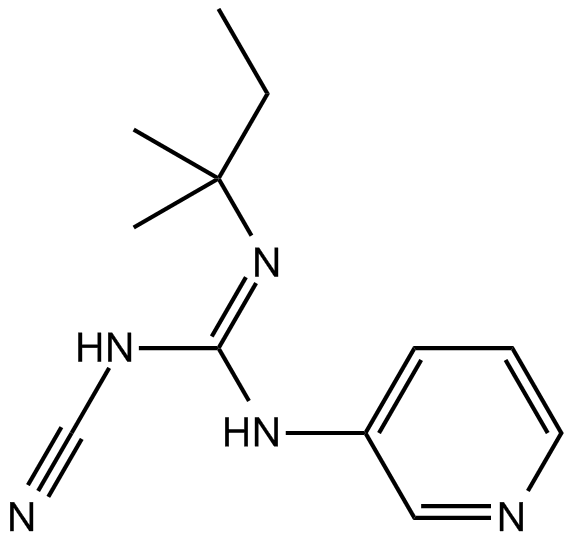
P1075 is a potent activator of sulfonylurea receptor 2-related ATP-sensitive potassium channel (SUR2-KIR6) with an EC50 value of 45±10nM[1]. P1075 is a cyanoguanidine derivative that can increase anterior segment outflow capacity and reduce intraocular pressure[2]. P1075 can induce dilation of rat renal arteries[3]. P1075 can relax smooth muscle and shorten cardiac action potential duration (APD) in the nanomolar concentration range[4].
In vitro, P1075 (100μM) treatment of rabbit cardiomyocytes for 10min significantly induced the generation of intracellular ROS[5]. P1075 (30μM) treatment of rabbit ventricular myocytes significantly inhibited diazoxide-induced flavoprotein oxidation[6].
In vivo, P1075 (1μg/kg) treated by intravenous injection in rats with cardiac ischemia/reperfusion model significantly reduced the infarct size[7].
References:
[1] Schwanstecher M, Sieverding C, Dörschner H, et al. Potassium channel openers require ATP to bind to and act through sulfonylurea receptors[J]. The EMBO journal, 1998.
[2] Chowdhury U R, Bahler C K, Hann C R, et al. ATP-sensitive potassium (KATP) channel activation decreases intraocular pressure in the anterior chamber of the eye[J]. Investigative ophthalmology & visual science, 2011, 52(9): 6435-6442.
[3] Novakovic A, Pavlovic M, Milojevic P, et al. Different potassium channels are involved in relaxation of rat renal artery induced by P 1075[J]. Basic & clinical pharmacology & toxicology, 2012, 111(1): 24-30.
[4] Sargent C A, Sleph P G, Dzwonczyk S, et al. Cardioprotective effects of the cyanoguanidine potassium channel opener P-1075[J]. Journal of cardiovascular pharmacology, 1993, 22(4): 564-576.
[5] Oldenburg O, Yang X M, Krieg T, et al. P1075 opens mitochondrial KATP channels and generates reactive oxygen species resulting in cardioprotection of rabbit hearts[J]. Journal of molecular and cellular cardiology, 2003, 35(9): 1035-1042.
[6] Sato T, Nakaya H. P-1075 exerts diverse modulatory effects on mitochondrial ATP-sensitive K+ channels in rabbit ventricular myocytes[J]. Journal of cardiovascular pharmacology, 2006, 47(2): 165-168.
[7] Gross E R, Hsu A K, Gross G J. GSK3β inhibition and K ATP channel opening mediate acute opioid-induced cardioprotection at reperfusion[J]. Basic research in cardiology, 2007, 102: 341-349.
| Cell experiment [1]: | |
Cell lines | Rabbit cardiomyocytes |
Preparation Method | Rabbit ventricular myocytes were isolated by collagenase perfusion. Experiments were performed 2-4d after isolation. Each experiment started with a change of medium for 10min. The medium was then removed and replaced with fresh medium containing the drug, and reduced MitoTracker™Reddye (500nM). Concentration of P1075 was 100µM, the incubation medium during the initial 10min of stabilization contained the blocker GLI (50µM) or 5HD (1mM). Incubating cells were stored at 37°C in the incubator. At the end of the 15min staining period, cells were washed two times with fresh MTR-free medium. Mitochondrial ROS generation was analyzed by measuring the fluorescence of 15-30 rod-shaped cells that were randomly selected within each well of the four-well chambers. |
Reaction Conditions | 100μM; 10min |
Applications | Fluorescence was markedly increased in cells treated with P1075 compared to controls. This P1075-induced ROS generation was abolished byco-incubation with the mitoKATP blocker 5HD. We also studied the effect of the non-selective, but potent, KATP blocker GLI on the P1075 response. P1075 again led to a robust and significant increase in ROS production. |
References: | |
| Cas No. | 60559-98-0 | SDF | |
| Chemical Name | |||
| Canonical SMILES | N#CN/C(NC1=CC=CN=C1)=N\C(C)(C)CC | ||
| Formula | C12H17N5 | M.Wt | 231.3 |
| الذوبان | DMSO: <100mM,Ethanol: <50mM | Storage | Store at RT |
| General tips | Please select the appropriate solvent to prepare the stock solution according to the
solubility of the product in different solvents; once the solution is prepared, please store it in
separate packages to avoid product failure caused by repeated freezing and thawing.Storage method
and period of the stock solution: When stored at -80°C, please use it within 6 months; when stored
at -20°C, please use it within 1 month. To increase solubility, heat the tube to 37°C and then oscillate in an ultrasonic bath for some time. |
||
| Shipping Condition | Evaluation sample solution: shipped with blue ice. All other sizes available: with RT, or with Blue Ice upon request. | ||
| Prepare stock solution | |||

|
1 mg | 5 mg | 10 mg |
| 1 mM | 4.3234 mL | 21.6169 mL | 43.2339 mL |
| 5 mM | 864.7 μL | 4.3234 mL | 8.6468 mL |
| 10 mM | 432.3 μL | 2.1617 mL | 4.3234 mL |
Step 1: Enter information below (Recommended: An additional animal making an allowance for loss during the experiment)
 g
μL
g
μL
Step 2: Enter the in vivo formulation (This is only the calculator, not formulation. Please contact us first if there is no in vivo formulation at the solubility Section.)
Calculation results:
Working concentration: mg/ml;
Method for preparing DMSO master liquid: mg drug pre-dissolved in μL DMSO ( Master liquid concentration mg/mL, Please contact us first if the concentration exceeds the DMSO solubility of the batch of drug. )
Method for preparing in vivo formulation: Take μL DMSO master liquid, next addμL PEG300, mix and clarify, next addμL Tween 80, mix and clarify, next add μL saline, mix and clarify.
Method for preparing in vivo formulation: Take μL DMSO master liquid, next add μL Corn oil, mix and clarify.
Note: 1. Please make sure the liquid is clear before adding the next solvent.
2. Be sure to add the solvent(s) in order. You must ensure that the solution obtained, in the previous addition, is a clear solution before proceeding to add the next solvent. Physical methods such as vortex, ultrasound or hot water bath can be used to aid dissolving.
3. All of the above co-solvents are available for purchase on the GlpBio website.
Quality Control & SDS
- View current batch:
- Purity: >97.00% Appearance: A solid
- COA (Certificate of Analysis)
- SDS (Safety Data Sheet)
- Datasheet
Average Rating: 5 (Based on Reviews and 13 reference(s) in Google Scholar.)