

P1075 |
Catalog No.GC16848
 One-Click Copy Product Info
|

P1075 es un potente activador del canal de potasio sensible al ATP relacionado con el receptor de sulfonilurea 2 (SUR2-KIR6) con un valor EC50 de 45±10nM
Products are for research use only. Not for human use. We do not sell to patients.
Cas No.: 60559-98-0
Sample solution is provided at 25 µL, 10mM.
_1-3.$$$39978408@51.jpg');)
_1-9.$$$38538795@65.jpg');)
_1-9.$$$39112701@51.jpg');)
_1-7.$$$37316672@70.jpg');)
_366-372.$$$36198801@70.jpg');)
.$$$38565142@65.jpg');)
_1867-1883.$$$33248023@67.jpg');)
_eads6055.$$$39977546@45.jpg');)
_eadm9805.$$$40080571@45.jpg');)
_eadj3020.$$$39666821@45.jpg');)
_1-20.$$$39757301@28.jpg');)
_1-24.$$$38898113@28.jpg');)
_273-287.$$$36806353@46.jpg');)
_1-16.$$$37156877@44.jpg');)
_1-19.$$$37460805@44.jpg');)
_1291-1307.$$$34518654@46.jpg');)
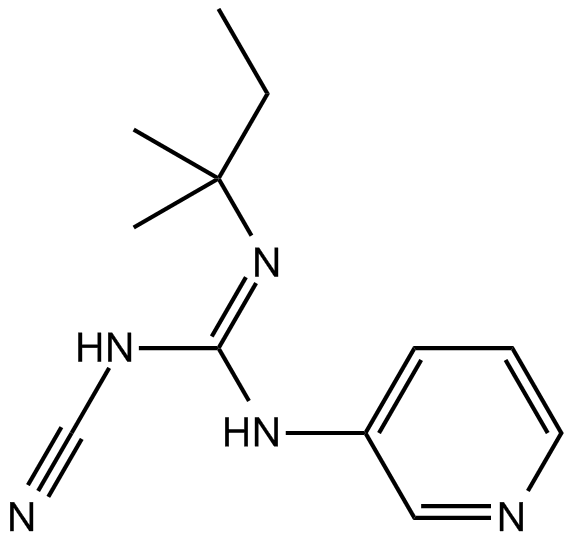
P1075 es un potente activador del canal de potasio sensible al ATP relacionado con el receptor de sulfonilurea 2 (SUR2-KIR6) con un valor EC50 de 45±10nM[1]. P1075 es un derivado de cianoguanidina que puede aumentar la capacidad de salida del sagmento anterior y reducir la presión intraocular [2]. P1075 puede inducir la dilatación de las artritis renales de la rata [3]. P1075 puede relajar el músculo liso y acortor la duración del potencial de acción cardíaca (APD) en el rango de concentración nanomolar [4].
In vitro, el tratamiento P1075 (100μM) de cardiomiocitos de conejo durante 10 minutos indujo significativamente la generación de ROS intracelulares[5]. El tratamiento P1075 (30μM) de miocitos ventriculares de conejo inhibió significativamente la oxidación de flavoproteínas inducida por diazóxido [6].
In vivo, P1075 (1μg/kg) tratado por inyección intravenosa en ratas con modelo de isquemia/reperfusión cardíaca redujo significativamente el tamaño del infarto[7].
References:
[1] Schwanstecher M, Sieverding C, Dörschner H, et al. Potassium channel openers require ATP to bind to and act through sulfonylurea receptors[J]. The EMBO journal, 1998.
[2] Chowdhury U R, Bahler C K, Hann C R, et al. ATP-sensitive potassium (KATP) channel activation decreases intraocular pressure in the anterior chamber of the eye[J]. Investigative ophthalmology & visual science, 2011, 52(9): 6435-6442.
[3] Novakovic A, Pavlovic M, Milojevic P, et al. Different potassium channels are involved in relaxation of rat renal artery induced by P 1075[J]. Basic & clinical pharmacology & toxicology, 2012, 111(1): 24-30.
[4] Sargent C A, Sleph P G, Dzwonczyk S, et al. Cardioprotective effects of the cyanoguanidine potassium channel opener P-1075[J]. Journal of cardiovascular pharmacology, 1993, 22(4): 564-576.
[5] Oldenburg O, Yang X M, Krieg T, et al. P1075 opens mitochondrial KATP channels and generates reactive oxygen species resulting in cardioprotection of rabbit hearts[J]. Journal of molecular and cellular cardiology, 2003, 35(9): 1035-1042.
[6] Sato T, Nakaya H. P-1075 exerts diverse modulatory effects on mitochondrial ATP-sensitive K+ channels in rabbit ventricular myocytes[J]. Journal of cardiovascular pharmacology, 2006, 47(2): 165-168.
[7] Gross E R, Hsu A K, Gross G J. GSK3β inhibition and K ATP channel opening mediate acute opioid-induced cardioprotection at reperfusion[J]. Basic research in cardiology, 2007, 102: 341-349.
| Experimentos celulares [1]: | |
Líneas celulares | Cardiomiocitos de conejo |
Método de preparación | Los miocitos ventriculares de conejo fueron aislados por perfusión de colagenasa. Los experimentos se realizaron 2-4d después del aislamiento. Cada experimento comenzó con un cambio de medio durante 10 minutos. Luego se retiró el medio y se reemplazó con medio fresco que contenía el medicamento, y se redujo MitoTracker™Reddye (500nM). La concentración de P1075 fue de 100µM, el medio de incubación durante los 10 minutos iniciales de estabilización contenía el bloqueador GLI (50µM) o 5HD (1mM). Las células incubadoras se almacenaron a 37°C en la incubadora. Al final del período de tinción de 15 minutos, las células se lavaron dos veces con medio fresco sin MTR. La generación de ROS mitocondrial se analizó midiendo la fluorescencia de 15-30 células en forma de varilla que se seleccionaron aleatoriamente dentro de cada pozo de las cámaras de cuatro pozos. |
Condiciones de reacción | 100μM; 10 minutos |
Áreas de aplicación | La fluorescencia aumentó notablemente en las células tratadas con P1075 en comparación con los controles. Esta generación de ROS inducida por P1075 fue abolida por co-incubación con el bloqueador mitoKATP 5HD. También estudiamos el efecto del bloqueador KATP GLI no selectivo, pero potente, en la respuesta P1075. P1075 colvió a llevar a un aumento robusto y significativo en la producción de ROS . |
References: | |
| Cas No. | 60559-98-0 | SDF | |
| Chemical Name | |||
| Canonical SMILES | N#CN/C(NC1=CC=CN=C1)=N\C(C)(C)CC | ||
| Formula | C12H17N5 | M.Wt | 231.3 |
| Solubility | DMSO: <100mM,Ethanol: <50mM | Storage | Store at RT |
| General tips | Please select the appropriate solvent to prepare the stock solution according to the
solubility of the product in different solvents; once the solution is prepared, please store it in
separate packages to avoid product failure caused by repeated freezing and thawing.Storage method
and period of the stock solution: When stored at -80°C, please use it within 6 months; when stored
at -20°C, please use it within 1 month. To increase solubility, heat the tube to 37°C and then oscillate in an ultrasonic bath for some time. |
||
| Shipping Condition | Evaluation sample solution: shipped with blue ice. All other sizes available: with RT, or with Blue Ice upon request. | ||
| Prepare stock solution | |||

|
1 mg | 5 mg | 10 mg |
| 1 mM | 4.3234 mL | 21.6169 mL | 43.2339 mL |
| 5 mM | 864.7 μL | 4.3234 mL | 8.6468 mL |
| 10 mM | 432.3 μL | 2.1617 mL | 4.3234 mL |
Step 1: Enter information below (Recommended: An additional animal making an allowance for loss during the experiment)
 g
μL
g
μL
Step 2: Enter the in vivo formulation (This is only the calculator, not formulation. Please contact us first if there is no in vivo formulation at the solubility Section.)
Calculation results:
Working concentration: mg/ml;
Method for preparing DMSO master liquid: mg drug pre-dissolved in μL DMSO ( Master liquid concentration mg/mL, Please contact us first if the concentration exceeds the DMSO solubility of the batch of drug. )
Method for preparing in vivo formulation: Take μL DMSO master liquid, next addμL PEG300, mix and clarify, next addμL Tween 80, mix and clarify, next add μL saline, mix and clarify.
Method for preparing in vivo formulation: Take μL DMSO master liquid, next add μL Corn oil, mix and clarify.
Note: 1. Please make sure the liquid is clear before adding the next solvent.
2. Be sure to add the solvent(s) in order. You must ensure that the solution obtained, in the previous addition, is a clear solution before proceeding to add the next solvent. Physical methods such as vortex, ultrasound or hot water bath can be used to aid dissolving.
3. All of the above co-solvents are available for purchase on the GlpBio website.
Quality Control & SDS
- View current batch:
- Purity: >97.00% Appearance: A solid
- COA (Certificate of Analysis)
- SDS (Safety Data Sheet)
- Datasheet
Average Rating: 5 (Based on Reviews and 13 reference(s) in Google Scholar.)