

Rucaparib (free base) (Synonyms: AG014447) |
رقم الكتالوجGC13249
 One-Click Copy Product Info
|

Rucaparib (قاعدة حرة) (AG014699) هو مثبط فعال وفعال عن طريق الفم لبروتينات PARP (PARP-1 و PARP-2 و PARP-3) مع Ki من 1.4 نانومتر لـ PARP1. Rucaparib (القاعدة الحرة) هو مثبط متواضع لهكسوز 6 فوسفات ديهيدروجينيز (H6PD). يحتوي Rucaparib (القاعدة الحرة) على إمكانية إجراء أبحاث عن سرطان البروستاتا المقاوم للإخصاء (CRPC).
Products are for research use only. Not for human use. We do not sell to patients.
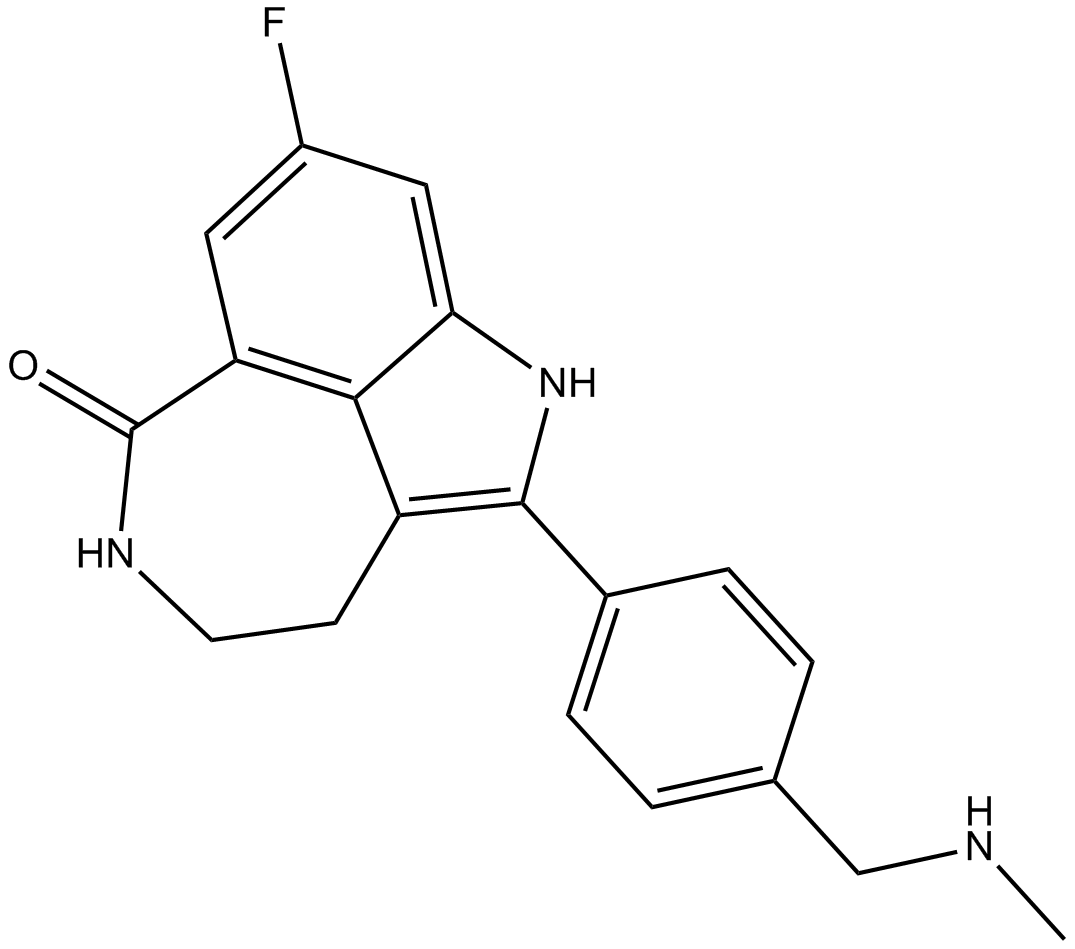
Cas No.: 283173-50-2
Sample solution is provided at 25 µL, 10mM.
Rucaparib (free base) is an orally bioavailable tricyclic indole poly (ADP-ribose) polymerase (PARP) inhibitor. Rucaparib phosphate blocks PARP-mediated DNA repair by selectively binding to and inhibiting the activity of PARP1 (Ki=1.4nM), PARP2, and PARP3, leading to accumulation of DNA strand breaks, genomic instability, and apoptosis. Rucaparib phosphate can be used in research related to BRCA mutation-associated ovarian cancer, fallopian tube cancer, primary peritoneal cancer, and metastatic castration-resistant prostate cancer (mCRPC)[1-4].
In vitro, Rucaparib phosphate (0.763nM-50μM) was used to treat CDK12 knockout (KO) prostate cancer cells (C42B, LNCaP) for 7 days. Rucaparib phosphate inhibited the growth of CDK12 KO cells[5]. Rucaparib phosphate (1.104-1.488μM) was combined with Trabectedin (0.352-2.64nM) to treat soft tissue sarcoma cell lines (IB115, IB111, IB136) for 72 hours. Rucaparib phosphate synergized with Trabectedin to inhibit cell proliferation, induce apoptosis, cause G2/M phase accumulation, and increase DNA damage[6].
In vivo, Rucaparib phosphate (150mg/kg) was orally administered to mice with lung adenocarcinoma (LP07) for 20 days. Rucaparib phosphate significantly reduced tumor burden, while decreasing PARP activity and cell proliferation, and increasing DNA damage, TUNEL-positive nuclei, protein oxidation, and SOD2 content[7]. Rucaparib phosphate (150mg/kg; five times per week) was orally administered to CD-1 nude mice bearing Capan-1 xenograft tumors for 6 weeks. Rucaparib phosphate significantly delayed tumor growth and induced tumor regression[8].
References:
[1] Fizazi K, Piulats JM, Reaume MN, et al. TRITON3 Investigators. Rucaparib or Physician's Choice in Metastatic Prostate Cancer. N Engl J Med. 2023 Feb 23;388(8):719-732.
[2] Thomas HD, Calabrese CR, Batey MA, et al. Preclinical selection of a novel poly(ADP-ribose) polymerase inhibitor for clinical trial. Mol Cancer Ther. 2007 Mar;6(3):945-56.
[3] Syed YY. Rucaparib: First Global Approval. Drugs. 2017 Apr;77(5):585-592.
[4] Shirley M. Rucaparib: A Review in Ovarian Cancer. Target Oncol. 2019 Apr;14(2):237-246.
[5] Chou J, Robinson TM, Egusa EA, et al. Synthetic Lethal Targeting of CDK12-Deficient Prostate Cancer with PARP Inhibitors. Clin Cancer Res. 2024 Dec 2;30(23):5445-5458.
[6] Laroche A, Chaire V, Le Loarer F, et al. Activity of trabectedin and the PARP inhibitor rucaparib in soft-tissue sarcomas. J Hematol Oncol. 2017 Apr 11;10(1):84.
[7] Pérez-Peiró M, Valentí-Serra P, León-González B, et al. Attenuation of Tumor Burden in Response to Rucaparib in Lung Adenocarcinoma: The Contribution of Oxidative Stress, Apoptosis, and DNA Damage. Int J Mol Sci. 2023 Jan 30;24(3):2580.
[8] Murray J, Thomas H, Berry P, et al. Tumour cell retention of rucaparib, sustained PARP inhibition and efficacy of weekly as well as daily schedules. Br J Cancer. 2014 Apr 15;110(8):1977-84.
| Cell experiment [1]: | |
Cell lines | LNCaP, C42B, PC3, DLD-1, MDA-MB-231, CAOV3, OVCAR-8 (prostate cancer and other cancer cell lines) |
Preparation Method | Cells were maintained in RPMI-1640 or DMEM supplemented with 10% fetal bovine serum (FBS) under standard conditions. Cells were treated with Rucaparib phosphate or DMSO for seven days. |
Reaction Conditions | 0.763nM-50μM; 7 days |
Applications | Rucaparib phosphate preferentially inhibited the growth of CDK12 knockout (KO) cells compared to isogenic wild-type cells. CDK12 KO cells were more sensitive to Rucaparib phosphate than control cells. |
| Animal experiment [2]: | |
Animal models | BALB/c mice with LP07 lung adenocarcinoma tumors |
Preparation Method | Mice were subcutaneously injected with LP07 lung adenocarcinoma cells to generate tumors. Tumor-bearing mice were randomized into two groups: non-treated (control) and treated with Rucaparib phosphate (150mg/kg; p.o.). Treatment started when tumors became measurable. |
Dosage form | 150mg/kg; p.o.; 20 days |
Applications | Rucaparib phosphate treatment significantly reduced tumor weight and tumor area compared to non-treated controls. Rucaparib phosphate decreased PARP activity and cell proliferation, while increasing DNA damage, TUNEL-positive nuclei, protein oxidation, and superoxide dismutase 2 content within the tumors. |
References: | |
| Cas No. | 283173-50-2 | SDF | |
| المرادفات | AG014447 | ||
| Chemical Name | 8-fluoro-2-(4-((methylamino)methyl)phenyl)-4,5-dihydro-1H-azepino[5,4,3-cd]indol-6(3H)-one | ||
| Canonical SMILES | FC1=CC2=C3C(CCNC2=O)=C(C4=CC=C(CNC)C=C4)NC3=C1 | ||
| Formula | C19H18FN3O | M.Wt | 323.36 |
| الذوبان | ≥ 16.15mg/mL in DMSO | Storage | Store at -20°C |
| General tips | Please select the appropriate solvent to prepare the stock solution according to the
solubility of the product in different solvents; once the solution is prepared, please store it in
separate packages to avoid product failure caused by repeated freezing and thawing.Storage method
and period of the stock solution: When stored at -80°C, please use it within 6 months; when stored
at -20°C, please use it within 1 month. To increase solubility, heat the tube to 37°C and then oscillate in an ultrasonic bath for some time. |
||
| Shipping Condition | Evaluation sample solution: shipped with blue ice. All other sizes available: with RT, or with Blue Ice upon request. | ||
| Prepare stock solution | |||

|
1 mg | 5 mg | 10 mg |
| 1 mM | 3.0925 mL | 15.4626 mL | 30.9253 mL |
| 5 mM | 618.5 μL | 3.0925 mL | 6.1851 mL |
| 10 mM | 309.3 μL | 1.5463 mL | 3.0925 mL |
Step 1: Enter information below (Recommended: An additional animal making an allowance for loss during the experiment)
 g
μL
g
μL
Step 2: Enter the in vivo formulation (This is only the calculator, not formulation. Please contact us first if there is no in vivo formulation at the solubility Section.)
Calculation results:
Working concentration: mg/ml;
Method for preparing DMSO master liquid: mg drug pre-dissolved in μL DMSO ( Master liquid concentration mg/mL, Please contact us first if the concentration exceeds the DMSO solubility of the batch of drug. )
Method for preparing in vivo formulation: Take μL DMSO master liquid, next addμL PEG300, mix and clarify, next addμL Tween 80, mix and clarify, next add μL saline, mix and clarify.
Method for preparing in vivo formulation: Take μL DMSO master liquid, next add μL Corn oil, mix and clarify.
Note: 1. Please make sure the liquid is clear before adding the next solvent.
2. Be sure to add the solvent(s) in order. You must ensure that the solution obtained, in the previous addition, is a clear solution before proceeding to add the next solvent. Physical methods such as vortex, ultrasound or hot water bath can be used to aid dissolving.
3. All of the above co-solvents are available for purchase on the GlpBio website.
Quality Control & SDS
- View current batch:
- Purity: >99.00% Appearance: A solid
- COA (Certificate of Analysis)
- SDS (Safety Data Sheet)
- Datasheet
Average Rating: 5 (Based on Reviews and 24 reference(s) in Google Scholar.)