
Sulfaphenazole (Synonyms: Depocid,Depotsulfonamide,Plisulfan,Raziosulfa) |
| رقم الكتالوجGC11638 |
السلفافينازول هو مثبط محدد لـ CYP2C9 الذي يمنع التأثيرات المسببة للالتهاب وتصلب الشرايين لحمض اللينوليك (زيادة الإجهاد التأكسدي وتنشيط AP-1) بوساطة CYP2C9
Products are for research use only. Not for human use. We do not sell to patients.
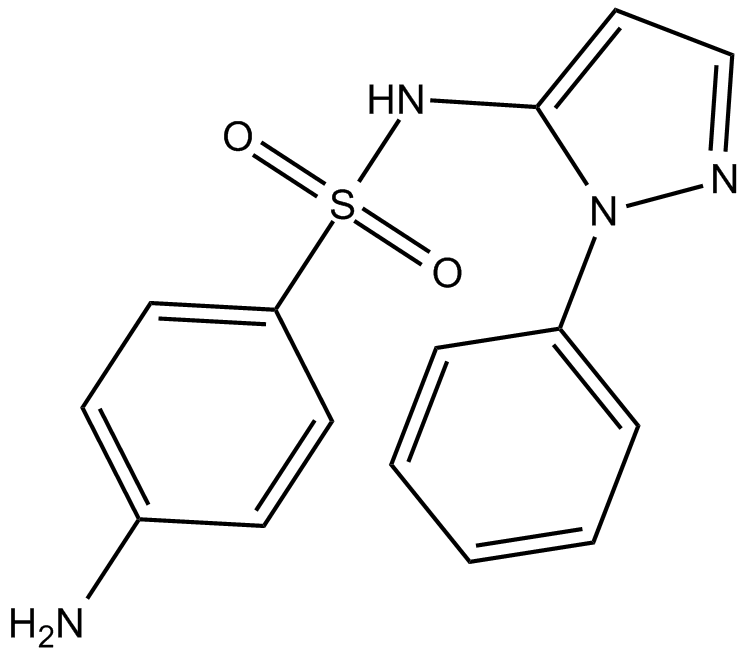
Cas No.: 526-08-9
Sample solution is provided at 25 µL, 10mM.
Sulfaphenazole is a sulfonamide antibacterial drug. It competitively inhibits bacterial dihydrofolate synthase, blocking bacterial folate synthesis and thereby inhibiting bacterial growth and reproduction [1]. Sulfaphenazole is a selective inhibitor of the human cytochrome P450 (CYP) 2C9 enzyme [2]. Sulfaphenazole is a cytoprotective agent that prevents light-induced photoreceptor cell death. Sulfaphenazole inhibits light-induced necrosis and apoptosis triggered by mitochondrial stress [3].
In yeast expressed human cytochromes P450 of the 1A, 3A, and 2C subfamilies, Sulfadilamide acts as a strong and competitive inhibitor of CYP 2C9 with the Ki value of 0.3±0.1μM. The Ki values of Sulfadilamide for CYP 2C8 and 2C18 were 63 and 29μM, respectively. Sulfaphenazole failed to inhibit CYP 1A1, 1A2, 3A4, and 2C19 [2]. Sulfaphenazole (10μM; 1h) causes the numbers of light-induced apoptotic and necrotic cells decreased by 33 and 44%, respectively[3].
In a model of Diabetic male mice (db/db strain), Sulfaphenazole(5.13mg/kg; po; 8 weeks) reduces oxidative stress (measured as plasma levels of 8-isoprostane), increases NO bioavailability (measured as NO2−), and restores endothelial function in db/db mice without affecting plasma glucose levels [4]. Sulfaphenazole (100µL; ip; 15d) exposure post-injury was found to improve tissue perfusion in mouse models of both thermal injury and I/R-induced pressure injury, leading to reduced overall severity, improved wound closure and increased scar tensile strength [5]. In a rat model of myocardial ischemia-reperfusion (I/R) injury, Sulfaphenazole (30mg/kg; iv) treatment restored cardiac function and reduced myocardial infarct size. Furthermore, Sulfaphenazole reduced superoxide anion levels and enhanced NO bioavailability in reperfused hearts [6]. In a rat model of acute myocardial infarction (MI), Sulfaphenazole (8.1mg/kg; ip; 3d) pretreatment of rats with ameliorated I=R-induced myocardial damage and improved cardiac contractile functions by decreasing superoxide production, peroxynitrite formation, and by enhancing NO bioavailability, myocardial tissue oxygenation, and iNOS expression [7].
References:
[1].Elmongy E I, Alanazi W S, Aldawsari A I, et al. Antimicrobial evaluation of sulfonamides after coupling with thienopyrimidine coplanar structure[J]. Pharmaceuticals, 2024, 17(2): 188.
[2].Rettie A E, Jones J P. Clinical and toxicological relevance of CYP2C9: drug-drug interactions and pharmacogenetics[J]. Annu. Rev. Pharmacol. Toxicol., 2005, 45(1): 477-494.
[3]. Bogaard J, Chang Q, Berdyshev E A, et al. Cytochrome P450 2C Inhibitors Protect Photoreceptors from Light Induced Cell Death[J]. Investigative Ophthalmology & Visual Science, 2014, 55(13): 4387-4387.
| Cell experiment [1]: | |
Cell lines | 661W cells |
Preparation Method | 661W cells were seeded onto 96 well plates and given 9-cis retinal overnight to sensitize them to light. Cells were then given serum free media with/without a compound of interest. The 661W cells were pretreated with 10μM Sulfaphenazole for 1 hour.Then cells were exposed to 11,000 lux of light to inflict cell death. Media fractions and lipid extracts were obtained following light exposure to perform lipid profiling using LC/MS. |
Reaction Conditions | 10 μM; 1h |
Applications | Sulfaphenazole (10 μM; 1h) causes the numbers of light-induced apoptotic and necrotic cells decreased by 33 and 44%, respectively. |
| Animal experiment [2]: | |
Animal models | Diabetic male mice (db/db strain) |
Preparation Method | Diabetic male mice (db/db strain) and their age-matched controls received daily intraperitoneal injections of either the CYP 2C inhibitor sulfaphenazole (5.13mg/kg) or saline (vehicle control) for 8 weeks. |
Dosage form | 5.13mg/kg; po; 8 weeks |
Applications | Sulfaphenazole reduces oxidative stress (measured as plasma levels of 8-isoprostane), increases NO bioavailability (measured as NO2−), and restores endothelial function in db/db mice without affecting plasma glucose levels. |
References: | |
| Cas No. | 526-08-9 | SDF | |
| المرادفات | Depocid,Depotsulfonamide,Plisulfan,Raziosulfa | ||
| Chemical Name | 4-amino-N-(1-phenyl-1H-pyrazol-5-yl)-benzenesulfonamide | ||
| Canonical SMILES | NC1=CC=C(S(NC2=CC=NN2C3=CC=CC=C3)(=O)=O)C=C1 | ||
| Formula | C15H14N4O2S | M.Wt | 314.4 |
| الذوبان | ≥ 13.15mg/mL in DMSO | Storage | Store at -20°C |
| General tips | Please select the appropriate solvent to prepare the stock solution according to the
solubility of the product in different solvents; once the solution is prepared, please store it in
separate packages to avoid product failure caused by repeated freezing and thawing.Storage method
and period of the stock solution: When stored at -80°C, please use it within 6 months; when stored
at -20°C, please use it within 1 month. To increase solubility, heat the tube to 37°C and then oscillate in an ultrasonic bath for some time. |
||
| Shipping Condition | Evaluation sample solution: shipped with blue ice. All other sizes available: with RT, or with Blue Ice upon request. | ||
| Prepare stock solution | |||
|
1 mg | 5 mg | 10 mg |
| 1 mM | 3.1807 mL | 15.9033 mL | 31.8066 mL |
| 5 mM | 636.1 μL | 3.1807 mL | 6.3613 mL |
| 10 mM | 318.1 μL | 1.5903 mL | 3.1807 mL |
Step 1: Enter information below (Recommended: An additional animal making an allowance for loss during the experiment)
Step 2: Enter the in vivo formulation (This is only the calculator, not formulation. Please contact us first if there is no in vivo formulation at the solubility Section.)
Calculation results:
Working concentration: mg/ml;
Method for preparing DMSO master liquid: mg drug pre-dissolved in μL DMSO ( Master liquid concentration mg/mL, Please contact us first if the concentration exceeds the DMSO solubility of the batch of drug. )
Method for preparing in vivo formulation: Take μL DMSO master liquid, next addμL PEG300, mix and clarify, next addμL Tween 80, mix and clarify, next add μL ddH2O, mix and clarify.
Method for preparing in vivo formulation: Take μL DMSO master liquid, next add μL Corn oil, mix and clarify.
Note: 1. Please make sure the liquid is clear before adding the next solvent.
2. Be sure to add the solvent(s) in order. You must ensure that the solution obtained, in the previous addition, is a clear solution before proceeding to add the next solvent. Physical methods such as vortex, ultrasound or hot water bath can be used to aid dissolving.
3. All of the above co-solvents are available for purchase on the GlpBio website.
Quality Control & SDS
- View current batch:
- Purity: >98.50%
- COA (Certificate Of Analysis)
- SDS (Safety Data Sheet)
- Datasheet
Average Rating: 5 (Based on Reviews and 10 reference(s) in Google Scholar.)
GLPBIO products are for RESEARCH USE ONLY. Please make sure your review or question is research based.
Required fields are marked with *


