

Thioridazine hydrochloride (Synonyms: Aldazine, NSC 186060) |
رقم الكتالوجGC11977
 One-Click Copy Product Info
|

يُظهر Thioridazine HCl ، وهو مضاد نشط عن طريق الفم لبروتينات عائلة مستقبلات الدوبامين D2 ، أنشطة قوية مضادة للذهان ومضادة للقلق.
Products are for research use only. Not for human use. We do not sell to patients.
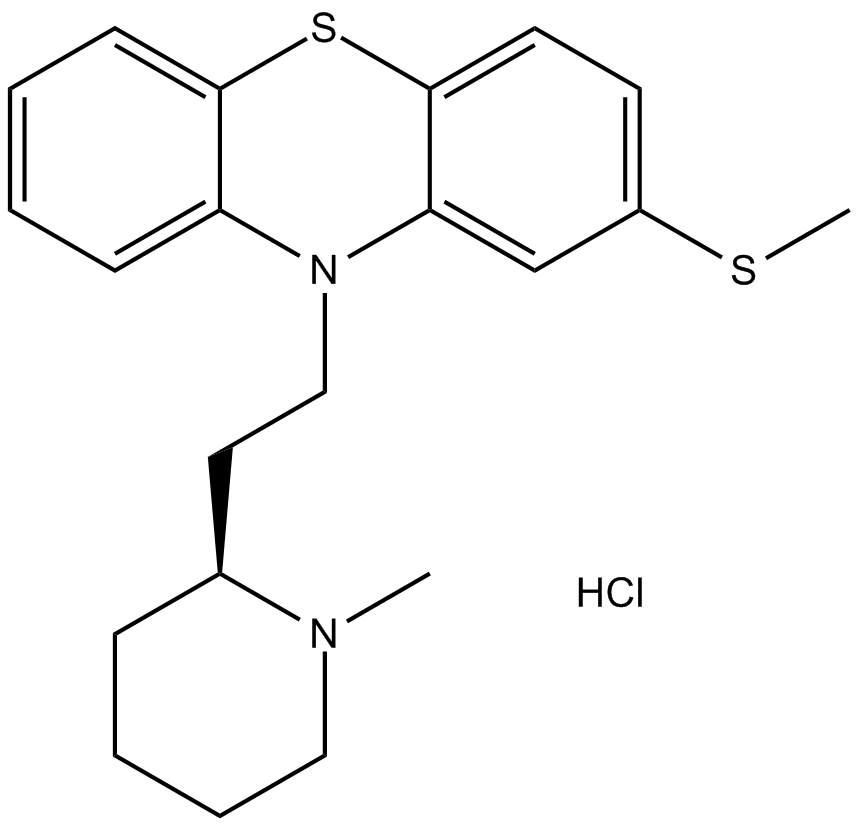
Cas No.: 130-61-0
Sample solution is provided at 25 µL, 10mM.
_1-3.$$$39978408@51.jpg');)
_1-9.$$$38538795@65.jpg');)
_1-9.$$$39112701@51.jpg');)
_1-7.$$$37316672@70.jpg');)
_366-372.$$$36198801@70.jpg');)
.$$$38565142@65.jpg');)
_1867-1883.$$$33248023@67.jpg');)
_eads6055.$$$39977546@45.jpg');)
_eadm9805.$$$40080571@45.jpg');)
_eadj3020.$$$39666821@45.jpg');)
_1-20.$$$39757301@28.jpg');)
_1-24.$$$38898113@28.jpg');)
_273-287.$$$36806353@46.jpg');)
_1-16.$$$37156877@44.jpg');)
_1-19.$$$37460805@44.jpg');)
_1291-1307.$$$34518654@46.jpg');)
Thioridazine hydrochloride is a phenothiazine antipsychotic agent with dopamine-receptor antagonistic activity[1]. Thioridazine hydrochloride inhibits dopamine D2 receptor (D2DR), dopamine D4 receptor (D4DR), and calcium channels and modulates autophagy, apoptosis, and vascular endothelial growth factor receptor 2 (VEGFR-2)/phosphoinositide 3-kinase (PI3K)/mechanistic target of rapamycin (mTOR) signaling in cancer-cell models[1-3]. Thioridazine hydrochloride is used in research on dopamine-receptor signaling, glioma stem-like cells, autophagy, apoptosis, angiogenesis, and tumor-xenograft biology[1-5].
In vitro, Thioridazine hydrochloride (5μM, 7.5μM, 10μM, and 15μM; 24h) activated caspases, promoted poly(adenosine diphosphate-ribose) polymerase (PARP) cleavage, increased microtubule-associated protein 1 light chain 3-II (LC3-II) accumulation, and reduced stem-like properties in U87MG and GBM8401 glioblastoma cells[1].
In vivo, Thioridazine hydrochloride (25mg/kg; oral administration every 3 days for 27 days) reduced tumor growth by approximately fivefold and decreased tumor weight and phosphorylation of VEGFR-2, PI3K, and mTOR in nude mice bearing 2774 ovarian cancer xenografts[3].
References:[1] Cheng HW, Liang YH, Kuo YL, Chuu CP, Lin CY, Lee MH, et al. Identification of thioridazine, an antipsychotic drug, as an antiglioblastoma and anticancer stem cell agent using public gene expression data. Cell Death Dis. 2015;6:e1753. doi:10.1038/cddis.2015.77.
[2] Chu CW, Ko HJ, Chou CH, Cheng TS, Cheng HW, Liang YH, et al. Thioridazine enhances P62-mediated autophagy and apoptosis through Wnt/β-catenin signaling pathway in glioma cells. Int J Mol Sci. 2019;20(3):473. doi:10.3390/ijms20030473.
[3] Park MS, Dong SM, Kim BR, Seo SH, Kang S, Lee EJ, et al. Thioridazine inhibits angiogenesis and tumor growth by targeting the VEGFR-2/PI3K/mTOR pathway in ovarian cancer xenografts. Oncotarget. 2014;5(13):4929-4934. doi:10.18632/oncotarget.2063.
[4] Yong M, Yu T, Tian S, Liu S, Xu J, Hu J, et al. DR2 blocker thioridazine: a promising drug for ovarian cancer therapy. Oncol Lett. 2017;14(6):8171-8177. doi:10.3892/ol.2017.7184.
[5] Colturato-Kido C, Salerno AG, Cardoso BA, Panepucci RA, Covas DT, Souto EX, et al. Inhibition of autophagy enhances the antitumor effect of thioridazine in acute lymphoblastic leukemia. Life (Basel). 2021;11(4):365. doi:10.3390/life11040365.
| Cell experiment [1]: | |
|
Cell lines |
U87MG and GBM8401 glioblastoma cells |
|
Preparation Method |
U87MG and GBM8401 cells were cultured and exposed to different Thioridazine hydrochloride concentrations. Cell viability, caspase activity, western blotting, and tumorsphere-formation assays were used to evaluate cell death, autophagy markers, and stem-like phenotypes. |
|
Reaction Conditions |
5μM, 7.5μM, 10μM, and 15μM for 24h |
|
Applications |
Thioridazine hydrochloride (5μM, 7.5μM, 10μM, and 15μM; 24h) activated caspases, promoted poly(adenosine diphosphate-ribose) polymerase (PARP) cleavage and microtubule-associated protein 1 light chain 3-II (LC3-II) accumulation, and reduced stem-like properties in U87MG and GBM8401 glioblastoma cells. |
| Animal experiment [2]: | |
|
Animal models |
2774 ovarian cancer xenograft model in nude mice |
|
Preparation Method |
2774 ovarian cancer cells were implanted subcutaneously into nude mice, and oral administration of Thioridazine hydrochloride began when tumors reached approximately 100mm³. Tumor volume and body weight were measured during the study, and tumor weight plus phosphorylation of vascular endothelial growth factor receptor 2 (VEGFR-2), phosphoinositide 3-kinase (PI3K), and mechanistic target of rapamycin (mTOR) were analyzed at the endpoint. |
|
Dosage form |
25mg/kg; oral administration every 3 days for 27 days |
|
Applications |
Thioridazine hydrochloride (25mg/kg; oral administration every 3 days for 27 days) reduced tumor growth by approximately fivefold and decreased tumor weight and phosphorylation of VEGFR-2, PI3K, and mTOR in the 2774 ovarian cancer xenograft model. |
| References: [1] Cheng HW, Liang YH, Kuo YL, Chuu CP, Lin CY, Lee MH, et al. Identification of thioridazine, an antipsychotic drug, as an antiglioblastoma and anticancer stem cell agent using public gene expression data. Cell Death Dis. 2015;6:e1753. doi:10.1038/cddis.2015.77. [2] Park MS, Dong SM, Kim BR, Seo SH, Kang S, Lee EJ, et al. Thioridazine inhibits angiogenesis and tumor growth by targeting the VEGFR-2/PI3K/mTOR pathway in ovarian cancer xenografts. Oncotarget. 2014;5(13):4929-4934. doi:10.18632/oncotarget.2063. | |
| Cas No. | 130-61-0 | SDF | |
| المرادفات | Aldazine, NSC 186060 | ||
| Chemical Name | 10-[2-(1-methylpiperidin-2-yl)ethyl]-2-methylsulfanylphenothiazine;hydrochloride | ||
| Canonical SMILES | CN1CCCCC1CCN2C3=CC=CC=C3SC4=C2C=C(C=C4)SC.Cl | ||
| Formula | C21H26N2S2.HCl | M.Wt | 407 |
| الذوبان | ≥ 20.35mg/mL in DMSO | Storage | Store at -20°C |
| General tips | Please select the appropriate solvent to prepare the stock solution according to the
solubility of the product in different solvents; once the solution is prepared, please store it in
separate packages to avoid product failure caused by repeated freezing and thawing.Storage method
and period of the stock solution: When stored at -80°C, please use it within 6 months; when stored
at -20°C, please use it within 1 month. To increase solubility, heat the tube to 37°C and then oscillate in an ultrasonic bath for some time. |
||
| Shipping Condition | Evaluation sample solution: shipped with blue ice. All other sizes available: with RT, or with Blue Ice upon request. | ||
| Prepare stock solution | |||

|
1 mg | 5 mg | 10 mg |
| 1 mM | 2.457 mL | 12.285 mL | 24.57 mL |
| 5 mM | 491.4 μL | 2.457 mL | 4.914 mL |
| 10 mM | 245.7 μL | 1.2285 mL | 2.457 mL |
Step 1: Enter information below (Recommended: An additional animal making an allowance for loss during the experiment)
 g
μL
g
μL
Step 2: Enter the in vivo formulation (This is only the calculator, not formulation. Please contact us first if there is no in vivo formulation at the solubility Section.)
Calculation results:
Working concentration: mg/ml;
Method for preparing DMSO master liquid: mg drug pre-dissolved in μL DMSO ( Master liquid concentration mg/mL, Please contact us first if the concentration exceeds the DMSO solubility of the batch of drug. )
Method for preparing in vivo formulation: Take μL DMSO master liquid, next addμL PEG300, mix and clarify, next addμL Tween 80, mix and clarify, next add μL saline, mix and clarify.
Method for preparing in vivo formulation: Take μL DMSO master liquid, next add μL Corn oil, mix and clarify.
Note: 1. Please make sure the liquid is clear before adding the next solvent.
2. Be sure to add the solvent(s) in order. You must ensure that the solution obtained, in the previous addition, is a clear solution before proceeding to add the next solvent. Physical methods such as vortex, ultrasound or hot water bath can be used to aid dissolving.
3. All of the above co-solvents are available for purchase on the GlpBio website.
Quality Control & SDS
- View current batch:
- Purity: >99.50% Appearance: A solid
- COA (Certificate of Analysis)
- SDS (Safety Data Sheet)
- Datasheet
Average Rating: 5 (Based on Reviews and 2 reference(s) in Google Scholar.)