

Acarbose (Synonyms: BAY-g 5421) |
Catalog No.GC10751
 One-Click Copy Product Info
|

Acarbose es un inhibidor oral de la α-glucosidase (IC50 = 11nM), que pertenece a la clase de medicamentos oligosacáridos
Products are for research use only. Not for human use. We do not sell to patients.
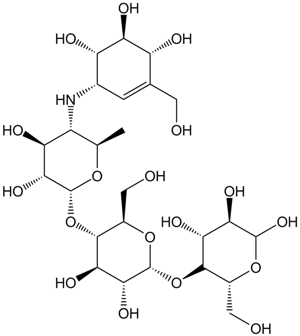
Cas No.: 56180-94-0
Sample solution is provided at 25 µL, 10mM.
Acarbose es un inhibidor oral de la α-glucosidase (IC50 = 11nM), que pertenece a la clase de medicamentos oligosacáridos [1]. Acarbose inhibe principalmente de forma competitiva y reversible la α-glucosidase y la amilasa pancreática en el “borde del cepillo” del intestino delgado, retrasndo así la descomposición de los carbohidratos en onosacárridos y ralentizando el rápido aumento del azúcar en la sangre dfespués de las comidas [2-3]. Acarbose se utiliza principalmente como tratamiento adyuvante para la diabetes tipo 2 [4].
En las células A7r5, Acarbose (0.5-5μM; 24h, 48h) inhibió la fosforilación de la quinasa de adhesión focal (FAK) y Akt, las actividades de las metaloproteinasas de matriz (MMPs) MMP-2 y MMP-9, y las expresiones de proteínas de pequeñas proteñinas G (Ras, Cdc42, RhoA y Rac1) de una manera dependiente de la dosis [5]. En las células THP-1 estimuladas por LPS, Acarbose (1μM; 24h) suprimió la acetilación inducida por LPS de las histonas H3 (H3) y H4 en las regiones promotoras IP-10 y MCP-1[6]. En las células A7r5 , Acarbose (3μM; 24h) redujo la migración celular inducida por la diabets [7].
En el modelo de ratones diabéticos inducidos por estreptozotocina, la administración de Acarbose (50mg/kg; po; 14d) por agvage redujo la gravedad de la insulitis y mejoró los niveles de insulina en los ratones diabéticos experimentales [8]. En ratones HET3 envejecidos, Acarbose (1000mg/kg; po; 1200d) mejora la salud y la visa útil [9].
References:
[1]. Hanefeld M, Schaper F. Acarbose: oral antidiabetes drug with additional cardiovascular benefits[J]. Expert review of cardiovascular therapy, 2008, 6(2): 153-163.
[2]. Khan F, Khan M V, Kumar A, et al. Recent advances in the development of alpha-glucosidase and alpha-amylase inhibitors in type 2 diabetes management: insights from in silico to in vitro studies[J]. Current Drug Targets, 2024, 25(12): 782-795.
[3]. Bhatnagar A, Mishra A. α-Glucosidase inhibitors for diabetes/blood sugar regulation[M]//Natural products as enzyme inhibitors: An industrial perspective. Singapore: Springer Nature Singapore, 2022: 269-283.
[4]. Chiasson J L, Josse R G, Gomis R, et al. Acarbose for prevention of type 2 diabetes mellitus: the STOP-NIDDM randomised trial[J]. The Lancet, 2002, 359(9323): 2072-2077.
[5]. Yu M H, Lin M C, Huang C N, et al. Acarbose inhibits the proliferation and migration of vascular smooth muscle cells via targeting Ras signaling[J]. Vascular Pharmacology, 2018, 103: 8-15.
[6]. Lin Y C, Chen Y C, Hsiao H P, et al. The effects of acarbose on chemokine and cytokine production in human monocytic THP-1 cells[J]. Hormones, 2019, 18(2): 179-187.
[7]. Chuang W Y, Yu M H, Yang T Y, et al. Acarbose attenuates migration/proliferation via targeting microRNA-143 in vascular smooth muscle cells under diabetic conditions[J]. Journal of Food and Drug Analysis, 2020, 28(3): 461.
[8]. Zhao B, Wu F, Han X, et al. Protective effects of acarbose against insulitis in multiple low-dose streptozotocin-induced diabetic mice[J]. Life Sciences, 2020, 263: 118490.
[9]. Harrison D E, Strong R, Alavez S, et al. Acarbose improves health and lifespan in aging HET3 mice[J]. Aging cell, 2019, 18(2): e12898.
| Experimentos celulares [1]: | |
Líneas celulares | Células A7r5 |
Método de preparación | Las células de A7r5 se sembraron a una densidad de 2 × 10⁵ células/pocillo en una placa de 24 pozos y se trataron con Acarbose a varias concentraciones (0,5, 1,0, 2,0, 3,0 y 5,0 μM) durante 24h o 48 horas. A continuación, las células se trataron con reactivo MTT de 0,5 mg/mL a 37℃ en una atmósfera humidificada de 5% de CO2 durante otras 4 horas. |
Condiciones de reacción | 0,5-5 μM; 24h, 48h |
Áreas de aplicación | Acarbose inhibió la fosforilación de la quinasa de adhesión focal (FAK) y Akt, las actividades de las metaloproteinasas de matriz (MMP) MMP-2 y MMP-9, y las expresiones de proteínas de pequeñas proteínas G (Ras, Cdc42, RhoA y Rac1) de una manera dependiente de la dosis. |
| Experimentos con animales [2]: | |
Modelos animales | Modelo de ratones diabéticos inducidos por estreptococo |
Método de preparación | A los ratones se les administró múltiples dosis bajas de estreptozotocina (STZ; 40 mg/kg/día) durante cinco días consecutivos. Los ratones se dividieron aleatoriamente en tres grupos: los grupos Control, STZ y STZ + Acabose. A los ratones se les administró una solución de vehículo de tampón de citrato de sodio de 0,1 mM (pH 4,5) fue considerado como el control. El segundo día después de la inyección inicial de STZ, los ratones de los tres grupos fueron tratados con vehículo (0,5% de carboximetilcelulosa, CMC) o Acarbose (50 mg/kg/día durante 14 días) por gavage. |
Forma de dosificación | 50 mg/kg; po; 14d |
Áreas de aplicación | La administración de Acarbose por gavage redujo la gravedad de la insulitis y mejoró los niveles de insulina en los ratones diabéticos experimentales. |
References: | |
| Cas No. | 56180-94-0 | SDF | |
| Sinónimos | BAY-g 5421 | ||
| Chemical Name | (3R,4R,5S,6R)-5-[(2R,3R,4R,5S,6R)-5-[(2R,3R,4S,5S,6R)-3,4-dihydroxy-6-methyl-5-[[(1S,4R,5S,6S)-4,5,6-trihydroxy-3-(hydroxymethyl)cyclohex-2-en-1-yl]amino]oxan-2-yl]oxy-3,4-dihydroxy-6-(hydroxymethyl)oxan-2-yl]oxy-6-(hydroxymethyl)oxane-2,3,4-triol | ||
| Canonical SMILES | CC1C(C(C(C(O1)OC2C(OC(C(C2O)O)OC3C(OC(C(C3O)O)O)CO)CO)O)O)NC4C=C(C(C(C4O)O)O)CO | ||
| Formula | C25H43NO18 | M.Wt | 645.6 |
| Solubility | ≥ 22.35mg/mL in DMSO | Storage | Store at -20°C |
| General tips | Please select the appropriate solvent to prepare the stock solution according to the
solubility of the product in different solvents; once the solution is prepared, please store it in
separate packages to avoid product failure caused by repeated freezing and thawing.Storage method
and period of the stock solution: When stored at -80°C, please use it within 6 months; when stored
at -20°C, please use it within 1 month. To increase solubility, heat the tube to 37°C and then oscillate in an ultrasonic bath for some time. |
||
| Shipping Condition | Evaluation sample solution: shipped with blue ice. All other sizes available: with RT, or with Blue Ice upon request. | ||
| Prepare stock solution | |||

|
1 mg | 5 mg | 10 mg |
| 1 mM | 1.5489 mL | 7.7447 mL | 15.4895 mL |
| 5 mM | 309.8 μL | 1.5489 mL | 3.0979 mL |
| 10 mM | 154.9 μL | 774.5 μL | 1.5489 mL |
Step 1: Enter information below (Recommended: An additional animal making an allowance for loss during the experiment)
 g
μL
g
μL
Step 2: Enter the in vivo formulation (This is only the calculator, not formulation. Please contact us first if there is no in vivo formulation at the solubility Section.)
Calculation results:
Working concentration: mg/ml;
Method for preparing DMSO master liquid: mg drug pre-dissolved in μL DMSO ( Master liquid concentration mg/mL, Please contact us first if the concentration exceeds the DMSO solubility of the batch of drug. )
Method for preparing in vivo formulation: Take μL DMSO master liquid, next addμL PEG300, mix and clarify, next addμL Tween 80, mix and clarify, next add μL saline, mix and clarify.
Method for preparing in vivo formulation: Take μL DMSO master liquid, next add μL Corn oil, mix and clarify.
Note: 1. Please make sure the liquid is clear before adding the next solvent.
2. Be sure to add the solvent(s) in order. You must ensure that the solution obtained, in the previous addition, is a clear solution before proceeding to add the next solvent. Physical methods such as vortex, ultrasound or hot water bath can be used to aid dissolving.
3. All of the above co-solvents are available for purchase on the GlpBio website.
Quality Control & SDS
- View current batch:
- Purity: >98.00% Appearance: A solid
- COA (Certificate of Analysis)
- SDS (Safety Data Sheet)
- Datasheet
Average Rating: 5 (Based on Reviews and 20 reference(s) in Google Scholar.)