

BMS-3 |
Catalog No.GC19076
 One-Click Copy Product Info
|

BMS-3 es un potente inhibidor de LIMK con IC50 de 5 nM y 6 nM para LIMK1 y LIMK2, respectivamente.
Products are for research use only. Not for human use. We do not sell to patients.
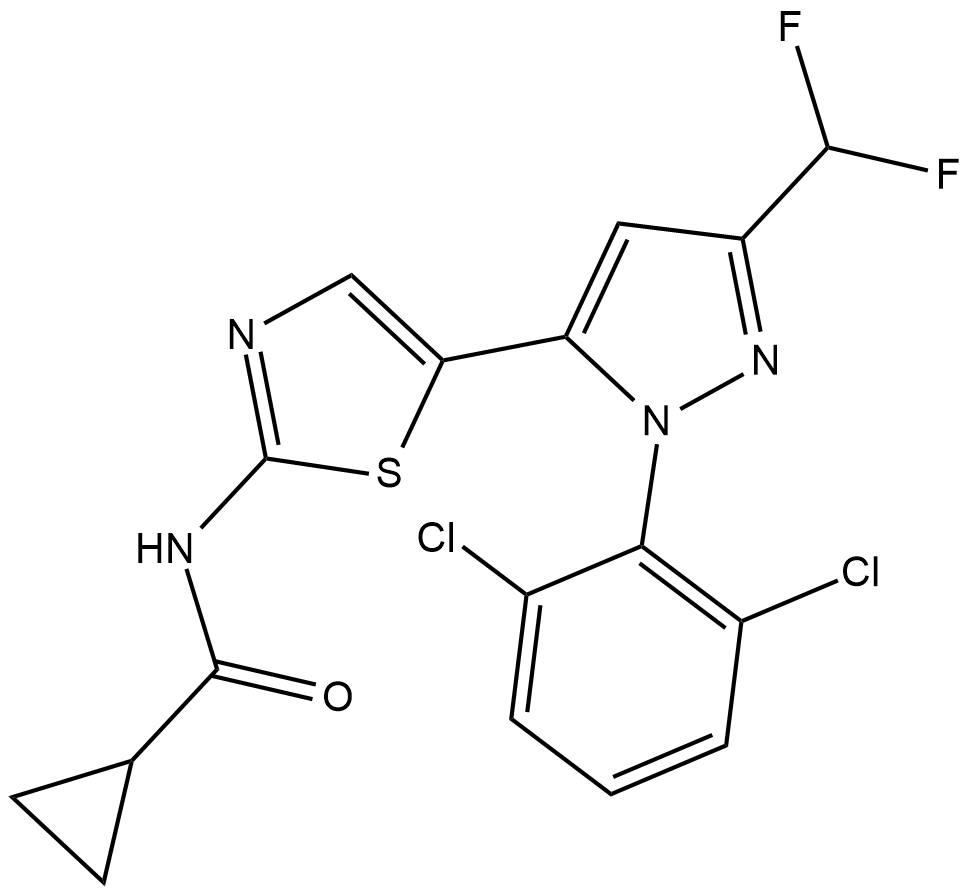
Cas No.: 1338247-30-5
Sample solution is provided at 25 µL, 10mM.
_1-3.$$$39978408@51.jpg');)
_1-9.$$$38538795@65.jpg');)
_1-9.$$$39112701@51.jpg');)
_1-7.$$$37316672@70.jpg');)
_366-372.$$$36198801@70.jpg');)
.$$$38565142@65.jpg');)
_1867-1883.$$$33248023@67.jpg');)
_eads6055.$$$39977546@45.jpg');)
_eadm9805.$$$40080571@45.jpg');)
_eadj3020.$$$39666821@45.jpg');)
_1-20.$$$39757301@28.jpg');)
_1-24.$$$38898113@28.jpg');)
_273-287.$$$36806353@46.jpg');)
_1-16.$$$37156877@44.jpg');)
_1-19.$$$37460805@44.jpg');)
_1291-1307.$$$34518654@46.jpg');)
BMS-3 is a potent LIMK inhibitor with IC50s of 5 nM and 6 nM for LIMK1 and LIMK2, respectively.
BMS-3 (Compound 2) causes a dose-dependent reduction in cell count and induces mitotic arrest by increases in total nuclear DNA intensity and histone H3 phosphorylation after 24 h treatment in A549 human lung cancer cells. BMS-3 inhibits A549 human lung cancer cells with EC50 value of 154 nM[1]. BMS-3 is used to demonstrate the direct participation of LIMK1 in the phosphorylation of Cofilin. Inhibition of p-LIMK with 1-50 uM of BMS-3 results in a dose-dependent decrease of p-Cofilin after 10 min incubation in capacitating conditions. As a control, sperm are also incubated for 10 min under non-capacitating conditions which result in low levels of p-Cofilin. In the presence of 1 or 50 uM of BMS-3, actin polymerization levels are significantly lower compared to controls (DMSO). Mouse sperm are incubated under capacitating conditions for 90 min in the presence or absence of increasing concentrations of p-LIMK inhibitor BMS-3 (0, 1, 10 and 50 uM). The increasing concentrations of BMS-3 result in a strong decrease on the percentage of sperm that undergoes acrosomal exocytosis after stimulation with 20 uM of Progesterone[2].
References:
[1]. Ross-Macdonald P, et al. Identification of a nonkinase target mediating cytotoxicity of novel kinase inhibitors. Mol Cancer Ther. 2008 Nov;7(11):3490-8.
[2]. Romarowski A, et al. PKA-dependent phosphorylation of LIMK1 and Cofilin is essential for mouse sperm acrosomal exocytosis. Dev Biol. 2015 Sep 15;405(2):237-49.
Kinase experiment: | The protein kinase domains of human LIMK1 and LIMK2 are expressed as glutathione S-transferase fusion proteins using the Bac-to-Bac system in Sf9 cells. Compounds 1 to 6 (e.g., BMS-3) are assayed for inhibition of LIMK1 and LIMK2 protein kinase activity by radioactive phosphate incorporation into biotinylated full-length human destrin. Reactions are done with a concentration series of compound in 25 mM HEPES, 100 mM NaCl, 5 mM MgCl2, 5 mM MnCl2, 1 μM total ATP, 83 μg/mL biotinylated destrin, 167 ng/mL glutathione S-transferase-LIMK1, or 835 ng/mL glutathione S-transferase-LIMK2 in a total volume of 60 μL at room temperature for 30 min (LIMK1) or 60 min (LIMK2). Reactions are terminated by addition of 140 μL of 20% TCA/100 mM sodium pyrophosphate, and the precipitates are harvested onto GF/C unifilter plates. The radioactivity incorporated is determined using a TopCount after addition of 35 μL Microscint scintillation fluid[1]. |
References: [1]. Ross-Macdonald P, et al. Identification of a nonkinase target mediating cytotoxicity of novel kinase inhibitors. Mol Cancer Ther. 2008 Nov;7(11):3490-8. | |
| Cas No. | 1338247-30-5 | SDF | |
| Canonical SMILES | O=C(C1CC1)NC2=NC=C(C3=CC(C(F)F)=NN3C4=C(Cl)C=CC=C4Cl)S2 | ||
| Formula | C17H12Cl2F2N4OS | M.Wt | 429.27 |
| Solubility | DMSO : ≥ 30 mg/mL (69.89 mM) | Storage | Store at -20°C |
| General tips | Please select the appropriate solvent to prepare the stock solution according to the
solubility of the product in different solvents; once the solution is prepared, please store it in
separate packages to avoid product failure caused by repeated freezing and thawing.Storage method
and period of the stock solution: When stored at -80°C, please use it within 6 months; when stored
at -20°C, please use it within 1 month. To increase solubility, heat the tube to 37°C and then oscillate in an ultrasonic bath for some time. |
||
| Shipping Condition | Evaluation sample solution: shipped with blue ice. All other sizes available: with RT, or with Blue Ice upon request. | ||
| Prepare stock solution | |||

|
1 mg | 5 mg | 10 mg |
| 1 mM | 2.3295 mL | 11.6477 mL | 23.2954 mL |
| 5 mM | 465.9 μL | 2.3295 mL | 4.6591 mL |
| 10 mM | 233 μL | 1.1648 mL | 2.3295 mL |
Step 1: Enter information below (Recommended: An additional animal making an allowance for loss during the experiment)
 g
μL
g
μL
Step 2: Enter the in vivo formulation (This is only the calculator, not formulation. Please contact us first if there is no in vivo formulation at the solubility Section.)
Calculation results:
Working concentration: mg/ml;
Method for preparing DMSO master liquid: mg drug pre-dissolved in μL DMSO ( Master liquid concentration mg/mL, Please contact us first if the concentration exceeds the DMSO solubility of the batch of drug. )
Method for preparing in vivo formulation: Take μL DMSO master liquid, next addμL PEG300, mix and clarify, next addμL Tween 80, mix and clarify, next add μL saline, mix and clarify.
Method for preparing in vivo formulation: Take μL DMSO master liquid, next add μL Corn oil, mix and clarify.
Note: 1. Please make sure the liquid is clear before adding the next solvent.
2. Be sure to add the solvent(s) in order. You must ensure that the solution obtained, in the previous addition, is a clear solution before proceeding to add the next solvent. Physical methods such as vortex, ultrasound or hot water bath can be used to aid dissolving.
3. All of the above co-solvents are available for purchase on the GlpBio website.
Quality Control & SDS
- View current batch:
- Purity: >99.00% Appearance: A solid
- COA (Certificate of Analysis)
- SDS (Safety Data Sheet)
- Datasheet
Average Rating: 5 (Based on Reviews and 34 reference(s) in Google Scholar.)