

CB-5339 |
Catalog No.GC20117
 One-Click Copy Product Info
|

CB-5339 es un inhibidor potente, selectivo y biodisponible por vía oral de la proteína que coniene valosina (VCP)/p97, con un valor de IC50 de 9nM
Products are for research use only. Not for human use. We do not sell to patients.
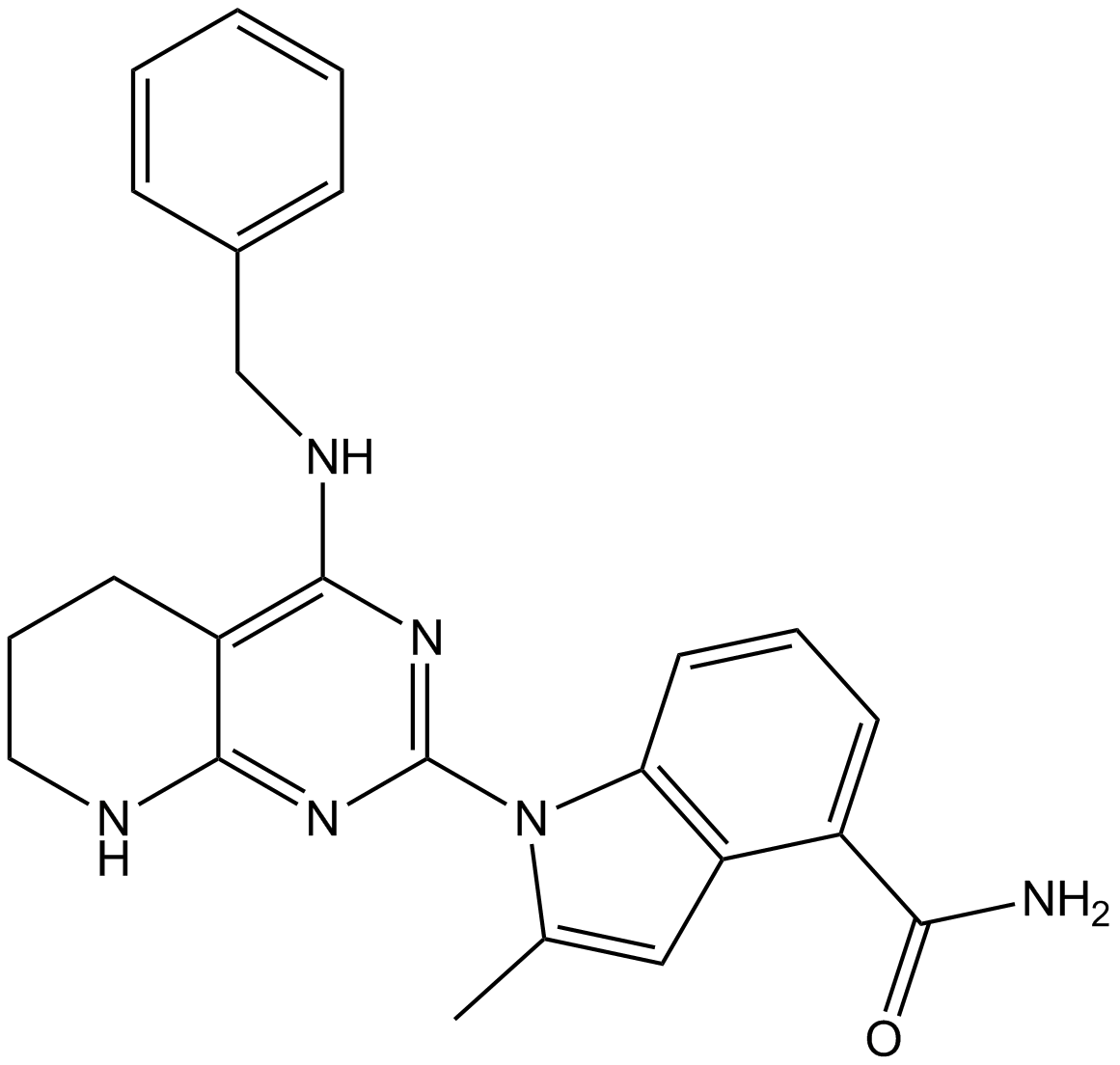
Cas No.: 1863952-15-1
Sample solution is provided at 25 µL, 10mM.
_1-3.$$$39978408@51.jpg');)
_1-9.$$$38538795@65.jpg');)
_1-9.$$$39112701@51.jpg');)
_1-7.$$$37316672@70.jpg');)
_366-372.$$$36198801@70.jpg');)
.$$$38565142@65.jpg');)
_1867-1883.$$$33248023@67.jpg');)
_eads6055.$$$39977546@45.jpg');)
_eadm9805.$$$40080571@45.jpg');)
_eadj3020.$$$39666821@45.jpg');)
_1-20.$$$39757301@28.jpg');)
_1-24.$$$38898113@28.jpg');)
_273-287.$$$36806353@46.jpg');)
_1-16.$$$37156877@44.jpg');)
_1-19.$$$37460805@44.jpg');)
_1291-1307.$$$34518654@46.jpg');)
CB-5339 es un inhibidor potente, selectivo y biodisponible por vía oral de la proteína que coniene valosina (VCP)/p97, con un valor de IC50 de 9nM[1]. CB-5339 se dirige al dominio D2 ATPase de p97, inhibiendo su función, provocando la acumulación de proteínas ubiquitinadas e induciendo estrés proteotóxico[2]. CB-5339 se ha usando como agente anticanceroso para inhibir la proliferación de tumorezs sólidos y tumores hematológicos[3].
In vitro, el tratamiento con CB-5339 durante 72 hora inhibió de forma la proliferación de células HCT-116, con un valor de IC50 de 0.7±0.07μM[4]. Después de 48 horas de tratamiento con CB-5339, la viabilidad de las células 17-71 y DH82 se redujo, con valores de IC50 de 188nM y 486nM, respectivamente[5]. El tratamiento con 2μM de CB-5339 durante 7 días indujo de forma la senescencia en células RBE[6].
In vivo, el tratamiento con CB-5339 (90mg/kg; p.o.) durante 4 días redujo el número de células leucémicas circulantes en el modelo murino singénico MLL-AF9 y prolongó el timempo de supervivencia de los ratones[7]. La combinación de CB-5339 (50mg/kg/día; p.o.) y venetoclax (30mg/kg/día; p.o.) durante 3 semanasd dismunuyó de manera la carga de leucemia myelocytic (AML) en ratones NSG, aumentó la mediana de supervivencia y la mediana de supervivencia y la supervivencia globla, sin provocar toxicidad aparente[8].
References:
[1] Kilgas S, Ramadan K. Inhibitors of the ATPase p97/VCP: From basic research to clinical applications[J]. Cell Chemical Biology, 2023, 30(1): 3-21.
[2] Carrera Espinoza M J, Tucker S K, Sureshkumar S, et al. Harnessing p97/VCP: A Transformative AAA+ ATPase Target for Next-Generation Cancer Therapeutics[J]. Cancers, 2025, 17(18): 2945.
[3] Benajiba L, Carraway H E, Hamad N, et al. Trials in progress: a phase I study to evaluate the safety and pharmacokinetic profiles of CB-5339 in participants with relapsed/refractory acute myeloid leukemia or relapsed/refractory intermediate or high-risk myelodysplastic syndrome[J]. Blood, 2020, 136: 21.
[4] Wang X, Wen T, Miao H, et al. Discovery of a new class of valosine containing protein (VCP/P97) inhibitors for the treatment of colorectal cancer[J]. Bioorganic & Medicinal Chemistry, 2022, 74: 117050.
[5] LeBlanc A K, Mazcko C N, Fan T M, et al. Comparative oncology assessment of a novel inhibitor of valosin-containing protein in tumor-bearing dogs[J]. Molecular cancer therapeutics, 2022, 21(10): 1510-1523.
[6] Yang W, Wang S, Ji S, et al. CRISPR screens identify the ATPase VCP as a druggable therapeutic vulnerability in cholangiocarcinoma[J]. Proceedings of the National Academy of Sciences, 2025, 122(39): e2519568122.
[7] Roux B, Vaganay C, Vargas J D, et al. Targeting acute myeloid leukemia dependency on VCP-mediated DNA repair through a selective second-generation small-molecule inhibitor[J]. Science translational medicine, 2021, 13(587): eabg1168.
[8] Fiskus W C, Das K, Mill C P, et al. Efficacy of Vcp/p97 inhibitor, CB-5339, alone and in combinations against high-risk AML, including those with genetic lesion in TP53[J]. 2022.
| Experimentos celulares [1]: | |
Líneas celulares | Células HCT-116 |
Método de preparación | Células HCT-116 (2000 células por pozo) se sembraron en placas de cultivo celular de 96 pocillos a un volumen de 90μl por pozo, y se cultivaron a 37°C con un 5% de CO2 durante 24 horas. CB-5339 se disolvió en DMSO (concentración inferiro al 0.1%) y se diluyó a diferentes concentraciones (0, 0.1, 0.5, 1, 2, 4, 6, 8 y 10μM). Luego, se incubaron diferentes concentraciones de CB-5339 con las células juntas bajo condiciones de 37°C y 5% de CO2. Después de 72 horas de tratamiento, se midió la absorbancia a 450 nm para determinar la viabilidad celular. |
Condiciones de reacción | 0, 0.1, 0.5, 1, 2, 4, 6, 8 y 10μM; 72h |
Áreas de aplicación | El tratamiento con CB-5339 inhibió la viabilidad de las células HCT-116 de una manera dependiente de la dosis. |
| Experimentos con animales [2]: | |
Modelos animales | Ratones NSG machos |
Método de preparación | Los ratones NSG machos fueron criados en condiciones estándar. Se inyectaron 2×10⁵ células MLL-AF9 en las venas de la cola de ratones NSG machos de 8 semanas. Después de confirmar el establecimiento exitoso del modelo de xenoinjerto, los ratones fueron divididos en dos grupoos y tartados con CB-5339 (90mg/kg/día; p.o.) o solución salina normal (0.5% de methylcellulose) durante 4 días. Luego, se recogieron muestras de sangre periférica de los ratones para su análisis. |
Forma de dosificación | 90mg/kg/día durante 4 días; p.o. |
Áreas de aplicación | El tratamiento con CB-5339 disminuyó las células leucémicas circulantes y prolongó la supervivencia de los ratones. |
References: | |
| Cas No. | 1863952-15-1 | SDF | |
| Chemical Name | 1-(4-(benzylamino)-5,6,7,8-tetrahydropyrido[2,3-d]pyrimidin-2-yl)-2-methyl-1H-indole-4-carboxamide | ||
| Canonical SMILES | O=C(N)C1=CC=CC2=C1C=C(C)N2C3=NC(NCC4=CC=CC=C4)=C(CCCN5)C5=N3 | ||
| Formula | C24H24N6O | M.Wt | 412.49 |
| Solubility | DMSO : 41.67 mg/mL | Storage | Store at -20°C |
| General tips | Please select the appropriate solvent to prepare the stock solution according to the
solubility of the product in different solvents; once the solution is prepared, please store it in
separate packages to avoid product failure caused by repeated freezing and thawing.Storage method
and period of the stock solution: When stored at -80°C, please use it within 6 months; when stored
at -20°C, please use it within 1 month. To increase solubility, heat the tube to 37°C and then oscillate in an ultrasonic bath for some time. |
||
| Shipping Condition | Evaluation sample solution: shipped with blue ice. All other sizes available: with RT, or with Blue Ice upon request. | ||
| Prepare stock solution | |||

|
1 mg | 5 mg | 10 mg |
| 1 mM | 2.4243 mL | 12.1215 mL | 24.243 mL |
| 5 mM | 484.9 μL | 2.4243 mL | 4.8486 mL |
| 10 mM | 242.4 μL | 1.2122 mL | 2.4243 mL |
Step 1: Enter information below (Recommended: An additional animal making an allowance for loss during the experiment)
 g
μL
g
μL
Step 2: Enter the in vivo formulation (This is only the calculator, not formulation. Please contact us first if there is no in vivo formulation at the solubility Section.)
Calculation results:
Working concentration: mg/ml;
Method for preparing DMSO master liquid: mg drug pre-dissolved in μL DMSO ( Master liquid concentration mg/mL, Please contact us first if the concentration exceeds the DMSO solubility of the batch of drug. )
Method for preparing in vivo formulation: Take μL DMSO master liquid, next addμL PEG300, mix and clarify, next addμL Tween 80, mix and clarify, next add μL saline, mix and clarify.
Method for preparing in vivo formulation: Take μL DMSO master liquid, next add μL Corn oil, mix and clarify.
Note: 1. Please make sure the liquid is clear before adding the next solvent.
2. Be sure to add the solvent(s) in order. You must ensure that the solution obtained, in the previous addition, is a clear solution before proceeding to add the next solvent. Physical methods such as vortex, ultrasound or hot water bath can be used to aid dissolving.
3. All of the above co-solvents are available for purchase on the GlpBio website.
Quality Control & SDS
- View current batch:
- Purity: >98.00% Appearance: A solid
- COA (Certificate of Analysis)
- SDS (Safety Data Sheet)
- Datasheet
Average Rating: 5 (Based on Reviews and 15 reference(s) in Google Scholar.)