

Docetaxel Trihydrate |
Catalog No.GC12550
 One-Click Copy Product Info
|

Products are for research use only. Not for human use. We do not sell to patients.
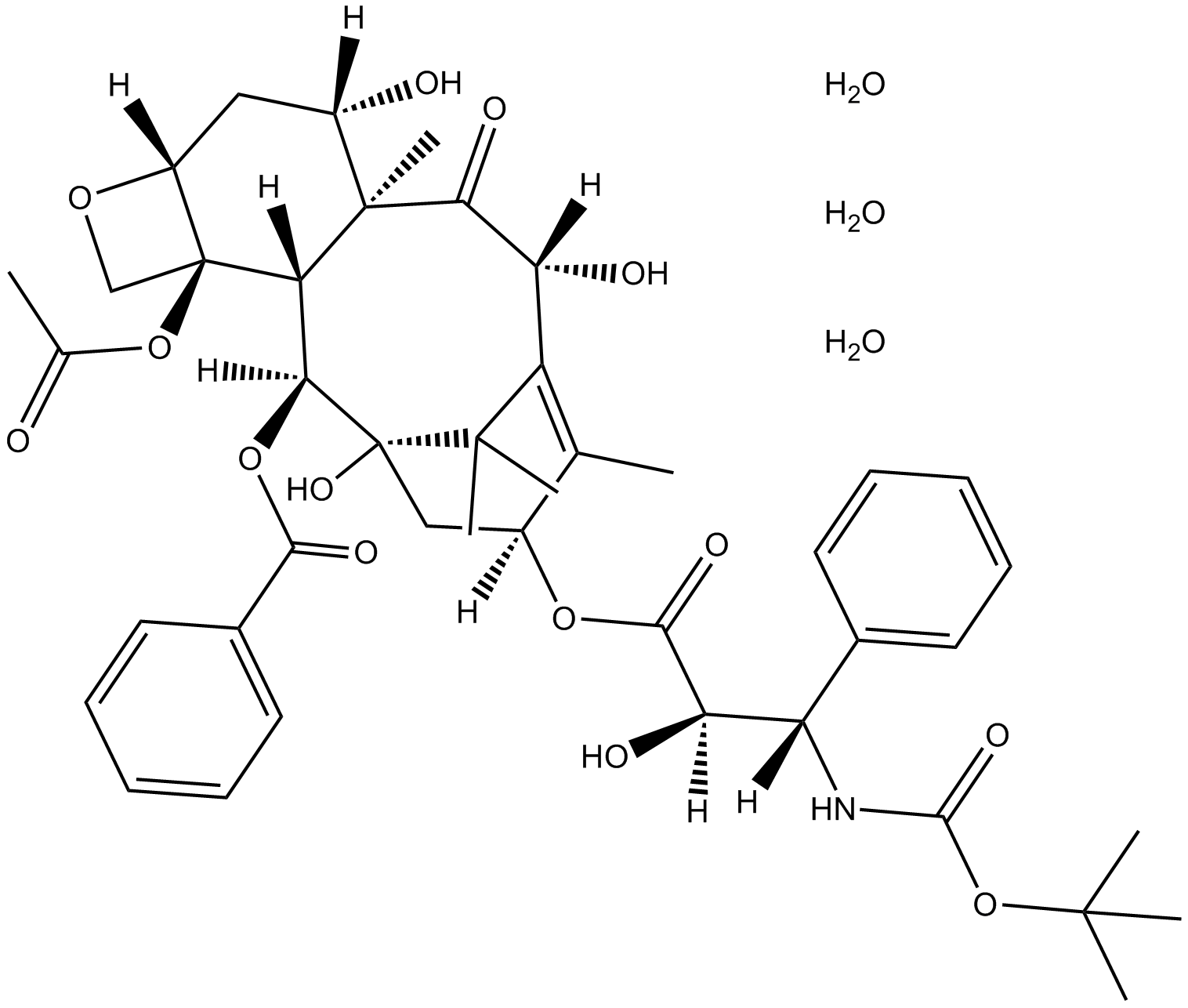
Cas No.: 148408-66-6
Sample solution is provided at 25 µL, 10mM.
_1-3.$$$39978408@51.jpg');)
_1-9.$$$38538795@65.jpg');)
_1-9.$$$39112701@51.jpg');)
_1-7.$$$37316672@70.jpg');)
_366-372.$$$36198801@70.jpg');)
.$$$38565142@65.jpg');)
_1867-1883.$$$33248023@67.jpg');)
_eads6055.$$$39977546@45.jpg');)
_eadm9805.$$$40080571@45.jpg');)
_eadj3020.$$$39666821@45.jpg');)
_1-20.$$$39757301@28.jpg');)
_1-24.$$$38898113@28.jpg');)
_273-287.$$$36806353@46.jpg');)
_1-16.$$$37156877@44.jpg');)
_1-19.$$$37460805@44.jpg');)
_1291-1307.$$$34518654@46.jpg');)
Description: IC50 Value: N/A Docetaxel, an analog of taxol, is an inhibitor of depolymerisation of microtubules through binding to stabilized microtubules. Docetaxel is a clinically well-established anti-mitotic chemotherapy medication. It is used mainly for the treatment of breast, ovarian, prostate, and non-small cell lung cancer. in vitro: IC50 concentrations (reducing survival by 50%) ranged from 0.13-3.3 ng/ml, with three neuroblastoma lines proving most sensitive and three breast and two colon carcinoma lines showing least sensitivity [1]. Docetaxel was shown to promote the assembly of microtubule protein without GTP in vitro, but no inhibitory effect on DNA, RNA and protein synthesis [2]. Gene expression changes induced by paclitaxel treatment were mainly enriched in actin cytoskeleton (ACTC1, MYL2 and MYH2), tyrosine-protein kinases (ERRB4, KIT and TIE1) and focal adhesion pathway (MYL2, IGF1 and FLT1), while the expression alterations responding to docetaxel were highly co-related to cell surface receptor linked signal transduction (SHH, DRD5 and ADM2), cytokine-cytokine receptor interaction (IL1A and IL6) and cell cycleregulation (CCNB1, CCNE2 and PCNA) [4]. in vivo: The patients, between 15 and 80 years old with performance status (PS) of 0-2, received at least two cycles of docetaxel 60 mg m-2 intravenously at 3-4 week intervals [3]. Intestinal damage after repeated dosing of docetaxel (20 mg/kg) for 3 weeks was more severe at 14HALO than at 2HALO (hours after light on). The intestinal protein expressions of Wee1, phosphorylated CDK1, and cleaved Caspase-3 were higher in the 14HALO group than in the 2HALO group, while that of survivin was lower in the 14HALO group [5]. Toxicity: Twenty-five patients were enrolled. Overall, 13/25 (52 %, 95 % CI 34-70) completed 4 cycles, and 19/25 (76 %, 95 % CI 60-87) completed ≥3 cycles. Twenty of 25 patients (80 %) experienced a Grade 3 or 4 adverse event [6]. Clinical trial: N/A
|
Cell experiment: |
Single-drug concentration-response curves are assessed. Seeding is done at a density of 2,000 cells/well for PC-3 and LNCaP, in 96-well plates. Cells are treated with each single drug and their combination for 72 h at different drug concentrations. Docetaxel is used at concentrations of 0.1-1,000 nM. GLU is used at concentrations of 0.1-300 µm. Cytotoxicity is assessed at the end of drug exposure using SRB assay. Following 72 h exposure the cells are fixed with 10% trichloroacetic acid (150 µL) for 1 h at 4°C. Then, cells are stained for 10 min at room temperature with 0.4% SRB dissolved in 1% acetic acid. The plates are then air dried for 24 h and the dye is made soluble with 150 µL Tris (10 mM, PH 7.4) for 5 min on a shaker at 1,600 rpm. Absorbance is then measured at 545 nM using microplate reader. Results are expressed as the relative percentage of absorbance compared to control[1]. |
|
Animal experiment: |
Mice[3] Five-week-old male Balb/c mice are used. Docetaxel (0, 10, 20, 30, 40, 60, and 80 mg/kg per week) is given once a week for 3 weeks for mice. Because more than 30 mg/kg per week of Docetaxel causes body weight loss in mice, 20 mg/kg per week of Docetaxel is judged to be the maximum nontoxic dose. Docetaxel (20 mg/kg per week) is given to mice once a week for 3 weeks at one of the following different points (2, 10, 14, or 22 HALO). Seventy-two hours after the final dosing of the agent, the intestinal mucosa of the small intestine (proximal 8 cm) is removed, fixed in 20 N Mildform solution (containing 8% formaldehyde in a buffered solution), and embedded in paraffin blocks, and sections of 5 μm are put on glass slides. Apoptosis is detected using the terminal deoxynucleotidyl transferase-mediated dUTP nick-end labeling (TUNEL) method, using the Apop Tag Peroxidase In Situ Apoptosis Detection Kit. Rats[4] Male Sprague-Dawley rats with body weight between 230-250 g and age between 6-7 weeks are used. About 25 SD rats are divided into five groups receiving Docetaxel (7 mg/kg, i.v.), PIP (35 mg/kg, p.o.) and their combined administration (DOX+PIP) as well as PIP (3.5 mg/kg, p.o.) and PIP (3.5 mg/kg, i.v.). A day before the drug administrations, the rats are anesthetized with an intramuscular injection of a cocktail containing 60 mg/kg ketamine and 6 mg/kg xylazine (injection volume, 0.2 mL). Right jugular vein is cannulated with a polyethylene tubing (0.5 mm ID, 1 mm) for blood collection. |
|
References: [1]. Attia RT, et al. The chemomodulatory effects of glufosfamide on docetaxel cytotoxicity in prostate cancer cells. PeerJ. 2016 Jun 29;4:e2168. |
|
| Cas No. | 148408-66-6 | SDF | |
| Chemical Name | (2aR,4S,4aS,6R,9S,11S,12S,12aR,12bS)-12b-acetoxy-9-(((2R,3S)-3-((tert-butoxycarbonyl)amino)-2-hydroxy-3-phenylpropanoyl)oxy)-4,6,11-trihydroxy-4a,8,13,13-tetramethyl-5-oxo-2a,3,4,4a,5,6,9,10,11,12,12a,12b-dodecahydro-1H-7,11-methanocyclodeca[3,4]benzo[1,2 | ||
| Canonical SMILES | CC([C@](OC([C@@](O)([H])[C@](NC(OC(C)(C)C)=O)([H])C1=CC=CC=C1)=O)([H])C[C@@]2(O)[C@](OC(C3=CC=CC=C3)=O)([H])[C@@]4([H])[C@@]([C@](O)([H])C[C@]5([H])[C@@]4(OC(C)=O)CO5)6C)=C(C(C)2C)[C@](O)([H])C6=O.O.O.O | ||
| Formula | C43H59NO17 | M.Wt | 861.93 |
| Solubility | ≥ 43.0965 mg/mL in DMSO, ≥ 87.6 mg/mL in EtOH with gentle warming | Storage | Store at -20°C |
| General tips | Please select the appropriate solvent to prepare the stock solution according to the
solubility of the product in different solvents; once the solution is prepared, please store it in
separate packages to avoid product failure caused by repeated freezing and thawing.Storage method
and period of the stock solution: When stored at -80°C, please use it within 6 months; when stored
at -20°C, please use it within 1 month. To increase solubility, heat the tube to 37°C and then oscillate in an ultrasonic bath for some time. |
||
| Shipping Condition | Evaluation sample solution: shipped with blue ice. All other sizes available: with RT, or with Blue Ice upon request. | ||
| Prepare stock solution | |||

|
1 mg | 5 mg | 10 mg |
| 1 mM | 1.1602 mL | 5.8009 mL | 11.6019 mL |
| 5 mM | 232 μL | 1.1602 mL | 2.3204 mL |
| 10 mM | 116 μL | 580.1 μL | 1.1602 mL |
Step 1: Enter information below (Recommended: An additional animal making an allowance for loss during the experiment)
 g
μL
g
μL
Step 2: Enter the in vivo formulation (This is only the calculator, not formulation. Please contact us first if there is no in vivo formulation at the solubility Section.)
Calculation results:
Working concentration: mg/ml;
Method for preparing DMSO master liquid: mg drug pre-dissolved in μL DMSO ( Master liquid concentration mg/mL, Please contact us first if the concentration exceeds the DMSO solubility of the batch of drug. )
Method for preparing in vivo formulation: Take μL DMSO master liquid, next addμL PEG300, mix and clarify, next addμL Tween 80, mix and clarify, next add μL saline, mix and clarify.
Method for preparing in vivo formulation: Take μL DMSO master liquid, next add μL Corn oil, mix and clarify.
Note: 1. Please make sure the liquid is clear before adding the next solvent.
2. Be sure to add the solvent(s) in order. You must ensure that the solution obtained, in the previous addition, is a clear solution before proceeding to add the next solvent. Physical methods such as vortex, ultrasound or hot water bath can be used to aid dissolving.
3. All of the above co-solvents are available for purchase on the GlpBio website.
Quality Control & SDS
- View current batch:
- Purity: >99.50% Appearance: A solid
- COA (Certificate of Analysis)
- SDS (Safety Data Sheet)
- Datasheet
Average Rating: 5 (Based on Reviews and 30 reference(s) in Google Scholar.)