

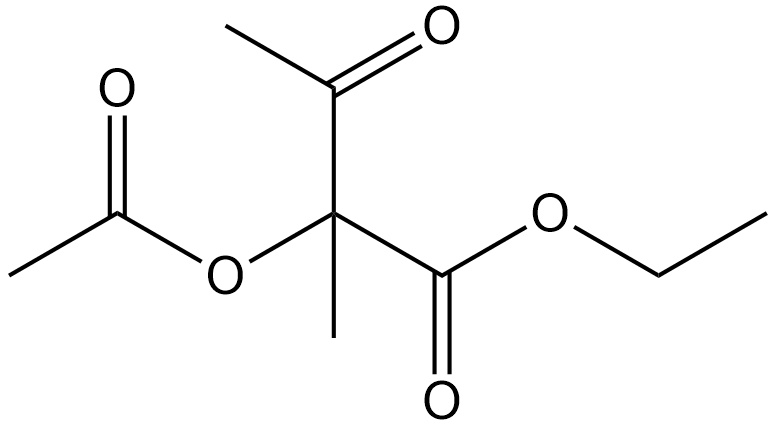
Ethyl 2-acetoxy-2-methylacetoacetate |
Catalog No.GF13011
 One-Click Copy Product Info
|

Ethyl 2-acetoxy-2-methylacetoacetate es un derivado multifuncional de β-ketoester que tiene la actividad química de éster, cetona y acetoxi. Se utiliza ampliamente en la síntesis de intermediarios farmacéuticos y monómeros de materiales
Products are for research use only. Not for human use. We do not sell to patients.
Cas No.: 25409-39-6
Sample solution is provided at 25 µL, 10mM.
_1-3.$$$39978408@51.jpg');)
_1-9.$$$38538795@65.jpg');)
_1-9.$$$39112701@51.jpg');)
_1-7.$$$37316672@70.jpg');)
_366-372.$$$36198801@70.jpg');)
.$$$38565142@65.jpg');)
_1867-1883.$$$33248023@67.jpg');)
_eads6055.$$$39977546@45.jpg');)
_eadm9805.$$$40080571@45.jpg');)
_eadj3020.$$$39666821@45.jpg');)
_1-20.$$$39757301@28.jpg');)
_1-24.$$$38898113@28.jpg');)
_273-287.$$$36806353@46.jpg');)
_1-16.$$$37156877@44.jpg');)
_1-19.$$$37460805@44.jpg');)
_1291-1307.$$$34518654@46.jpg');)
Ethyl 2-acetoxy-2-methylacetoacetate es un derivado multifuncional de β-ketoester que tiene la actividad química de éster, cetona y acetoxi. Se utiliza ampliamente en la síntesis de intermediarios farmacéuticos y monómeros de materiales [1]. Debido a su alta reactividad, debe almacenarse a baja temperatura y lejos de la luz, y se debe tomar protección durante el funcionamiento.
References:
[1].Xing RY, Whitman WB. Characterization of enzymes of the branched-chain amino acid biosynthetic pathway in Methanococcus spp. Journal of bacteriology. 1991 Mar;173(6):2086-92.
Este protocolo utiliza el experimento de sintetizar ácido 2-levulinic acid using Ethyl 2-acetoxy-2-methylacetoacetate[1-2]como ejemplo. Solo se utiliza como guía experimental. La aplicación real debe modificarse de acuerdo a susnecesidades.
1.Preparación del reactivo: Ethyl 2-acetoxy-2-methylacetoacetate; sulfuric acid (H₂SO₄, 10%); sodium bicarbonate (NaHCO₃, saturated solution); anhydrous magnesium sulfate (MgSO₄, desiccant); ether (extraction solvent).
2.Acidic hydrolysis: Agregue Ethyl 2-acetoxy-2-methylacetoacetate (5.0g, aproximadamente 24mmol) y 10% H₂SO₄ (30mL) a un matrz de fondo redondo de 100mL en secuencia y agite para mezclar. Conecte el frasco de fondo redondo a un condensador de reflujo, caliente a 80-90°C y deje de calentar después de remover durante 4-6 horas. La mezcla de reacción se enfrió a temperatura ambiente, el producto se extrajo con éter (3×20mL) y se combinaron las fases orgánicas. La fase orgánica se lavó con solución saturada de NaHCO₃ hasta que era neutra. Después del secado con MgSO₄ anhidro, el disolvente se eliminó por evaporación rotativa después de la filtración para obtener un productoi crudo.
3. Reacción de deacarboxilación: El producto crudo se disolvió en una pequeña cantidad de agua, se calentó a 100°C durante 1-2 horas para promover la liberación de CO₂. Después del enfriamiento, se extrajo de nuevo con éter, se secó y se concentró para obtener 2-levulinic acid.
4. Purificación y almacenamiento: 2-levulinic acid se destiló a presión reducida, y la fracción con un punto de ebullición de 120-130°C/10mmHg se recogió, se disolvió en etanol caliente, se enfrió y cristalizó, y se filtró y secó para obtener el producto puro. El producto puro se selló y se almacenó a 4°C (a corto plazo) o -20°C (a largo plazo) de manera a prueba de luz para evitar la absorción de humedad.
Precauciones:
1. Se debe usar equipo de protección (guantes, gafas) cuando se opera en condiciones ácidos fuertes.
2. Caliente lentamente durante la etapa de descarboxilación para evitar una ebullición violenta.
3. Por su seguridad y salud, use una bata de laboratorio y guantes desechables cuando opere.
4. Evite inhalar vapores y opere en una campana extractora.
References:
[1]. Dulieu C, Poncelet D. Spectrophotometric assay of ?-acetolactate decarboxylase. Enzyme and microbial technology. 1999 Sep 1;25(6):537-42.
[2]. Park SH, Xing R, Whitman WB. Nonenzymatic acetolactate oxidation to diacetyl by flavin, nicotinamide and quinone coenzymes. Biochimica et Biophysica Acta (BBA)-General Subjects. 1995 Dec 14;1245(3):366-70.
| Cas No. | 25409-39-6 | SDF | |
| Formula | C9H14O5 | M.Wt | 202.2 |
| Solubility | Storage | 2-8°C | |
| General tips | Please select the appropriate solvent to prepare the stock solution according to the
solubility of the product in different solvents; once the solution is prepared, please store it in
separate packages to avoid product failure caused by repeated freezing and thawing.Storage method
and period of the stock solution: When stored at -80°C, please use it within 6 months; when stored
at -20°C, please use it within 1 month. To increase solubility, heat the tube to 37°C and then oscillate in an ultrasonic bath for some time. |
||
| Shipping Condition | Evaluation sample solution: shipped with blue ice. All other sizes available: with RT, or with Blue Ice upon request. | ||
| Prepare stock solution | |||

|
1 mg | 5 mg | 10 mg |
| 1 mM | 4.9456 mL | 24.728 mL | 49.456 mL |
| 5 mM | 989.1 μL | 4.9456 mL | 9.8912 mL |
| 10 mM | 494.6 μL | 2.4728 mL | 4.9456 mL |
Step 1: Enter information below (Recommended: An additional animal making an allowance for loss during the experiment)
 g
μL
g
μL
Step 2: Enter the in vivo formulation (This is only the calculator, not formulation. Please contact us first if there is no in vivo formulation at the solubility Section.)
Calculation results:
Working concentration: mg/ml;
Method for preparing DMSO master liquid: mg drug pre-dissolved in μL DMSO ( Master liquid concentration mg/mL, Please contact us first if the concentration exceeds the DMSO solubility of the batch of drug. )
Method for preparing in vivo formulation: Take μL DMSO master liquid, next addμL PEG300, mix and clarify, next addμL Tween 80, mix and clarify, next add μL saline, mix and clarify.
Method for preparing in vivo formulation: Take μL DMSO master liquid, next add μL Corn oil, mix and clarify.
Note: 1. Please make sure the liquid is clear before adding the next solvent.
2. Be sure to add the solvent(s) in order. You must ensure that the solution obtained, in the previous addition, is a clear solution before proceeding to add the next solvent. Physical methods such as vortex, ultrasound or hot water bath can be used to aid dissolving.
3. All of the above co-solvents are available for purchase on the GlpBio website.
Quality Control & SDS
- View current batch:
- Purity: >98.00% Appearance: An oil
- COA (Certificate of Analysis)
- SDS (Safety Data Sheet)
- Datasheet
Average Rating: 5 (Based on Reviews and 30 reference(s) in Google Scholar.)