

Glimepiride (Synonyms: HOE 490) |
Catalog No.GC10104
 One-Click Copy Product Info
|

Glimepiride es una sulfonilurea de segunda generación que estimula las células β pancreáticas para liberar insulina. Glimepiride se utiliza para el tratamiento de la diabetes mellitus tipo 2 en monoterapia, así como en combinación con metformina o insulina
Products are for research use only. Not for human use. We do not sell to patients.
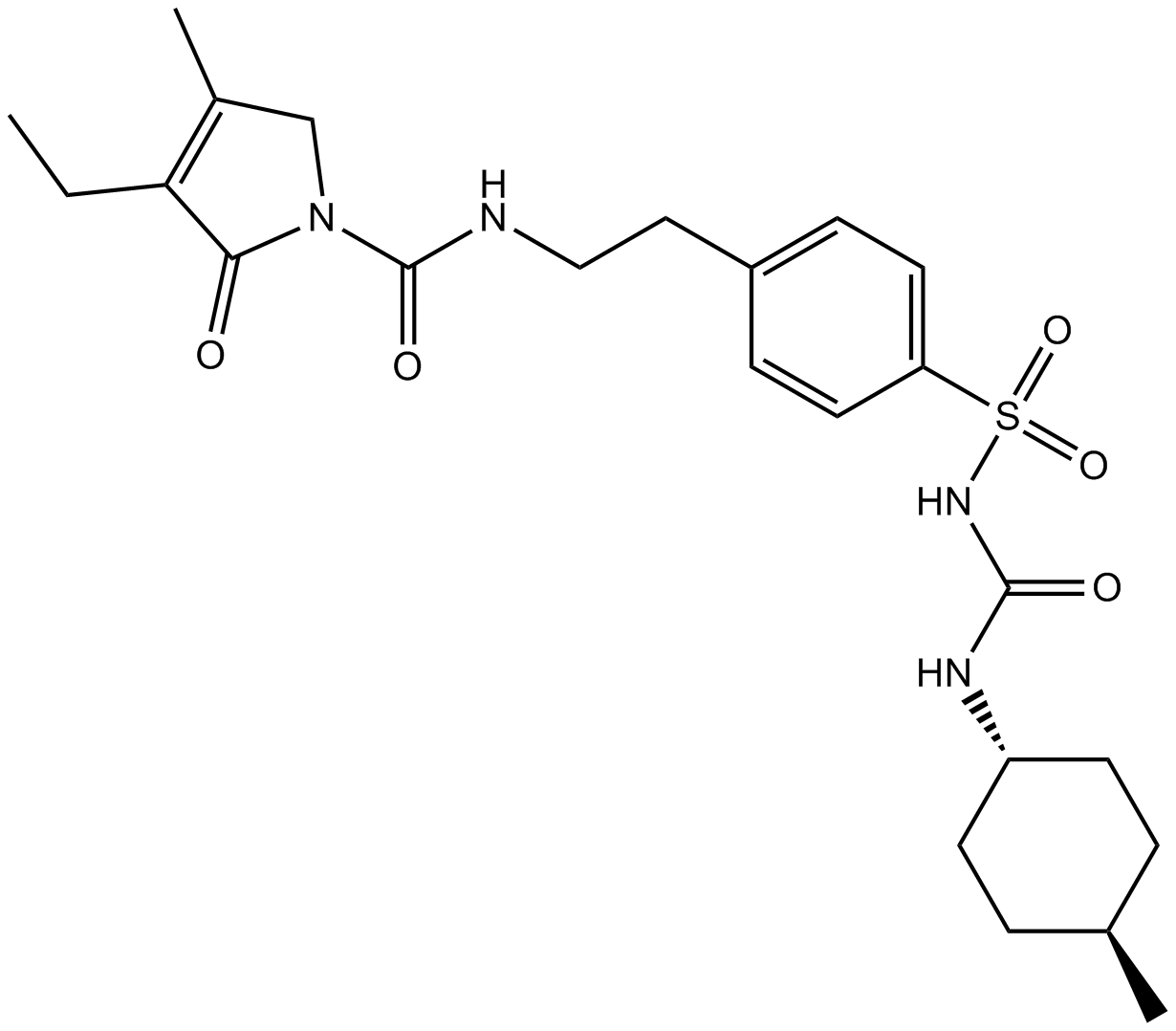
Cas No.: 93479-97-1
Sample solution is provided at 25 µL, 10mM.
_1-3.$$$39978408@51.jpg');)
_1-9.$$$38538795@65.jpg');)
_1-9.$$$39112701@51.jpg');)
_1-7.$$$37316672@70.jpg');)
_366-372.$$$36198801@70.jpg');)
.$$$38565142@65.jpg');)
_1867-1883.$$$33248023@67.jpg');)
_eads6055.$$$39977546@45.jpg');)
_eadm9805.$$$40080571@45.jpg');)
_eadj3020.$$$39666821@45.jpg');)
_1-20.$$$39757301@28.jpg');)
_1-24.$$$38898113@28.jpg');)
_273-287.$$$36806353@46.jpg');)
_1-16.$$$37156877@44.jpg');)
_1-19.$$$37460805@44.jpg');)
_1291-1307.$$$34518654@46.jpg');)
Glimepiride es una sulfonilurea de segunda generación que estimula las células β pancreáticas para liberar insulina. Glimepiride se utiliza para el tratamiento de la diabetes mellitus tipo 2 en monoterapia, así como en combinación con metformina o insulina[1].
In vitro, Glimepiride (0, 0.3, 0.6, 1.2, 2.5 y 5μM; 1h) estimuló la liberación de CD14 de las células RAW 264[2]. Glimepiride (10μM; 1, 4 y 7 días) indujo la proliferación y diferenciación de los osteoblastos de rata en un microambiente con alto contenido de glucosa[3]. Glimepiride (10µM; 30min) induce la producción de NO por los HCAECs[4].
In vivo, Glimepiride (1, 2 o 4mg/kg; 4 días; p.o.) previene la degeneración de las neuronas dopamina inducida por la 1-methyl-4-phenyl-1,2,3,6-tetrahydropyridine a través de la atenuación de la activación de la glia y el estrés oxidativo en ratones [5]. Glimepiride (4mg/kg; 3 semanas; i.p.) mejora la toxicidad renal inducida por el cadmio en ratones[6].
References:
[1] Basit A, Riaz M, Fawwad A. Glimepiride: evidence-based facts, trends, and observations (GIFTS). [corrected]. Vasc Health Risk Manag. 2012;8:463-72.
[2] Ingham V, Williams A, Bate C. Glimepiride reduces CD14 expression and cytokine secretion from macrophages. J Neuroinflammation. 2014 Jun 21;11:115.
[3] Ma P, Gu B, Xiong W, Tan B, Geng W, Li J, Liu H. Glimepiride promotes osteogenic differentiation in rat osteoblasts via the PI3K/Akt/eNOS pathway in a high glucose microenvironment. PLoS One. 2014 Nov 12;9(11):e112243.
[4] Ueba H, Kuroki M, Hashimoto S, Umemoto T, Yasu T, Ishikawa SE, Saito M, Kawakami M. Glimepiride induces nitric oxide production in human coronary artery endothelial cells via a PI3-kinase-Akt dependent pathway. Atherosclerosis. 2005 Nov;183(1):35-9.
[5] Oduola-Akande MD, Ishola IO, Olubodun-Obadun TG, Akande AJ, Adeyemi OO. Glimepiride Prevents 1-Methyl-4-Phenyl-1,2,3,6-Tetrahydropyridine Induced Dopamine Neurons Degeneration Through Attenuation of Glia Activation and Oxidative Stress in Mice. Neurotox Res. 2023 Jun;41(3):212-223.
[6] ElMahdy MK, Zaki MO, Al-Karmalawy AA, Abdo W, Alnasser SM, Antar SA. Glimepiride ameliorates renal toxicity induced by cadmium in mice: Modulation of Jun N terminal kinase (JNK)/nuclear factor kappa B (NF-κB) and phosphatidylinositol 3-kinases (PI3K)/protein kinase (AKT) pathways. Life Sci. 2022 Dec 15;311(Pt B):121184.
| Experimentos celulares [1]: | |
Líneas celulares | HCAEC |
Método de preparación | Los HCAEC se incubaron con 10µM de Glimepiride, HGF (control positivo) o vehículo en el tampón de Krebs (118mM NaCl, 4,7mM KCl, 2,5mM de CaCl2, 1,2 mM MgSO4, 1,2 mM KH2PO4, 11mM de glucosa, 25mM de NaHCO3, 20mM HEPES, pH 7,4) precalentado a 37°C; después de 30 minutos, el sobrenadante se recogió de los platos y se mantuvo a 4 °C. El óxido nítrico (NO) liberado se cuantificó dentro de las 24 horas de cada recolección utilizando un sistema HPLC de análisis de NOx. |
Condiciones de reacción | 10µM; 30min |
Áreas de aplicación | Glimepiride induce la producción de NO por parte de los HCAEC. |
| Experimentos con animales [2]: | |
Modelos animales | 20 a 25 g de ratones |
Método de preparación | Durante el período experimental, los animales tuvieron acceso ad libitum a alimentos y agua; se dividieron en cuatro grupos: el Grupo 1 recibió solución salina como control normal, el Grupo 2 recibió CdCl2 intraperitoneal (6,5 mg/kg) durante siete días consecutivos como control de CdCl2, el Grupo 3 recibió Glimepiride (4 mg/kg; i.p.), y el Grupo 4 fue cotratado con CdCl2 más Glimepirida, con Glimepiride continuó durante 3 semanas. Veinticuatro horas después de la última dosis, los ratones fueron anestesiados con sodio tiopental (50 mg/kg/kg) y sacrificados; la sangre recogida a través de una punción cardíaca en tubos secos de Eppendorf se dejó coagularse durante 30 minutos y luego se centrifugó a 2000 g durante 15 minutos, y el suero se almacenó a -20 °C para ensayos bioquímicos; ambos riñones fueron extirpados, uno fijado en paraformaldehído al 10% para histopatología y el otro se congeló a -80 °C para ELISA. |
Forma de dosificación | 4 mg/kg; 3 semanas; i.p. |
Áreas de aplicación | Glimepiride mejora la toxicidad renal inducida por el cadmio en ratones. |
References: | |
| Cas No. | 93479-97-1 | SDF | |
| Sinónimos | HOE 490 | ||
| Chemical Name | 4-ethyl-3-methyl-N-[2-[4-[(4-methylcyclohexyl)carbamoylsulfamoyl]phenyl]ethyl]-5-oxo-2H-pyrrole-1-carboxamide | ||
| Canonical SMILES | CCC1=C(CN(C1=O)C(=O)NCCC2=CC=C(C=C2)S(=O)(=O)NC(=O)NC3CCC(CC3)C)C | ||
| Formula | C24H34N4O3S | M.Wt | 490.62 |
| Solubility | ≥ 21.45 mg/mL in DMSO | Storage | Store at -20°C,dry,protect from light |
| General tips | Please select the appropriate solvent to prepare the stock solution according to the
solubility of the product in different solvents; once the solution is prepared, please store it in
separate packages to avoid product failure caused by repeated freezing and thawing.Storage method
and period of the stock solution: When stored at -80°C, please use it within 6 months; when stored
at -20°C, please use it within 1 month. To increase solubility, heat the tube to 37°C and then oscillate in an ultrasonic bath for some time. |
||
| Shipping Condition | Evaluation sample solution: shipped with blue ice. All other sizes available: with RT, or with Blue Ice upon request. | ||
| Prepare stock solution | |||

|
1 mg | 5 mg | 10 mg |
| 1 mM | 2.0382 mL | 10.1912 mL | 20.3824 mL |
| 5 mM | 407.6 μL | 2.0382 mL | 4.0765 mL |
| 10 mM | 203.8 μL | 1.0191 mL | 2.0382 mL |
Step 1: Enter information below (Recommended: An additional animal making an allowance for loss during the experiment)
 g
μL
g
μL
Step 2: Enter the in vivo formulation (This is only the calculator, not formulation. Please contact us first if there is no in vivo formulation at the solubility Section.)
Calculation results:
Working concentration: mg/ml;
Method for preparing DMSO master liquid: mg drug pre-dissolved in μL DMSO ( Master liquid concentration mg/mL, Please contact us first if the concentration exceeds the DMSO solubility of the batch of drug. )
Method for preparing in vivo formulation: Take μL DMSO master liquid, next addμL PEG300, mix and clarify, next addμL Tween 80, mix and clarify, next add μL saline, mix and clarify.
Method for preparing in vivo formulation: Take μL DMSO master liquid, next add μL Corn oil, mix and clarify.
Note: 1. Please make sure the liquid is clear before adding the next solvent.
2. Be sure to add the solvent(s) in order. You must ensure that the solution obtained, in the previous addition, is a clear solution before proceeding to add the next solvent. Physical methods such as vortex, ultrasound or hot water bath can be used to aid dissolving.
3. All of the above co-solvents are available for purchase on the GlpBio website.
Quality Control & SDS
- View current batch:
- Purity: >98.00% Appearance: A solid
- COA (Certificate of Analysis)
- SDS (Safety Data Sheet)
- Datasheet
Average Rating: 5 (Based on Reviews and 30 reference(s) in Google Scholar.)