

GP531 |
Catalog No.GC32675
 One-Click Copy Product Info
|

GP531 es un potente agente regulador de la adenosina de segunda generaciÓn, es farmacolÓgicamente silencioso en condiciones basales pero aumenta la adenosina endÓgena localizada durante la isquemia.
Products are for research use only. Not for human use. We do not sell to patients.
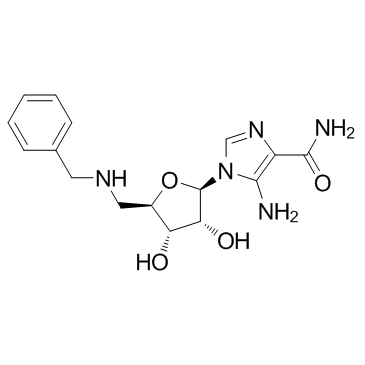
Cas No.: 142344-87-4
Sample solution is provided at 25 µL, 10mM.
_1-3.$$$39978408@51.jpg');)
_1-9.$$$38538795@65.jpg');)
_1-9.$$$39112701@51.jpg');)
_1-7.$$$37316672@70.jpg');)
_366-372.$$$36198801@70.jpg');)
.$$$38565142@65.jpg');)
_1867-1883.$$$33248023@67.jpg');)
_eads6055.$$$39977546@45.jpg');)
_eadm9805.$$$40080571@45.jpg');)
_eadj3020.$$$39666821@45.jpg');)
_1-20.$$$39757301@28.jpg');)
_1-24.$$$38898113@28.jpg');)
_273-287.$$$36806353@46.jpg');)
_1-16.$$$37156877@44.jpg');)
_1-19.$$$37460805@44.jpg');)
_1291-1307.$$$34518654@46.jpg');)
GP531 is a potent, second-generation adenosine regulating agent, is pharmacologically silent under basal conditions but increases localized endogenous adenosine during ischemia.
Low-dose GP531 reduces infarct size by 34% compared with vehicle and reduces the extent of the anatomic no-reflow zone by 31% compared with vehicle. Infarct size and zone of no-reflow in the high dose are reduced by 22% and 16%, respectively. GP531 does not affect hemodynamics or blood flow. GP531 is effective at the lower dose in reducing the severity of ischemic/reperfusion injury, without inducing the adverse hemodynamic effects associated with adenosine administration such as bradycardia and hypotension[1]. GP531 infusion has no effect on heart rate or mean aortic pressure but significantly decreases left ventricular end-diastolic pressure, end-diastolic volume, end-systolic volume and end-diastolic wall stress. GP531 significantly increases left ventricular EF, deceleration time of early mitral inflow velocity and the slope of end-systolic PVR without increasing MVO2[2].
[1]. Hale SL, et al. Cardioprotection with adenosine-regulating agent, GP531: effects on no-reflow, infarct size, and blood flow following ischemia/ reperfusion in the rabbit. J Cardiovasc Pharmacol Ther. 2010 Mar;15(1):60-7. [2]. Wang M, et al. Acute intravenous infusion of an adenosine regulating agent improves left ventricular function in dogs with advanced heart failure. Cardiovasc Drugs Ther. 2013 Dec;27(6):489-98.
Animal experiment: | Rabbits: Baseline hemodynamic parameters and temperature are obtained. The rabbits are randomized to 1 of 3 groups: a low dose of GP531, a high dose of GP 531, or vehicle (10% sodium metabisulfite). The low dose consists of a loading dose of 700 mg/kg given over 10 minutes starting at 12 minutes before coronary artery occlusion, followed by an infusion of 10 mg/kg per minute for the duration of the study. The high dose consists of a loading dose of 2100 mg/kg given over 10 minutes starting at 12 minutes before CAO followed by an infusion of 30 mg/kg per min for the duration of the study. All rabbits receive the same volume (12 mL over the duration of the study), so the concentrations are adjusted for body weight. The rabbits are then subjected to 30 minutes of coronary artery occlusion. The coronary artery is occluded by tightening the snare. Regional myocardial blood flow is measured during the ischemic period at 25 minutes of CAO[1]. Dog: Six dogs with intracoronary microembolizationinduced HF receive a constant intravenous infusion of GP531 (10 μg/kg/min) or vehicle (normal saline) for 6 h in random order 1 week apart. Hemodynamic measurements are made at baseline and at 1, 2, 3, 4, 5 and 6 h after initiating drug infusion. Myocardial oxygen consumption (MVO2) is measured at baseline and 4 and 6 h. LV pressure-volume relationship (PVR) is measured at baseline and 6 h[2]. |
References: [1]. Hale SL, et al. Cardioprotection with adenosine-regulating agent, GP531: effects on no-reflow, infarct size, and blood flow following ischemia/ reperfusion in the rabbit. J Cardiovasc Pharmacol Ther. 2010 Mar;15(1):60-7. | |
| Cas No. | 142344-87-4 | SDF | |
| Canonical SMILES | O=C(C1=C(N)N([C@H]2[C@@H]([C@@H]([C@@H](CNCC3=CC=CC=C3)O2)O)O)C=N1)N | ||
| Formula | C16H21N5O4 | M.Wt | 347.37 |
| Solubility | DMSO: 125 mg/mL (359.85 mM) | Storage | Store at -20°C |
| General tips | Please select the appropriate solvent to prepare the stock solution according to the
solubility of the product in different solvents; once the solution is prepared, please store it in
separate packages to avoid product failure caused by repeated freezing and thawing.Storage method
and period of the stock solution: When stored at -80°C, please use it within 6 months; when stored
at -20°C, please use it within 1 month. To increase solubility, heat the tube to 37°C and then oscillate in an ultrasonic bath for some time. |
||
| Shipping Condition | Evaluation sample solution: shipped with blue ice. All other sizes available: with RT, or with Blue Ice upon request. | ||
| Prepare stock solution | |||

|
1 mg | 5 mg | 10 mg |
| 1 mM | 2.8788 mL | 14.3939 mL | 28.7877 mL |
| 5 mM | 575.8 μL | 2.8788 mL | 5.7575 mL |
| 10 mM | 287.9 μL | 1.4394 mL | 2.8788 mL |
Step 1: Enter information below (Recommended: An additional animal making an allowance for loss during the experiment)
 g
μL
g
μL
Step 2: Enter the in vivo formulation (This is only the calculator, not formulation. Please contact us first if there is no in vivo formulation at the solubility Section.)
Calculation results:
Working concentration: mg/ml;
Method for preparing DMSO master liquid: mg drug pre-dissolved in μL DMSO ( Master liquid concentration mg/mL, Please contact us first if the concentration exceeds the DMSO solubility of the batch of drug. )
Method for preparing in vivo formulation: Take μL DMSO master liquid, next addμL PEG300, mix and clarify, next addμL Tween 80, mix and clarify, next add μL saline, mix and clarify.
Method for preparing in vivo formulation: Take μL DMSO master liquid, next add μL Corn oil, mix and clarify.
Note: 1. Please make sure the liquid is clear before adding the next solvent.
2. Be sure to add the solvent(s) in order. You must ensure that the solution obtained, in the previous addition, is a clear solution before proceeding to add the next solvent. Physical methods such as vortex, ultrasound or hot water bath can be used to aid dissolving.
3. All of the above co-solvents are available for purchase on the GlpBio website.
Quality Control & SDS
- View current batch:
- Purity: >98.50% Appearance: A solid
- COA (Certificate of Analysis)
- SDS (Safety Data Sheet)
- Datasheet
Average Rating: 5 (Based on Reviews and 9 reference(s) in Google Scholar.)