

HS 014 |
Catalog No.GC12840
 One-Click Copy Product Info
|

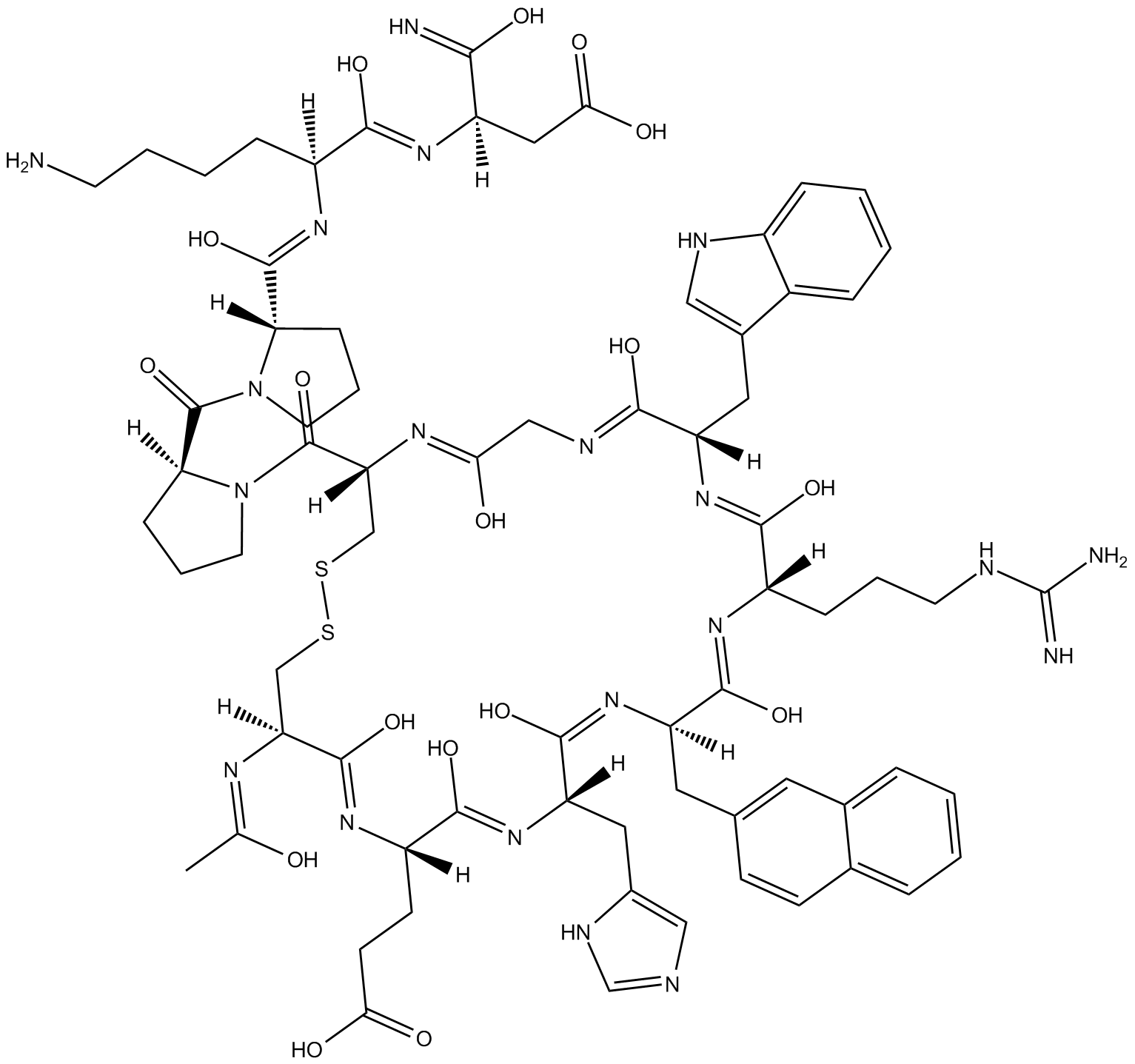
HS 014 es un antagonista muy selectivo del receptor de melanocortina MC4, su valor Ki alcanza los 3.16nM.
Products are for research use only. Not for human use. We do not sell to patients.
Cas No.: 207678-81-7
Sample solution is provided at 25 µL, 10mM.
_1-3.$$$39978408@51.jpg');)
_1-9.$$$38538795@65.jpg');)
_1-9.$$$39112701@51.jpg');)
_1-7.$$$37316672@70.jpg');)
_366-372.$$$36198801@70.jpg');)
.$$$38565142@65.jpg');)
_1867-1883.$$$33248023@67.jpg');)
_eads6055.$$$39977546@45.jpg');)
_eadm9805.$$$40080571@45.jpg');)
_eadj3020.$$$39666821@45.jpg');)
_1-20.$$$39757301@28.jpg');)
_1-24.$$$38898113@28.jpg');)
_273-287.$$$36806353@46.jpg');)
_1-16.$$$37156877@44.jpg');)
_1-19.$$$37460805@44.jpg');)
_1291-1307.$$$34518654@46.jpg');)
HS 014 es un antagonista muy selectivo del receptor de melanocortina MC4, su valor Ki alcanza los 3.16nM. Al bloquear la unión entre el receptor MC4 y sus ligandos naturales, consigue regular el apetito y el equilibrio energético del organismo. Además, frena las reacciones inflamatorias, ya que reprime la expresión de la proteína Fos provocada por la interleucina 1β[1-2]. Muchos grupos de investigación lo emplean parar estudiar la obesidad, la diabetes y el síndrome metabólico[3-4].
Primero se pretratan los melanocitos epidérmicos con HS 014 (10nM–200nM) durante 30 minutos. Después se estimulan las células con β-MSH (200nM) con el análogo NDP-α-MSH durante 72 horas. Se observa HS 014 limita mucho la síntesis de melanina y baja la generación de cAMP en estas células[5]. También se usan células de astrocitoma M1830 que sobreexpresan el receptor MC4R. Al incubarlas con HS 014 (1nM) durante 12 días, baja la cantidad de las proteínas p-JNK, ATF3 y c-Jun. Así mismo, se frena la activación de la vía de señalización JNK[6].
Se inyectó una única dosis intracerebroventricular de HS 014 (1μg; 5μl) en las que se había provocado fiebre con una dosis intraperitoneal de LPS (30μg/kg). El compuesto no modifica la respuesta febril por sí solo, pero anula por completo el efecto antipirético del agonista selectivo MRLOB-0001 del receptor MC4R , administrado también por vía intracerebroventricular a 150ng[7]. Se prueba también una instilación intranasal de HS 014 (3.5ng o 100μg). Se aplica una sola dosis treinta munitos antes de algo a las ratas a un estrés proloongado agudo. La dosis de 100μg logra reducir el aumento de corticosterona plasmática que aparece media hora después del estrés. Ambas concentraciones evitan que el estrés suba los niveles de mRNA de la hormona liberadora de corticotropina en el hipotálamo mediobasal. También impiden el incremento de los mensajeros mRNA de tirosina hidroxilasa y dopamina β-hydroxylase en el locus coerúleo[8].
References:
[1] Schiöth HB, Mutulis F, Muceniece R, et al. Discovery of novel melanocortin4 receptor selective MSH analogues. Br J Pharmacol. 1998 May;124(1):75-82.
[2] Ercil NE, Galici R, Kesterson RA. HS014, a selective melanocortin-4 (MC4) receptor antagonist, modulates the behavioral effects of morphine in mice. Psychopharmacology (Berl). 2005 Jul;180(2):279-85.
[3] Kask A, Rägo L, Mutulis F, et al. Selective antagonist for the melanocortin 4 receptor (HS014) increases food intake in free-feeding rats. Biochem Biophys Res Commun. 1998 Apr 7;245(1):90-3.
[4] Gao Z, Lei D, Welch J, et al. Agonist-dependent internalization of the human melanocortin-4 receptors in human embryonic kidney 293 cells. J Pharmacol Exp Ther. 2003 Dec;307(3):870-7.
[5] Spencer JD, Schallreuter KU. Regulation of pigmentation in human epidermal melanocytes by functional high-affinity beta-melanocyte-stimulating hormone/melanocortin-4 receptor signaling. Endocrinology. 2009 Mar;150(3):1250-8.
[6] Zhao Y, Xin Y, Chu H. MC4R Is Involved in Neuropathic Pain by Regulating JNK Signaling Pathway After Chronic Constriction Injury. Front Neurosci. 2019 Sep 10;13:919.
[7] Loopuijt LD. Local application of L- threo-hydroxyaspartate and malonate in rats in vivo induces rigidity and damages neurons of the substantia nigra, pars compacta. J Neural Transm (Vienna). 2002 Oct;109(10):1275-94.
[8] Serova LI, Laukova M, Alaluf LG, et al, Blockage of melanocortin-4 receptors by intranasal HS014 attenuates single prolonged stress-triggered changes in several brain regions. J Neurochem. 2014 Dec;131(6):825-35.
| Experimentos celulares [1]: | |
Líneas celulares | Melanocitos epidérmicos y queratinocitos |
Método de preparación | Los melanocitos epidérmicos y los queratinocitos (fototipo III) se sembraron en placas de seis pozos y se preincubaron en un medio que carecía de acetato de tetradecanoilforbol suplementado durante 48 horas. Antes de la estimulación, se añadió el antagonista específico de MC4-R HS 014 (10nM-200nM) a los pozos apropiados. |
Condiciones de reacción | 10nM-200nM; 30min. |
Áreas de aplicación | HS 014 atenuó la inducción de la formación de melanina en melanocitos estimulados por β-MSH o NDP-α-MSH durante 72 horas. Tanto en melanocitos como en queratinocitos, HS 014 atenuó la respuesta de cAMP inducida por β-MSH o NDP-α-MSH después de 1 hora de estimulación. |
| Experimentos con animales [2]: | |
Modelos animales | Ratas machos adultos de Sprague-Dawley |
Método de preparación | Las ratas fueron implantadas con un transmisor de radiotelemetría para el monitoreo de la temperatura corporal central (Tc) y una cánula de guía en el ventrículo lateral derecho para la inyección intracerebroventricular (icv). El día del experiemnto, las ratas recibieron una inyección intraperitoneal (i.p.) de lipopolisacárido endotoxina bacteriana (LPS; 30µg/kg) para inducir fiebre, seguida 30 minutos después por la inyección icv de HS 014 o vehículo (líquido cefalorraquídeo artificial, aCSF). Tc y actividad motora se registraron, y la temperatura de la piel de la cola (Tsk) se midió cada hora. |
Forma de dosificación | 1µg en 5µl; icv; inyección única |
Áreas de aplicación | HS 014 no tuvo ningún efecto en el aumento febril inducido por LPS en la temperatura corporal central (Tc) o la disminución asociada en la temperatura de la piel de la cola (Tsk) en ratas. HS 014 tampoco tuvo un efecto sobre Tc, Tsk, o actividad motora en ratas afebriles (tratadas con salina). Sin embargo, la misma dosis de HS 014 bloqueó por completo los efectos antipiréticos y antivasoconstrictores de un agonista selectivo MC4R coadministrado (MRLOB-0001; 150ng; icv) durante la primera fase de fiebre. |
References: | |
| Cas No. | 207678-81-7 | SDF | |
| Chemical Name | (R)-3-((Z)-((S)-2-((Z)-(((S)-1-((S)-1-((4S,5Z,8Z,10S,11Z,13S,14Z,16R,17E,19S,20Z,22S,23Z,25R)-19-((1H-imidazol-5-yl)methyl)-10-((1H-indol-3-yl)methyl)-22-(2-carboxyethyl)-13-(3-guanidinopropyl)-6,9,12,15,18,21,24-heptahydroxy-25-((Z)-(1-hydroxyethylidene) | ||
| Canonical SMILES | C/C(O)=N/[C@@](/C(O)=N/[C@@](/C(O)=N/[C@@](/C(O)=N\[C@](/C(O)=N/[C@@](/C(O)=N/[C@@](/C(O)=N/C/C(O)=N/1)([H])CC2=CNC3=CC=CC=C23)([H])CCCNC(N)=N)([H])CC4=CC5=CC=CC=C5C=C4)([H])CC6=CN=CN6)([H])CCC(O)=O)([H])CSSC[C@]1([H])C(N7CCC[C@@]7([H])C(N8CCC[C@@]8([H])/ | ||
| Formula | C71H94N20O17S2 | M.Wt | 1563.77 |
| Solubility | Soluble to 1 mg/ml in Water | Storage | Desiccate at -20°C |
| General tips | Please select the appropriate solvent to prepare the stock solution according to the
solubility of the product in different solvents; once the solution is prepared, please store it in
separate packages to avoid product failure caused by repeated freezing and thawing.Storage method
and period of the stock solution: When stored at -80°C, please use it within 6 months; when stored
at -20°C, please use it within 1 month. To increase solubility, heat the tube to 37°C and then oscillate in an ultrasonic bath for some time. |
||
| Shipping Condition | Evaluation sample solution: shipped with blue ice. All other sizes available: with RT, or with Blue Ice upon request. | ||
| Prepare stock solution | |||

|
1 mg | 5 mg | 10 mg |
| 1 mM | 639.5 μL | 3.1974 mL | 6.3948 mL |
| 5 mM | 127.9 μL | 639.5 μL | 1.279 mL |
| 10 mM | 63.9 μL | 319.7 μL | 639.5 μL |
Step 1: Enter information below (Recommended: An additional animal making an allowance for loss during the experiment)
 g
μL
g
μL
Step 2: Enter the in vivo formulation (This is only the calculator, not formulation. Please contact us first if there is no in vivo formulation at the solubility Section.)
Calculation results:
Working concentration: mg/ml;
Method for preparing DMSO master liquid: mg drug pre-dissolved in μL DMSO ( Master liquid concentration mg/mL, Please contact us first if the concentration exceeds the DMSO solubility of the batch of drug. )
Method for preparing in vivo formulation: Take μL DMSO master liquid, next addμL PEG300, mix and clarify, next addμL Tween 80, mix and clarify, next add μL saline, mix and clarify.
Method for preparing in vivo formulation: Take μL DMSO master liquid, next add μL Corn oil, mix and clarify.
Note: 1. Please make sure the liquid is clear before adding the next solvent.
2. Be sure to add the solvent(s) in order. You must ensure that the solution obtained, in the previous addition, is a clear solution before proceeding to add the next solvent. Physical methods such as vortex, ultrasound or hot water bath can be used to aid dissolving.
3. All of the above co-solvents are available for purchase on the GlpBio website.
Quality Control & SDS
- View current batch:
- Purity: >98.00% Appearance: A solid
- COA (Certificate of Analysis)
- SDS (Safety Data Sheet)
- Datasheet
Average Rating: 5 (Based on Reviews and 26 reference(s) in Google Scholar.)