

NCGC00378430 |
Catalog No.GC62286
 One-Click Copy Product Info
|

NCGC00378430 es un potente inhibidor de la interacciÓn SIX1/EYA2. NCGC00378430 invierte parcialmente los perfiles metabÓlicos y transcripcionales mediados por la sobreexpresiÓn de SIX1 y revierte la seÑalizaciÓn de TGF-β inducida por SIX1 y la transiciÓn epitelial-mesenquimatosa (EMT). NCGC00378430 inhibe la metÁstasis de cÁncer de mama mediada por SIX1 en un modelo de ratÓn.
Products are for research use only. Not for human use. We do not sell to patients.
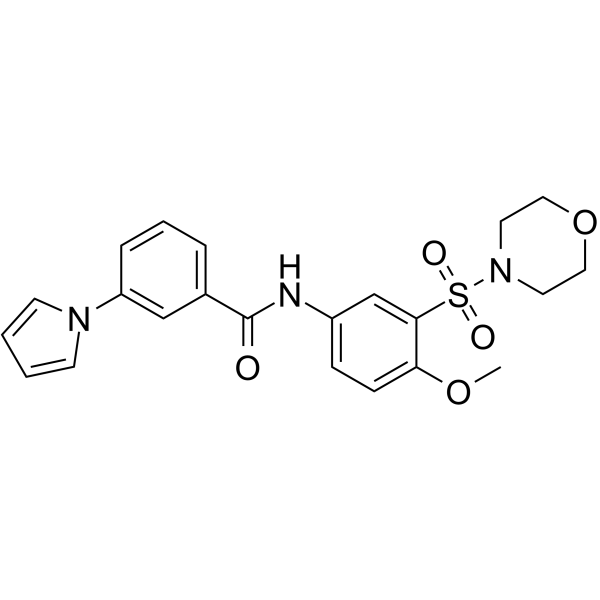
Cas No.: 920650-00-6
Sample solution is provided at 25 µL, 10mM.
_1-3.$$$39978408@51.jpg');)
_1-9.$$$38538795@65.jpg');)
_1-9.$$$39112701@51.jpg');)
_1-7.$$$37316672@70.jpg');)
_366-372.$$$36198801@70.jpg');)
.$$$38565142@65.jpg');)
_1867-1883.$$$33248023@67.jpg');)
_eads6055.$$$39977546@45.jpg');)
_eadm9805.$$$40080571@45.jpg');)
_eadj3020.$$$39666821@45.jpg');)
_1-20.$$$39757301@28.jpg');)
_1-24.$$$38898113@28.jpg');)
_273-287.$$$36806353@46.jpg');)
_1-16.$$$37156877@44.jpg');)
_1-19.$$$37460805@44.jpg');)
_1291-1307.$$$34518654@46.jpg');)
NCGC00378430 is a potent inhibitor of the SIX1/EYA2 protein-protein interaction[1]. NCGC00378430 disrupts the SIX1/EYA2 complex, reverses SIX1-induced TGF-β signaling activation, and counteracts the epithelial-mesenchymal transition (EMT) phenotype. NCGC00378430 is applicable in research areas such as breast cancer and pulmonary fibrosis[2-3].
In vitro, NCGC00378430 (10µM) was used to treat KIRC cells for 3 days. NCGC00378430 did not alter cell viability or proliferation, nor did NCGC00378430 impair the binding of SIX1 to the ITGB1 promoter. NCGC00378430 had no effect on SIX1-induced ITGB1 transcription, but did disrupt the SIX1-EYA2 interaction[1]. NCGC00378430 (10–20µM) was applied to MCF7-SIX1, T47D, and MDA-MB-231 breast cancer cell lines for 3 days. NCGC00378430 significantly disrupted the SIX1/EYA2 protein-protein interaction and reversed the TGF-β signaling activation and EMT phenotype induced by SIX1 overexpression[2].
In vivo, NCGC00378430 (25mg/kg) was administered via local injection (near the tumor cell injection site) every other day to NSG mice bearing MCF7-SIX1 tumors, from day 3 to day 21 post-injection. NCGC00378430 significantly inhibited breast cancer metastasis but did not affect the growth of the primary tumor[2]. NCGC00378430 (20mg/kg) was delivered intranasally every three days to either Six1 conditionally overexpressing mice (from day 3 to day 21) or wild-type C57BL/6 mice (from day 10 to day 21) in a bleomycin-induced pulmonary fibrosis model. NCGC00378430 alleviated fibrotic changes and enhanced lung function[3].
References:
[1] Huang S, Hu J, Hu M, et al. Cooperation between SIX1 and DHX9 transcriptionally regulates integrin-focal adhesion signaling mediated metastasis and sunitinib resistance in KIRC. Oncogene. 2024 Sep;43(39):2951-2969.
[2] Zhou H, Blevins MA, Hsu JY, et al. Identification of a Small-Molecule Inhibitor That Disrupts the SIX1/EYA2 Complex, EMT, and Metastasis. Cancer Res. 2020 Jun 15;80(12):2689-2702.
[3] Fan Y, Tian Z, Zheng H, et al. Six1 promotes alveolar epithelium senescence in pulmonary fibrosis through regulating Tp53. Int Immunopharmacol. 2025 Dec 3;166:115554.
| Cell experiment [1]: | |
Cell lines | MCF7-SIX1 cells (human breast adenocarcinoma cell line with SIX1 overexpression), MCF7-Ctrl cells (control), T47D cells (human breast ductal carcinoma cell line), MDA-MB-231 cells (human breast adenocarcinoma cell line) |
Preparation Method | Cells were maintained in Dulbecco's modified Eagle's medium (DMEM) supplemented with 10% fetal bovine serum (FBS). MCF7-SIX1 and MCF7-Ctrl cells were treated with 10µM NCGC00378430 for 3 days. T47D and MDA-MB-231 cells were treated with 20µM NCGC00378430 for 3 days. |
Reaction Conditions | 10 or 20nM; 3 days. |
Applications | NCGC00378430 significantly disrupted the SIX1-EYA2 protein-protein interaction and reduced SIX1/EYA2 transcriptional activity. NCGC00378430 partially reversed transcriptional and metabolic profiles induced by SIX1 overexpression, including reversing gene expression signatures of epithelial-mesenchymal transition (EMT). In MCF7-SIX1 cells, NCGC00378430 suppressed TGF-β signaling (reduced phospho-SMAD3), restored membranous E-cadherin localization, and decreased fibronectin expression. |
| Animal experiment [2]: | |
Animal models | Six1 conditionally overexpressing mice (Six1-CTG) in alveolar epithelial cells and wild-type (WT) C57BL/6 mice. |
Preparation Method | Mice were treated with NCGC00378430 (20mg/kg) via transnasal delivery every three days. For the preventive regimen, treatment started on day 3 post-bleomycin (BLM) induction until day 21. For the therapeutic regimen in WT mice, treatment started on day 10 post-BLM induction until day 21. |
Dosage form | 20mg/kg; intranasal; every three days for 19 or 12 days. |
Applications | NCGC00378430 treatment attenuated fibrotic changes (reduced Ashcroft score and expression of Fibronectin and Collagen I), reduced inflammatory cell infiltration (decreased total protein in BALF), and improved declining lung function (increased compliance, reduced elastance) in BLM-induced pulmonary fibrosis models. NCGC00378430 showed both preventive and therapeutic effects. |
References: | |
| Cas No. | 920650-00-6 | SDF | |
| Formula | C22H23N3O5S | M.Wt | 441.5 |
| Solubility | DMSO : 100 mg/mL (226.50 mM; Need ultrasonic) | Storage | Store at -20°C |
| General tips | Please select the appropriate solvent to prepare the stock solution according to the
solubility of the product in different solvents; once the solution is prepared, please store it in
separate packages to avoid product failure caused by repeated freezing and thawing.Storage method
and period of the stock solution: When stored at -80°C, please use it within 6 months; when stored
at -20°C, please use it within 1 month. To increase solubility, heat the tube to 37°C and then oscillate in an ultrasonic bath for some time. |
||
| Shipping Condition | Evaluation sample solution: shipped with blue ice. All other sizes available: with RT, or with Blue Ice upon request. | ||
| Prepare stock solution | |||

|
1 mg | 5 mg | 10 mg |
| 1 mM | 2.265 mL | 11.325 mL | 22.6501 mL |
| 5 mM | 453 μL | 2.265 mL | 4.53 mL |
| 10 mM | 226.5 μL | 1.1325 mL | 2.265 mL |
Step 1: Enter information below (Recommended: An additional animal making an allowance for loss during the experiment)
 g
μL
g
μL
Step 2: Enter the in vivo formulation (This is only the calculator, not formulation. Please contact us first if there is no in vivo formulation at the solubility Section.)
Calculation results:
Working concentration: mg/ml;
Method for preparing DMSO master liquid: mg drug pre-dissolved in μL DMSO ( Master liquid concentration mg/mL, Please contact us first if the concentration exceeds the DMSO solubility of the batch of drug. )
Method for preparing in vivo formulation: Take μL DMSO master liquid, next addμL PEG300, mix and clarify, next addμL Tween 80, mix and clarify, next add μL saline, mix and clarify.
Method for preparing in vivo formulation: Take μL DMSO master liquid, next add μL Corn oil, mix and clarify.
Note: 1. Please make sure the liquid is clear before adding the next solvent.
2. Be sure to add the solvent(s) in order. You must ensure that the solution obtained, in the previous addition, is a clear solution before proceeding to add the next solvent. Physical methods such as vortex, ultrasound or hot water bath can be used to aid dissolving.
3. All of the above co-solvents are available for purchase on the GlpBio website.
Quality Control & SDS
- View current batch:
- Purity: >99.50% Appearance: A solid
- COA (Certificate of Analysis)
- SDS (Safety Data Sheet)
- Datasheet
Average Rating: 5 (Based on Reviews and 25 reference(s) in Google Scholar.)