

P53R3 |
Catalog No.GC65961
 One-Click Copy Product Info
|

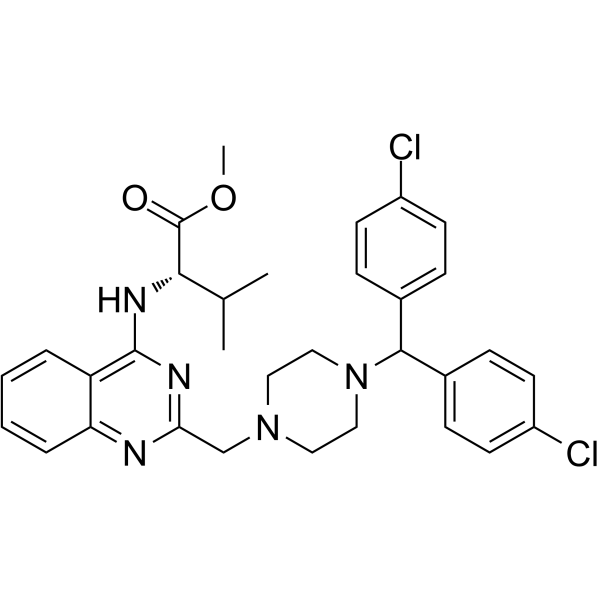
P53R3 es un potente reactivador de p53 y restaura la uniÓn de ADN especÍfica de secuencia de mutantes de puntos calientes de p53, incluidos p53R175H, p53R248W y p53R273H. P53R3 induce efectos antiproliferativos dependientes de p53 con una especificidad mucho mayor que PRIMA-1. P53R3 mejora el reclutamiento de p53 y p53M237I de tipo salvaje para varios promotores de genes diana. P53R3 aumenta fuertemente el ARNm, la proteÍna total y la expresiÓn en la superficie celular del receptor de muerte 5 (DR5). P53R3 se utiliza para la investigaciÓn del cÁncer.
Products are for research use only. Not for human use. We do not sell to patients.
Cas No.: 922150-12-7
Sample solution is provided at 25 µL, 10mM.
_1-3.$$$39978408@51.jpg');)
_1-9.$$$38538795@65.jpg');)
_1-9.$$$39112701@51.jpg');)
_1-7.$$$37316672@70.jpg');)
_366-372.$$$36198801@70.jpg');)
.$$$38565142@65.jpg');)
_1867-1883.$$$33248023@67.jpg');)
_eads6055.$$$39977546@45.jpg');)
_eadm9805.$$$40080571@45.jpg');)
_eadj3020.$$$39666821@45.jpg');)
_1-20.$$$39757301@28.jpg');)
_1-24.$$$38898113@28.jpg');)
_273-287.$$$36806353@46.jpg');)
_1-16.$$$37156877@44.jpg');)
_1-19.$$$37460805@44.jpg');)
_1291-1307.$$$34518654@46.jpg');)
P53R3 is a potent p53 reactivator and restores sequence-specific DNA binding of p53 hot spot mutants, including p53R175H, p53R248W and p53R273H. P53R3 induces p53-dependent antiproliferative effects with much higher specificity than PRIMA-1. P53R3 enhances the recruitment of wild-type p53 and p53M237I to several target gene promoters. P53R3 strongly enhances the mRNA, total protein and cell surface expression of the death receptor death receptor 5 (DR5). P53R3 is used for cancer research[1].
P53R3 (10 μg/ml; 24 hours; in the absence or presence of the unlabelled p53 consensus oligonucleotide) restores p53-specific DNA binding activity to p53R273H (a DNA contact mutant) and p53R175H (a structural mutant) in WiDr colon tumour cells harbouring p53R273H and KLE cells with p53R175H[1].
P53R3 (1-33 μg/ml; 24 hours) inhibits the proliferation of the LN-308 sublines expressing mutant p53 plasmids in a p53-dependent manner. The p53R175H-dependent effects are strong over a broad range of concentrations, but p53R273H-dependent effects are weaker and requires high concentrations of P53R3[1].
P53R3 induces p53R248W reactivation is more pronounced proliferation inhibition than observed with p53R273H. P53R3 does not exhibit cytotoxic effects even at concentrations close to its solubility limit (33 μg/ml)[1].
P53R3 (33 μg/ml; 18 hours) induces a strong decrease in S phase cells and a G0/G1 cell cycle arrest in LN-308 p53R175H and LN-308 p53R273H cells. But it does not affect cell cycle distribution of LN-308 p53R248W cells[1].
Cell Viability Assay[1]
| Cell Line: | p53 null LN-308 human glioma cells with a control plasmid or plasmids encoding the mutants p53R175H, p53R248W and p53R273H |
| Concentration: | 1-33 μg/mL |
| Incubation Time: | 24 hours |
| Result: | Induced p53-dependent and -independent antiproliferative and cytotoxic effects in vitro. |
| Cas No. | 922150-12-7 | SDF | |
| Formula | C32H35Cl2N5O2 | M.Wt | 592.56 |
| Solubility | DMSO : ≥ 100 mg/mL (168.76 mM) | Storage | 4°C, stored under nitrogen |
| General tips | Please select the appropriate solvent to prepare the stock solution according to the
solubility of the product in different solvents; once the solution is prepared, please store it in
separate packages to avoid product failure caused by repeated freezing and thawing.Storage method
and period of the stock solution: When stored at -80°C, please use it within 6 months; when stored
at -20°C, please use it within 1 month. To increase solubility, heat the tube to 37°C and then oscillate in an ultrasonic bath for some time. |
||
| Shipping Condition | Evaluation sample solution: shipped with blue ice. All other sizes available: with RT, or with Blue Ice upon request. | ||
| Prepare stock solution | |||

|
1 mg | 5 mg | 10 mg |
| 1 mM | 1.6876 mL | 8.438 mL | 16.8759 mL |
| 5 mM | 337.5 μL | 1.6876 mL | 3.3752 mL |
| 10 mM | 168.8 μL | 843.8 μL | 1.6876 mL |
Step 1: Enter information below (Recommended: An additional animal making an allowance for loss during the experiment)
 g
μL
g
μL
Step 2: Enter the in vivo formulation (This is only the calculator, not formulation. Please contact us first if there is no in vivo formulation at the solubility Section.)
Calculation results:
Working concentration: mg/ml;
Method for preparing DMSO master liquid: mg drug pre-dissolved in μL DMSO ( Master liquid concentration mg/mL, Please contact us first if the concentration exceeds the DMSO solubility of the batch of drug. )
Method for preparing in vivo formulation: Take μL DMSO master liquid, next addμL PEG300, mix and clarify, next addμL Tween 80, mix and clarify, next add μL saline, mix and clarify.
Method for preparing in vivo formulation: Take μL DMSO master liquid, next add μL Corn oil, mix and clarify.
Note: 1. Please make sure the liquid is clear before adding the next solvent.
2. Be sure to add the solvent(s) in order. You must ensure that the solution obtained, in the previous addition, is a clear solution before proceeding to add the next solvent. Physical methods such as vortex, ultrasound or hot water bath can be used to aid dissolving.
3. All of the above co-solvents are available for purchase on the GlpBio website.
Quality Control & SDS
- View current batch:
- Purity: >99.00% Appearance: A solid
- COA (Certificate of Analysis)
- SDS (Safety Data Sheet)
- Datasheet
Average Rating: 5 (Based on Reviews and 30 reference(s) in Google Scholar.)