

Palmitelaidic Acid (9-trans-Hexadecenoic acid) (Synonyms: C16:1(9E), 9-trans-Hexadecenoic Acid) |
Catalog No.GC33765
 One-Click Copy Product Info
|

El Ácido palmitelaÍdico (Ácido 9-trans-hexadecenoico) (Ácido 9-trans-hexadecenoico) es el isÓmero trans del Ácido palmitoleico.
Products are for research use only. Not for human use. We do not sell to patients.
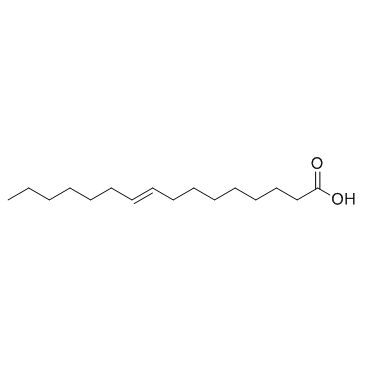
Cas No.: 10030-73-6
Sample solution is provided at 25 µL, 10mM.
Palmitelaidic Acid (9-trans-Hexadecenoic acid) is a trans isomer of palmitoleic acid and dietary fatty acid that has been found in dairy fat products and various partially hydrogenated oils [1]. High levels of Palmitelaidic Acid in ovarian tissue are associated with poor prognosis and Palmitelaidic Acid can serve as a diagnostic biomarker for ovarian cancer [2]. Palmitelaidic Acid has been widely used as an additive to reduce the toxicity of resveratrol ester to the cell membrane of Corynebacterium glutamicum, and to increase the productivity and total yield of polyphenols[3].
In vitro, Palmitelaidic Acid treatment (300μM) for 72 hours significantly reduced the cell viability of undifferentiated bovine preadipocytes, and increased the contents of trans-11 vaccenic acid and total fatty acid content in bovine adipocytes[4].
References:
[1] Frigolet M E, Gutiérrez-Aguilar R. The role of the novel lipokine palmitoleic acid in health and disease[J]. Advances in Nutrition, 2017, 8(1): 173S-181S.
[2] Zhong X, Bilal M, Zhou Y, et al. Elucidating the role of fatty acid reprogramming in ovarian cancer: insights cross-talk between blood, subcutaneous fat, and ovarian cancer tissues[J]. Frontiers in Oncology, 2025, 15: 1530487.
[3] Tharmasothirajan A, Melcr J, Linney J, et al. Membrane manipulation by free fatty acids improves microbial plant polyphenol synthesis[J]. Nature Communications, 2023, 14(1): 5619.
[4] Kadegowda A K G, Burns T A, Miller M C, et al. Cis-9, trans-11 conjugated linoleic acid is endogenously synthesized from palmitelaidic (C16: 1 trans-9) acid in bovine adipocytes[J]. Journal of Animal Science, 2013, 91(4): 1614-1623.
| Cell experiment [1]: | |
Cell lines | Bovine preadipocytes |
Preparation Method | Bovine preadipocytes were grown in DMEM medium with 10% (v/v) fetal bovine serum (FBS), 0.2mM glutamine, 100U/ml penicillin, and 100μg/ml streptomycin at 37°C in 5% CO2/atmosphere. Cells (5×10⁴ cells/ml) were seeded in 24-well plates and allowed to adhere in a 5% CO2 incubator at 37°C overnight. Cells were treated with different concentrations of Palmitelaidic Acid (0, 50, 150, and 300μM) for 72h. The viability was evaluated. |
Reaction Conditions | 0, 50, 150, and 300μM; 72h |
Applications | Palmitelaidic Acid treatment significantly reduced the viability of bovine preadipocytes at concentrations higher than 150μM. |
References: | |
| Cas No. | 10030-73-6 | SDF | |
| Sinónimos | C16:1(9E), 9-trans-Hexadecenoic Acid | ||
| Canonical SMILES | CCCCCC/C=C/CCCCCCCC(O)=O | ||
| Formula | C16H30O2 | M.Wt | 254.41 |
| Solubility | Ethanol : 100 mg/mL (393.07 mM) | Storage | Store at -20°C |
| General tips | Please select the appropriate solvent to prepare the stock solution according to the
solubility of the product in different solvents; once the solution is prepared, please store it in
separate packages to avoid product failure caused by repeated freezing and thawing.Storage method
and period of the stock solution: When stored at -80°C, please use it within 6 months; when stored
at -20°C, please use it within 1 month. To increase solubility, heat the tube to 37°C and then oscillate in an ultrasonic bath for some time. |
||
| Shipping Condition | Evaluation sample solution: shipped with blue ice. All other sizes available: with RT, or with Blue Ice upon request. | ||
| Prepare stock solution | |||

|
1 mg | 5 mg | 10 mg |
| 1 mM | 3.9307 mL | 19.6533 mL | 39.3066 mL |
| 5 mM | 786.1 μL | 3.9307 mL | 7.8613 mL |
| 10 mM | 393.1 μL | 1.9653 mL | 3.9307 mL |
Step 1: Enter information below (Recommended: An additional animal making an allowance for loss during the experiment)
 g
μL
g
μL
Step 2: Enter the in vivo formulation (This is only the calculator, not formulation. Please contact us first if there is no in vivo formulation at the solubility Section.)
Calculation results:
Working concentration: mg/ml;
Method for preparing DMSO master liquid: mg drug pre-dissolved in μL DMSO ( Master liquid concentration mg/mL, Please contact us first if the concentration exceeds the DMSO solubility of the batch of drug. )
Method for preparing in vivo formulation: Take μL DMSO master liquid, next addμL PEG300, mix and clarify, next addμL Tween 80, mix and clarify, next add μL saline, mix and clarify.
Method for preparing in vivo formulation: Take μL DMSO master liquid, next add μL Corn oil, mix and clarify.
Note: 1. Please make sure the liquid is clear before adding the next solvent.
2. Be sure to add the solvent(s) in order. You must ensure that the solution obtained, in the previous addition, is a clear solution before proceeding to add the next solvent. Physical methods such as vortex, ultrasound or hot water bath can be used to aid dissolving.
3. All of the above co-solvents are available for purchase on the GlpBio website.
Quality Control & SDS
- View current batch:
- Purity: >98.00% Appearance: A solid
- COA (Certificate of Analysis)
- SDS (Safety Data Sheet)
- Datasheet
Average Rating: 5 (Based on Reviews and 23 reference(s) in Google Scholar.)