

Phomopsin A (Synonyms: NSC 381839) |
Catalog No.GC15514
 One-Click Copy Product Info
|

La fomopsina A es una micotoxina hexapeptÍdica cÍclica aislada del hongo Phomopsis leptostomiformis. La fomopsina A es un inhibidor no competitivo de la uniÓn de la vincristina radiomarcada a la tubulina.
Products are for research use only. Not for human use. We do not sell to patients.
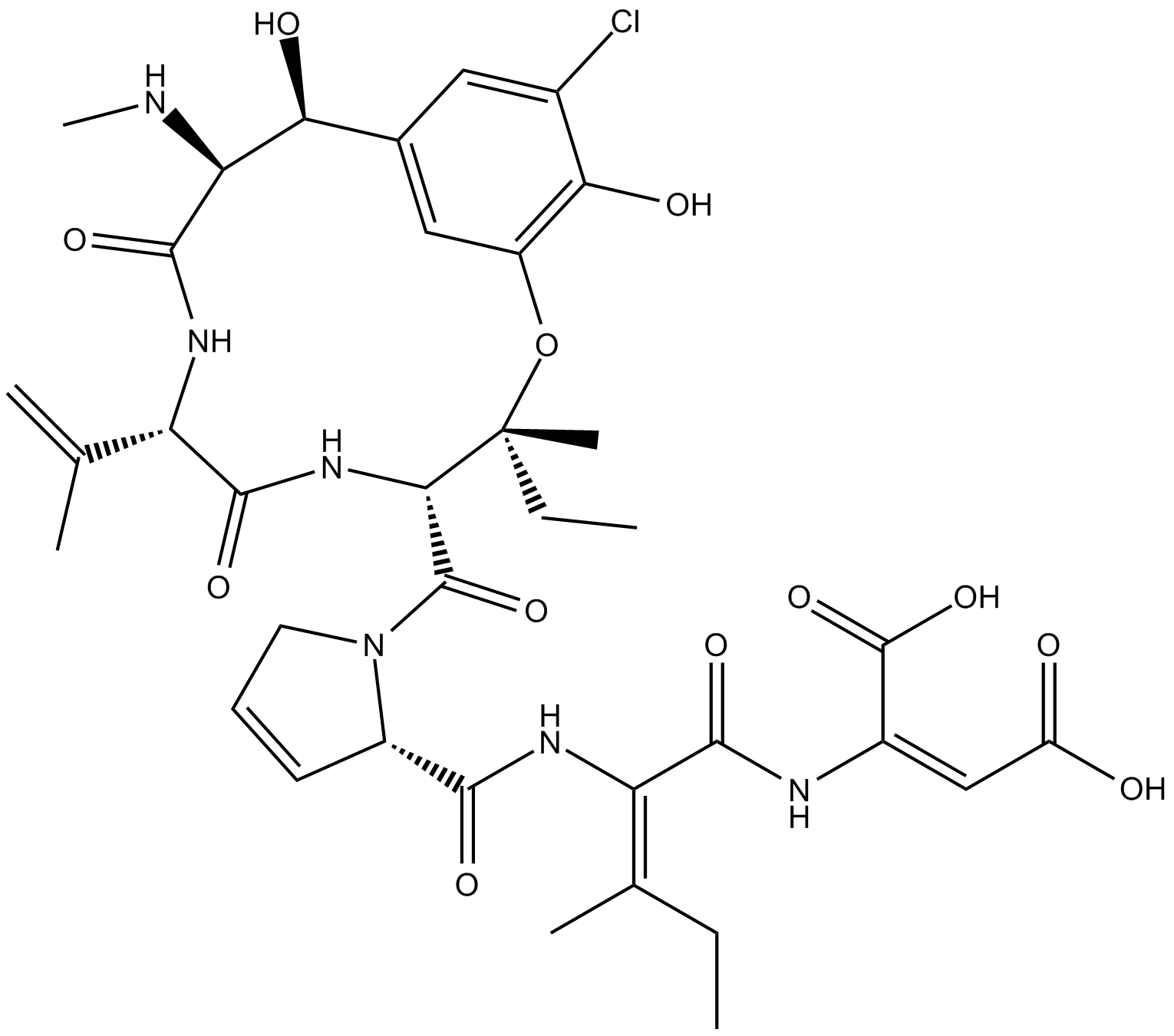
Cas No.: 64925-80-0
Sample solution is provided at 25 µL, 10mM.
_1-3.$$$39978408@51.jpg');)
_1-9.$$$38538795@65.jpg');)
_1-9.$$$39112701@51.jpg');)
_1-7.$$$37316672@70.jpg');)
_366-372.$$$36198801@70.jpg');)
.$$$38565142@65.jpg');)
_1867-1883.$$$33248023@67.jpg');)
_eads6055.$$$39977546@45.jpg');)
_eadm9805.$$$40080571@45.jpg');)
_eadj3020.$$$39666821@45.jpg');)
_1-20.$$$39757301@28.jpg');)
_1-24.$$$38898113@28.jpg');)
_273-287.$$$36806353@46.jpg');)
_1-16.$$$37156877@44.jpg');)
_1-19.$$$37460805@44.jpg');)
_1291-1307.$$$34518654@46.jpg');)
Phomopsin A is a cyclic hexapeptide mycotoxin that inhibits β-tubulin.
Phomopsins are a family of mycotoxins produced by the fungus Phomopsis leptostomiformis grows on lupins, which cause lupinosis, a severe liver disease of grazing animals [1][2].
Microtubules are one of the major components of the cytoskeleton that are essential in several cellular functions such as cell division and morphogenesis. α- and β-tubulins polymerize into microtubules.
Phomopsin A is a cyclic hexapeptide mycotoxin that binds β-tubulin in a vinca domain, partly overlapping with the site targeted by vinblastine and other tubulin inhibitors [2][3]. Phomopsin A noncompetitively inhibited the binding of radiolabeled vinblastine to tubulin with IC50 and Ki values of 0.8 μM and 2.8 μM, respectively. Phomopsin A potently inhibited tubulin-dependent GTP hydrolysis and nucleotide exchange on tubulin [2]. Phomopsin A, a vinca domain antimitotic peptide, also inhibited microtubule assembly [3][4]. Phomopsin A inhibited microtubule growth, modulated the dynamics of microtubules, and induced the self-association of tubulin dimers into single-walled rings and spirals [4].
References:
[1]. Hamel E. Natural products which interact with tubulin in the vinca domain: maytansine, rhizoxin, phomopsin A, dolastatins 10 and 15 and halichondrin B. Pharmacol Ther. 1992;55(1):31-51.
[2]. Cormier A, Marchand M, Ravelli RB, et al. Structural insight into the inhibition of tubulin by vinca domain peptide ligands. EMBO Rep. 2008 Nov;9(11):1101-6.
[3]. Li Y, Kobayashi H, Hashimoto Y, et al. Binding selectivity of rhizoxin, phomopsin A, vinblastine, and ansamitocin P-3 to fungal tubulins: differential interactions of these antimitotic agents with brain and fungal tubulins. Biochem Biophys Res Commun. 1992 Sep 16;187(2):722-9.
[4]. Mitra A, Sept D. Localization of the antimitotic peptide and depsipeptide binding site on beta-tubulin. Biochemistry. 2004 Nov 9;43(44):13955-62.
| Cas No. | 64925-80-0 | SDF | |
| Sinónimos | NSC 381839 | ||
| Chemical Name | (2E)-(βS)-3-chloro-β,5-dihydroxy-N-methyl-L-tyrosyl-3,4-didehydro-L-valyl-3-hydroxy-L-isoleucyl-3,4-didehydro-L-prolyl-(2E)-2,3-didehydroisoleucyl-2,3-didehydro-aspartic acid, cyclic (15→3)-ether | ||
| Canonical SMILES | OC(/C(NC(/C(NC([C@H]1N(C([C@@H]2NC([C@H](C(C)=C)NC([C@@H](NC)[C@H](C3=CC(O[C@@]2(CC)C)=C(O)C(Cl)=C3)O)=O)=O)=O)CC=C1)=O)=C(CC)/C)=O)=C\C(O)=O)=O | ||
| Formula | C36H45ClN6O12 | M.Wt | 789.2 |
| Solubility | DMF: Soluble,DMSO: Soluble,Ethanol: Soluble,Methanol: Soluble | Storage | Store at -20°C |
| General tips | Please select the appropriate solvent to prepare the stock solution according to the
solubility of the product in different solvents; once the solution is prepared, please store it in
separate packages to avoid product failure caused by repeated freezing and thawing.Storage method
and period of the stock solution: When stored at -80°C, please use it within 6 months; when stored
at -20°C, please use it within 1 month. To increase solubility, heat the tube to 37°C and then oscillate in an ultrasonic bath for some time. |
||
| Shipping Condition | Evaluation sample solution: shipped with blue ice. All other sizes available: with RT, or with Blue Ice upon request. | ||
| Prepare stock solution | |||

|
1 mg | 5 mg | 10 mg |
| 1 mM | 1.2671 mL | 6.3355 mL | 12.6711 mL |
| 5 mM | 253.4 μL | 1.2671 mL | 2.5342 mL |
| 10 mM | 126.7 μL | 633.6 μL | 1.2671 mL |
Step 1: Enter information below (Recommended: An additional animal making an allowance for loss during the experiment)
 g
μL
g
μL
Step 2: Enter the in vivo formulation (This is only the calculator, not formulation. Please contact us first if there is no in vivo formulation at the solubility Section.)
Calculation results:
Working concentration: mg/ml;
Method for preparing DMSO master liquid: mg drug pre-dissolved in μL DMSO ( Master liquid concentration mg/mL, Please contact us first if the concentration exceeds the DMSO solubility of the batch of drug. )
Method for preparing in vivo formulation: Take μL DMSO master liquid, next addμL PEG300, mix and clarify, next addμL Tween 80, mix and clarify, next add μL saline, mix and clarify.
Method for preparing in vivo formulation: Take μL DMSO master liquid, next add μL Corn oil, mix and clarify.
Note: 1. Please make sure the liquid is clear before adding the next solvent.
2. Be sure to add the solvent(s) in order. You must ensure that the solution obtained, in the previous addition, is a clear solution before proceeding to add the next solvent. Physical methods such as vortex, ultrasound or hot water bath can be used to aid dissolving.
3. All of the above co-solvents are available for purchase on the GlpBio website.
Quality Control & SDS
- View current batch:
- Purity: >98.00% Appearance: A solid
- COA (Certificate of Analysis)
- SDS (Safety Data Sheet)
- Datasheet
Average Rating: 5 (Based on Reviews and 6 reference(s) in Google Scholar.)