

Probenecid (Synonyms: NSC 18786, Tubophan) |
Catalog No.GC16825
 One-Click Copy Product Info
|

El probenecid es un agonista potente y selectivo de los canales del receptor potencial transitorio vanilloid 2 (TRPV2).
Products are for research use only. Not for human use. We do not sell to patients.
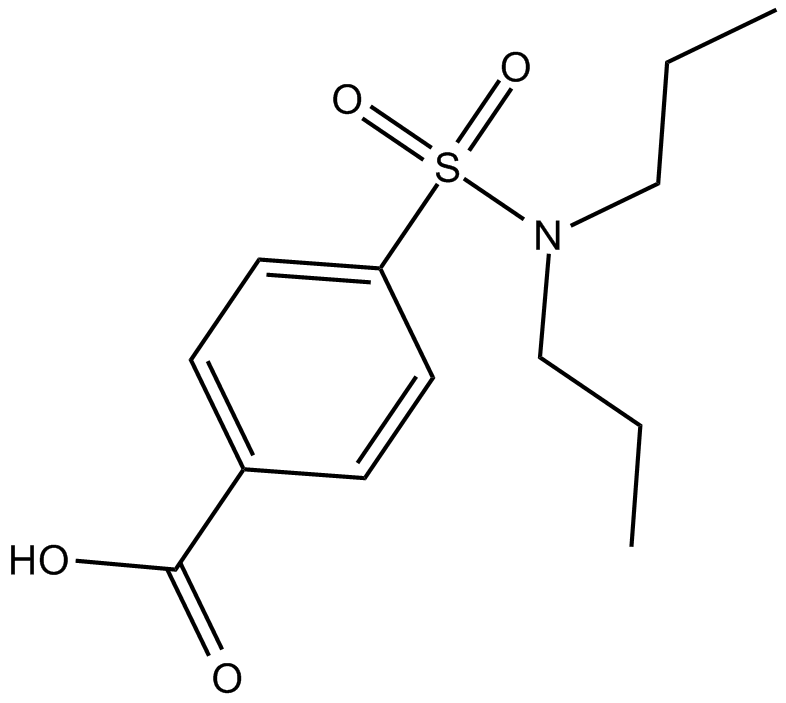
Cas No.: 57-66-9
Sample solution is provided at 25 µL, 10mM.
_1-3.$$$39978408@51.jpg');)
_1-9.$$$38538795@65.jpg');)
_1-9.$$$39112701@51.jpg');)
_1-7.$$$37316672@70.jpg');)
_366-372.$$$36198801@70.jpg');)
.$$$38565142@65.jpg');)
_1867-1883.$$$33248023@67.jpg');)
_eads6055.$$$39977546@45.jpg');)
_eadm9805.$$$40080571@45.jpg');)
_eadj3020.$$$39666821@45.jpg');)
_1-20.$$$39757301@28.jpg');)
_1-24.$$$38898113@28.jpg');)
_273-287.$$$36806353@46.jpg');)
_1-16.$$$37156877@44.jpg');)
_1-19.$$$37460805@44.jpg');)
_1291-1307.$$$34518654@46.jpg');)
Probenecid is an inhibitor of organic anion transport and MRP [1] [2]. Also, probenecid inhibited pannexin-1 channel with IC50 value of 150μM [3].
Multidrug resistance-associated proteins (MRPs) are ATP-binding cassette (ABC) transporters that transport various molecules across cellular membranes and are involved in multi-drug resistance.
Probenecid is an inhibitor of organic anion transport, MRP and pannexin-1 channel. In MRP-overexpressing HL60/AR and H69/AR tumor cell lines, probenecid reversed resistance to daunorubicin (DNR) and vincristine (VCR) in a concentration-dependent way [1]. In wild-type AML-2 cells, probenecid increased the MRP levels in a dose- and time-dependent way. In MRP-overexpressing AML cells, probenecid exhibited a significant chemosensitizing effect. These results suggested that probenecid functioned as an effective chemosensitizer of multidrug resistance (MDR) tumor cells but also an MRP activator [2].
In ischemia/reperfusion (I/R) injury rats, probenecid protected against CA1 neuronal death. Probenecid strengthened the upregulation of Hsp70 and inhibited the expression of calpain-1 and the released of cathepsin B. Also, probenecid inhibited the proliferation of astrocytes and microglia [4].
References:
[1]. Gollapudi S, Kim CH, Tran BN, et al. Probenecid reverses multidrug resistance in multidrug resistance-associated protein-overexpressing HL60/AR and H69/AR cells but not in P-glycoprotein-overexpressing HL60/Tax and P388/ADR cells. Cancer Chemother Pharmacol, 1997, 40(2): 150-158.
[2]. Kim HS, Min YD, Choi CH. Double-edged sword of chemosensitizer: increase of multidrug resistance protein (MRP) in leukemic cells by an MRP inhibitor probenecid. Biochem Biophys Res Commun, 2001, 283(1): 64-71.
[3]. Silverman W, Locovei S, Dahl G. Probenecid, a gout remedy, inhibits pannexin 1 channels. Am J Physiol Cell Physiol, 2008, 295(3): C761-767.
[4]. Wei R, Wang J, Xu Y, et al. Probenecid protects against cerebral ischemia/reperfusion injury by inhibiting lysosomal and inflammatory damage in rats. Neuroscience, 2015, 301: 168-177.
|
Cell experiment: |
HEK-293T cells are transfected with hTAS2R expression constructs using Lipofectamine 2000 in poly-lysine coated, black 384-well plates with clear bottoms and incubated for 22 hours at 37°C. Growth media is removed and cells are washed twice with HBSS containing 20 mM HEPES, then loaded with a calcium indicator dye in HBSS containing 20 mM HEPES (Calcium 4 Assay kit) with or without 1 mM Probenecid. Cells are incubated at 37°C for 1 hour in the presence of both dye and Probenecid, then moved to a Flexstation II-384 set for 32°C. After a 15-minute temperature equilibration (without washout), indicated compounds are injected (at t=~25 seconds) and fluorescence is measured for 100 to 180 seconds, reading every 3 seconds. Data sets are analyzed and represented as % over baseline signal using Prism 5.0 software. For Schild plots, replicates of raw calcium flux values are expressed as % over baseline signal. The mean value at 36 seconds (corresponding to the maximum flux signal) for each concentration of TAS2R ligand in the presence of the indicated concentration of Probenecid is plotted against the log of ligand concentration. Data points are fit using non-linear regression in GraphPad Prism[1]. |
|
Animal experiment: |
Mice[1] In order to obtain a dose response curve, male C57 WT (n=39) mice 12-16 weeks of age are anesthetized with isoflurane while intravenous jugular access (IV) is obtained under a microscope. Subsequently, an echocardiographic study with both M-mode and B-mode is obtained in parasternal long axis (PSLAX) as described below. Either saline or different doses of Probenecid (increasing from 2 to 200mg/kg) are injected (bolus IV) for the initial contractility studies in WT mice. |
|
References: [1]. Koch SE, et al. Probenecid: novel use as a non-injurious positive inotrope acting via cardiac TRPV2 stimulation. J Mol Cell Cardiol. 2012 Jul;53(1):134-44. |
|
| Cas No. | 57-66-9 | SDF | |
| Sinónimos | NSC 18786, Tubophan | ||
| Chemical Name | 4-(dipropylsulfamoyl)benzoic acid | ||
| Canonical SMILES | CCCN(CCC)S(=O)(=O)C1=CC=C(C=C1)C(=O)O | ||
| Formula | C13H19NO4S | M.Wt | 285.36 |
| Solubility | ≥ 8.7mg/mL in DMSO | Storage | Store at RT |
| General tips | Please select the appropriate solvent to prepare the stock solution according to the
solubility of the product in different solvents; once the solution is prepared, please store it in
separate packages to avoid product failure caused by repeated freezing and thawing.Storage method
and period of the stock solution: When stored at -80°C, please use it within 6 months; when stored
at -20°C, please use it within 1 month. To increase solubility, heat the tube to 37°C and then oscillate in an ultrasonic bath for some time. |
||
| Shipping Condition | Evaluation sample solution: shipped with blue ice. All other sizes available: with RT, or with Blue Ice upon request. | ||
| Prepare stock solution | |||

|
1 mg | 5 mg | 10 mg |
| 1 mM | 3.5043 mL | 17.5217 mL | 35.0435 mL |
| 5 mM | 700.9 μL | 3.5043 mL | 7.0087 mL |
| 10 mM | 350.4 μL | 1.7522 mL | 3.5043 mL |
Step 1: Enter information below (Recommended: An additional animal making an allowance for loss during the experiment)
 g
μL
g
μL
Step 2: Enter the in vivo formulation (This is only the calculator, not formulation. Please contact us first if there is no in vivo formulation at the solubility Section.)
Calculation results:
Working concentration: mg/ml;
Method for preparing DMSO master liquid: mg drug pre-dissolved in μL DMSO ( Master liquid concentration mg/mL, Please contact us first if the concentration exceeds the DMSO solubility of the batch of drug. )
Method for preparing in vivo formulation: Take μL DMSO master liquid, next addμL PEG300, mix and clarify, next addμL Tween 80, mix and clarify, next add μL saline, mix and clarify.
Method for preparing in vivo formulation: Take μL DMSO master liquid, next add μL Corn oil, mix and clarify.
Note: 1. Please make sure the liquid is clear before adding the next solvent.
2. Be sure to add the solvent(s) in order. You must ensure that the solution obtained, in the previous addition, is a clear solution before proceeding to add the next solvent. Physical methods such as vortex, ultrasound or hot water bath can be used to aid dissolving.
3. All of the above co-solvents are available for purchase on the GlpBio website.
Quality Control & SDS
- View current batch:
- Purity: >98.00% Appearance: A solid
- COA (Certificate of Analysis)
- SDS (Safety Data Sheet)
- Datasheet
Average Rating: 5 (Based on Reviews and 16 reference(s) in Google Scholar.)