

Prodigiosin hydrochloride |
Catalog No.GC65066
 One-Click Copy Product Info
|

El clorhidrato de prodigiosina (Prodigiosine) es un pigmento rojo producido por bacterias como un metabolito secundario bioactivo.
Products are for research use only. Not for human use. We do not sell to patients.
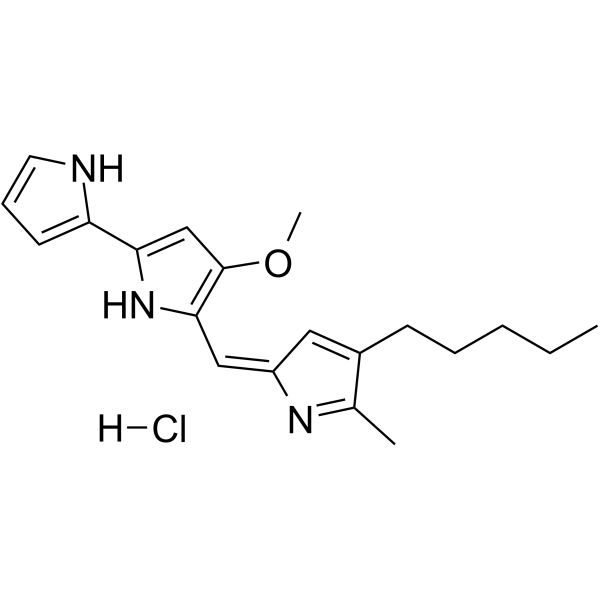
Cas No.: 56144-17-3
Sample solution is provided at 25 µL, 10mM.
_1-3.$$$39978408@51.jpg');)
_1-9.$$$38538795@65.jpg');)
_1-9.$$$39112701@51.jpg');)
_1-7.$$$37316672@70.jpg');)
_366-372.$$$36198801@70.jpg');)
.$$$38565142@65.jpg');)
_1867-1883.$$$33248023@67.jpg');)
_eads6055.$$$39977546@45.jpg');)
_eadm9805.$$$40080571@45.jpg');)
_eadj3020.$$$39666821@45.jpg');)
_1-20.$$$39757301@28.jpg');)
_1-24.$$$38898113@28.jpg');)
_273-287.$$$36806353@46.jpg');)
_1-16.$$$37156877@44.jpg');)
_1-19.$$$37460805@44.jpg');)
_1291-1307.$$$34518654@46.jpg');)
Prodigiosin (Prodigiosine) hydrochloride is a red pigment produced by bacteria as a bioactive secondary metabolite. Prodigiosin hydrochloride is a potent proapoptotic agent, and inhibits Wnt/β-catenin pathway. Prodigiosin hydrochloride has antibacterial, antifungal, antiprotozoal, antimalarial, immunosuppressive, and anticancer properties[1][2].
Prodigiosin (25-500 nM; 24 hours) treatment reduces the viability of breast cancer cells, with IC50 values at 48 h of 62.52 nM in MDA-MB-231 cells and 261.2 nM in MDA-MB-468 cells[1].Prodigiosin (25-500 nM; 24 hours) treatment significantly reduces the levels of phosphorylated LRP6 and DVL2, active β-catenin, and total β-catenin. Prodigiosin noticeably inhibits the phosphorylation of GSK3β at Ser9 in HEK293T cells, which is indicative of an increase in GSK3β activity[1]. Prodigiosin can inhibit proliferation and induce apoptosis in breast cancer cells[1].Prodigiosin (25-500 nM; 24 hours) treatment dose-dependently blocks Wnt signaling activated by Wnt1, Wnt3, Wnt1/LRP6, Wnt3/LRP6, and Dishevelled 2 (DVL2) in transfected HEK293T cells. Prodigiosin treatment inhibits Wnt3A-CM-induced transcription in a dose-dependent manner. Prodigiosin inhibits transcription of the SuperTopFlash reporter activated by either Wnt transfection or Wnt3A treatment[1].When applied to cultures of chytrid fungi Batrachochytrium dendrobatidis and B. salamandrivorans, Prodigiosin causes significant growth inhibition, with MIC values of 10 μM and 50 μM, respectively[2].
Prodigiosin (5 mg/kg; intraperitoneal injection; twice weekly; for 3 weeks) treatment significantly inhibits tumor growth. Prodigiosin treatment decreases tumor cell density and expression of the proliferation marker Ki-67[1].
[1]. Wang Z, et al. Prodigiosin inhibits Wnt/β-catenin signaling and exerts anticancer activity in breast cancer cells. Proc Natl Acad Sci U S A. 2016 Nov 15;113(46):13150-13155.
[2]. Woodhams DC, et al. Prodigiosin, Violacein, and Volatile Organic Compounds Produced by Widespread Cutaneous Bacteria of Amphibians Can Inhibit Two Batrachochytrium Fungal Pathogens. Microb Ecol. 2018 May;75(4):1049-1062.
| Cas No. | 56144-17-3 | SDF | |
| Formula | C20H26ClN3O | M.Wt | 359.89 |
| Solubility | DMSO : 10 mg/mL (27.79 mM; Need ultrasonic) | Storage | -20°C, away from moisture |
| General tips | Please select the appropriate solvent to prepare the stock solution according to the
solubility of the product in different solvents; once the solution is prepared, please store it in
separate packages to avoid product failure caused by repeated freezing and thawing.Storage method
and period of the stock solution: When stored at -80°C, please use it within 6 months; when stored
at -20°C, please use it within 1 month. To increase solubility, heat the tube to 37°C and then oscillate in an ultrasonic bath for some time. |
||
| Shipping Condition | Evaluation sample solution: shipped with blue ice. All other sizes available: with RT, or with Blue Ice upon request. | ||
| Prepare stock solution | |||

|
1 mg | 5 mg | 10 mg |
| 1 mM | 2.7786 mL | 13.8931 mL | 27.7863 mL |
| 5 mM | 555.7 μL | 2.7786 mL | 5.5573 mL |
| 10 mM | 277.9 μL | 1.3893 mL | 2.7786 mL |
Step 1: Enter information below (Recommended: An additional animal making an allowance for loss during the experiment)
 g
μL
g
μL
Step 2: Enter the in vivo formulation (This is only the calculator, not formulation. Please contact us first if there is no in vivo formulation at the solubility Section.)
Calculation results:
Working concentration: mg/ml;
Method for preparing DMSO master liquid: mg drug pre-dissolved in μL DMSO ( Master liquid concentration mg/mL, Please contact us first if the concentration exceeds the DMSO solubility of the batch of drug. )
Method for preparing in vivo formulation: Take μL DMSO master liquid, next addμL PEG300, mix and clarify, next addμL Tween 80, mix and clarify, next add μL saline, mix and clarify.
Method for preparing in vivo formulation: Take μL DMSO master liquid, next add μL Corn oil, mix and clarify.
Note: 1. Please make sure the liquid is clear before adding the next solvent.
2. Be sure to add the solvent(s) in order. You must ensure that the solution obtained, in the previous addition, is a clear solution before proceeding to add the next solvent. Physical methods such as vortex, ultrasound or hot water bath can be used to aid dissolving.
3. All of the above co-solvents are available for purchase on the GlpBio website.
Quality Control & SDS
- View current batch:
- Purity: >98.00% Appearance: A solid
- COA (Certificate of Analysis)
- SDS (Safety Data Sheet)
- Datasheet
Average Rating: 5 (Based on Reviews and 30 reference(s) in Google Scholar.)