

Pyr3 |
Catalog No.GC14649
 One-Click Copy Product Info
|

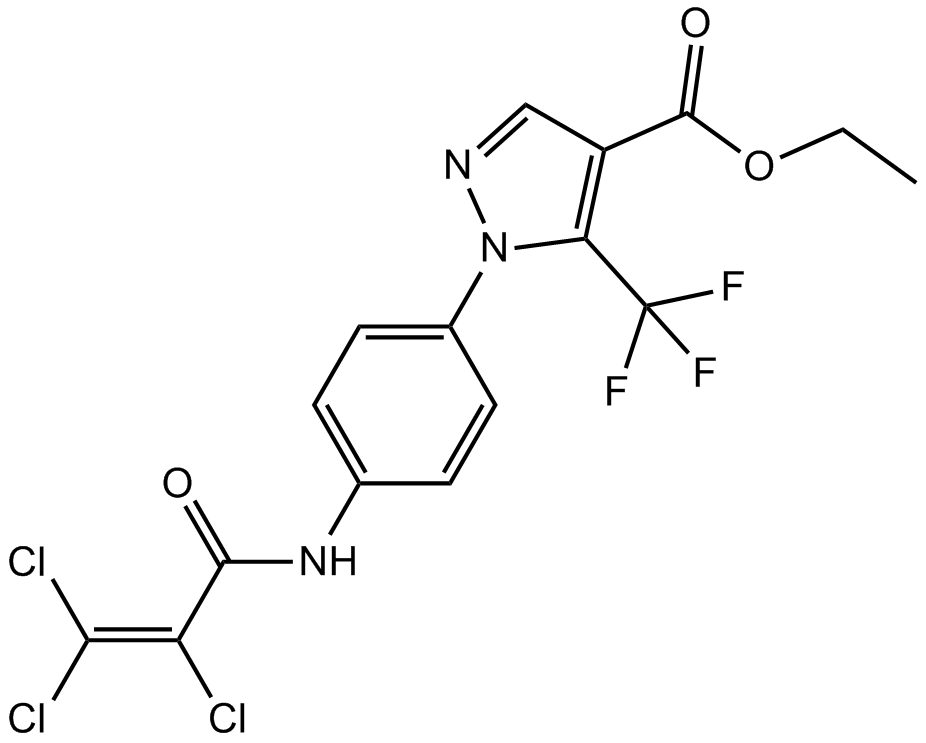
Pyr3 es un inhibidor muy específico del canal TRPC3. Su IC50 para la entrada de fútbol es de 700nM
Products are for research use only. Not for human use. We do not sell to patients.
Cas No.: 1160514-60-2
Sample solution is provided at 25 µL, 10mM.
_1-3.$$$39978408@51.jpg');)
_1-9.$$$38538795@65.jpg');)
_1-9.$$$39112701@51.jpg');)
_1-7.$$$37316672@70.jpg');)
_366-372.$$$36198801@70.jpg');)
.$$$38565142@65.jpg');)
_1867-1883.$$$33248023@67.jpg');)
_eads6055.$$$39977546@45.jpg');)
_eadm9805.$$$40080571@45.jpg');)
_eadj3020.$$$39666821@45.jpg');)
_1-20.$$$39757301@28.jpg');)
_1-24.$$$38898113@28.jpg');)
_273-287.$$$36806353@46.jpg');)
_1-16.$$$37156877@44.jpg');)
_1-19.$$$37460805@44.jpg');)
_1291-1307.$$$34518654@46.jpg');)
Pyr3 es un inhibidor muy específico del canal TRPC3. Su IC50 para la entrada de fútbol es de 700nM[1]. Baja la secreción de MMP9 en las células, también frena la fosforilación del STAT5[2]. Se usa bastante, pues para detenr el crecimiento y movimiento del melanoma, además de controlar tumores y sus metástasis[3].
En ensayos de laboratorio, cuarenta y ocho horas con Pyr3. Las células A549, HCT-116 y PC3 dejam de crecer. Sus IC50 hijo 15.4, 7.9 y 2.3μg/ml[4]. Con 10μM por 24 horas. Las células T24 puerden viabilidad, su ciclo se detiene y bajan el p-PKCα, el PKCα y la PP2A[5]. Con 1.0μM solo ocho horas, mira. Las MDA-MB-231 entran en apoptosis. Se encogen, su membrana forma burbujas, susu mitocondrias se rompen y el núcleo se compacta[6].
En animales vivos, pues 20mg/kg al día por inyección intraperitoneal, siete días seguidos, frena mucho los tumores de glioma en ratones con injerto[7]. Cinco minutos antes de reactivar la sangre, 10mg/kg por la vena yugular, la zona dañada del corazón baja, menos células mueren y la inflamación se calma[8].
References:
[1] Kiyonaka S, Kato K, Nishida M, et al. Selective and direct inhibition of TRPC3 channels underlies biological activities of a pyrazole compound[J]. Proceedings of the National Academy of Sciences, 2009, 106(13): 5400-5405.
[2] Oda K, Umemura M, Katsumata M, et al. Transient receptor potential cation channel 3 (TRPC3) regulates tumor proliferation and migration of BRAF wild type human malignant melanoma[J]. Cancer Research, 2015, 75(15_Supplement): 4371-4371.
[3] Umemura M, Baljinnyam E, De Lorenzo M S, et al. Role of store-operated Ca2+ entry in proliferation and cell cycle in melanoma[J]. Cancer Research, 2012, 72(8_Supplement): 1864-1864.
[4] Kıyan H T, Üvez A, Erkisa M, et al. A Comparative Study on In vitro Anti-cancer and In vivo Anti-angiogenic Effects of TRPC Blockers Pyr-3 and SKF-96365[J]. Letters in Drug Design & Discovery, 2023, 20(7): 957-964.
[5] Ting H K, Dou Y C, Lin Y H, et al. Pyr3 inhibits cell viability and PKCα activity to suppress migration in human bladder cancer cells[J]. European Journal of Pharmacology, 2025, 988: 177235.
[6] Wang Y, Qi Y X, Qi Z, et al. TRPC3 regulates the proliferation and apoptosis resistance of triple negative breast cancer cells through the TRPC3/RASA4/MAPK pathway[J]. Cancers, 2019, 11(4): 558.
[7] Chang H H, Cheng Y C, Tsai W C, et al. Pyr3 induces apoptosis and inhibits migration in human glioblastoma cells[J]. Cellular Physiology and Biochemistry, 2018, 48(4): 1694-1702.
[8] Lu M, Fang X, Shi D, et al. A selective TRPC3 inhibitor Pyr3 attenuates myocardial ischemia/reperfusion injury in mice[J]. Current Medical Science, 2020, 40(6): 1107-1113.
| Experimentos celulares [1]: | |
Líneas celulares | Células A549 |
Método de preparación | Las células A549 se cultivaron en un medio RPMI 1640 suplementado con penicillin G (100U/ml), streptomycin (100μg/ml), L-glutamine y suero bovino fetal al 10% en una incubadora humidificada a 37°C y 5% de CO2. Las células se sembraron a una densidad de 5×10³ células/pocillo en placas de 96 pozos y se trataron con diferentes concentraciones de Pyr3 (0.62, 1.25, 2.5, 5, 10, 20 y 40µg/ml) durante 48h. Luego, las células se fijaron in situ con 50μl de trichloroacetic acid al 50% (w/v) a 4°C durante 1h. Al final de la fijación, los pozos se lavaron 5 veces con agua desionizada y se dejaron secar al aire a temperatura ambiente durante 50μl de solución de SRB al 0.4% en cada pozo y se incubó a temperatura ambiente durante 30 minutos. Luego, las placas se lavaron con acetic acid al 1% para eliminar las uniones no específicas y el tinte sin límites. El tinte SRB limitado se disolvió añadfiendo 150μl 10mM de base Tris por cada pozo. Las mediciones se llevaron a cabo a 564nm. |
Condiciones de reacción | 0.62, 1.25, 2.5, 5, 10, 20 y 40µg/ml; 48h |
Áreas de aplicación | El tratamiento con Pyr3 disminuyó la viabilidad celular de las células A549 de una manera dependiente de la dosis. |
| Experimentos con animales [2]: | |
Modelos animales | BALB/cAnN.Cg-Foxn1nu/CrlNarl ratones desnudos |
Método de preparación | Los ratones desnudos BALB/cAnN.Cg-Foxn1nu/CrlNarl (20-25g) fueron anestesiados con una mezcla de gas oxígeno/isoflurano. Posteriormente, se implantaron células 1×10⁵ LN229-Luc2 en el hemisferio cerebral derecho de los ratones. Cuatro días después de la implantación, los ratones se dividieron en cuatro grupos y recibieron tratamiento con un control vectorial, o Pyr3. Pyr3 se disolvió en un 10% de Tween 80 y se administró por vía intraperitoneal a una dosis de 20mg/kg/día durante 7 días. Doce días después, los ratones fueron sacrificados con dióxido de carbono; los tejidos cerebrales fueron retirados, fijados con formalina, incrustados en parafina y cortados en secciones consecutivas. La intensidad de bioluminiscencia de los tumores implantados se monitoreó utilizando el sistema de imagen in vivo no invasivo (IVIS) tres veces por semana. El peso de los ratones se midió tres veces a la semana. |
Forma de dosificación | 20mg/kg/día durante 7 días; i.p. |
Áreas de aplicación | El tratamiento con Pyr3 inhibió el crecimiento tumoral del glioma en el modelo ortotópico de xenoinjerto sin afectar el peso corporal. |
References: | |
| Cas No. | 1160514-60-2 | SDF | |
| Chemical Name | ethyl 1-(4-(2,3,3-trichloroacrylamido)phenyl)-5-(trifluoromethyl)-1H-pyrazole-4-carboxylate | ||
| Canonical SMILES | Cl/C(C(NC1=CC=C(C=C1)N2N=CC(C(OCC)=O)=C2C(F)(F)F)=O)=C(Cl)\Cl | ||
| Formula | C16H11Cl3F3N3O3 | M.Wt | 456.63 |
| Solubility | DMF: 50 mg/ml,DMSO: 20 mg/ml,Ethanol: 10 mg/ml | Storage | Store at -20°C |
| General tips | Please select the appropriate solvent to prepare the stock solution according to the
solubility of the product in different solvents; once the solution is prepared, please store it in
separate packages to avoid product failure caused by repeated freezing and thawing.Storage method
and period of the stock solution: When stored at -80°C, please use it within 6 months; when stored
at -20°C, please use it within 1 month. To increase solubility, heat the tube to 37°C and then oscillate in an ultrasonic bath for some time. |
||
| Shipping Condition | Evaluation sample solution: shipped with blue ice. All other sizes available: with RT, or with Blue Ice upon request. | ||
| Prepare stock solution | |||

|
1 mg | 5 mg | 10 mg |
| 1 mM | 2.19 mL | 10.9498 mL | 21.8996 mL |
| 5 mM | 438 μL | 2.19 mL | 4.3799 mL |
| 10 mM | 219 μL | 1.095 mL | 2.19 mL |
Step 1: Enter information below (Recommended: An additional animal making an allowance for loss during the experiment)
 g
μL
g
μL
Step 2: Enter the in vivo formulation (This is only the calculator, not formulation. Please contact us first if there is no in vivo formulation at the solubility Section.)
Calculation results:
Working concentration: mg/ml;
Method for preparing DMSO master liquid: mg drug pre-dissolved in μL DMSO ( Master liquid concentration mg/mL, Please contact us first if the concentration exceeds the DMSO solubility of the batch of drug. )
Method for preparing in vivo formulation: Take μL DMSO master liquid, next addμL PEG300, mix and clarify, next addμL Tween 80, mix and clarify, next add μL saline, mix and clarify.
Method for preparing in vivo formulation: Take μL DMSO master liquid, next add μL Corn oil, mix and clarify.
Note: 1. Please make sure the liquid is clear before adding the next solvent.
2. Be sure to add the solvent(s) in order. You must ensure that the solution obtained, in the previous addition, is a clear solution before proceeding to add the next solvent. Physical methods such as vortex, ultrasound or hot water bath can be used to aid dissolving.
3. All of the above co-solvents are available for purchase on the GlpBio website.
Quality Control & SDS
- View current batch:
- Purity: >99.50% Appearance: A solid
- COA (Certificate of Analysis)
- SDS (Safety Data Sheet)
- Datasheet
Average Rating: 5 (Based on Reviews and 14 reference(s) in Google Scholar.)