

R162 |
Catalog No.GC32750
 One-Click Copy Product Info
|

R162 es un potente inhibidor de la glutamato dehydrogenase 1 (GDH1)
Products are for research use only. Not for human use. We do not sell to patients.
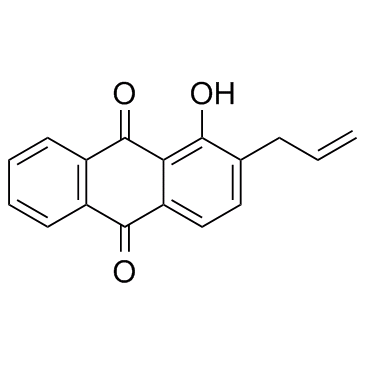
Cas No.: 64302-87-0
Sample solution is provided at 25 µL, 10mM.
_1-3.$$$39978408@51.jpg');)
_1-9.$$$38538795@65.jpg');)
_1-9.$$$39112701@51.jpg');)
_1-7.$$$37316672@70.jpg');)
_366-372.$$$36198801@70.jpg');)
.$$$38565142@65.jpg');)
_1867-1883.$$$33248023@67.jpg');)
_eads6055.$$$39977546@45.jpg');)
_eadm9805.$$$40080571@45.jpg');)
_eadj3020.$$$39666821@45.jpg');)
_1-20.$$$39757301@28.jpg');)
_1-24.$$$38898113@28.jpg');)
_273-287.$$$36806353@46.jpg');)
_1-16.$$$37156877@44.jpg');)
_1-19.$$$37460805@44.jpg');)
_1291-1307.$$$34518654@46.jpg');)
R162 es un potente inhibidor de la glutamato dehydrogenase 1 (GDH1)[1]. R162 tiene buena actividad antitumoral y no causa toxicidad significativa a los tejidos normales [2].
In vitro, el tratamiento de células de cáncer de pulmón de células no pequeñas (NSCLC)deficientes en LKB1 (células A549, H157 y H460) con R162 (40μM) indujo significativamente la apoptosis, que se revirtió mediante el tratamiento con α-KG [3]. El tratamiento con SUM44 y LCCTam con R162 (10μM) durante 4h indujo significativamente la producción de ROS intracelulares[4].
In vivo,el tratamiento de ratones de xenoinjertos de células A549 con R162 (20mg/kg) mediante inyección intraperitoneal durante 45 days redujo significativamente la metástasis tumoral [3]. El tratamiento de ratones xenoinjerto de células U251 con R162 (30mg/kg) por inyección intraperitoneal durante 35 días inhibió significativamente el crecimiento tumoral en ratones[5]. R162 (20mg/kg) se inyectó intraperitonealmente en ratones xednoinjertos de células H1299 durante 35 días, lo que inhibió significativamente el crecimiento y la masa del tumor de los ratones y suprimió la actividad de GDH1 en los tejidos tumorales[6].
References:
[1] Bian Y, Hou W, Chen X, et al. Glutamate dehydrogenase as a promising target for hyperinsulinism hyperammonemia syndrome therapy[J]. Current Medicinal Chemistry, 2022, 29(15): 2652-2672.
[2] Ren J, Zhou J, Liu H, et al. Ultrasound (US)-activated redox dyshomeostasis therapy reinforced by immunogenic cell death (ICD) through a mitochondrial targeting liposomal nanosystem[J]. Theranostics, 2021, 11(19): 9470.
[3] Jin L, Chun J, Pan C, et al. The PLAG1-GDH1 axis promotes anoikis resistance and tumor metastasis through CamKK2-AMPK signaling in LKB1-deficient lung cancer[J]. Molecular cell, 2018, 69(1): 87-99. e7.
[4] Young T A, Bahnassy S, Abalum T C, et al. Glutamate Transport Proteins and Metabolic Enzymes are Poor Prognostic Factors in Invasive Lobular Carcinoma[J]. bioRxiv, 2024.
[5] Zhang J, Wang G, Mao Q, et al. Glutamate dehydrogenase (GDH) regulates bioenergetics and redox homeostasis in human glioma[J]. Oncotarget, 2016, 5.
[6] Jin L, Li D, Alesi G N, et al. Glutamate dehydrogenase 1 signals through antioxidant glutathione peroxidase 1 to regulate redox homeostasis and tumor growth[J]. Cancer cell, 2015, 27(2): 257-270.
| Experimentos celulares [1]: | |
Líneas celulares | Células A549, H460, H157(células deficientes en LKB1) |
Método de preparación | Las células deficientes de LKB1 se cultivaron en condiciones separadas en presencia o ausencia de R162 (40μM) y methyl-α-KG (5mM para A549 y H460, 1mM para H157). Las células se cultivaron en una placa tratada con agar al 1% durante 48h. Anoikis se determinó por tinción de anexina V . |
Condiciones de reacción | 40μM; 48h |
Áreas de aplicación | El tratamiento con R162 sensibilizó significativamente las células LKB1-deficient A549, H157 y H460 a la inducción de anoikis, y esto fue completamente rescatado por el tratamiento con α-KG. |
| Experimentos con animales [2]: | |
Modelos animales | Ratones desnudos |
Método de preparación | Los ratones desnudos (athymic nu/nu, hembra, de 4-6 semanas de edad) se inyectaron por vía subcutánea con células 1×10⁷ U251 que albergan un vector vacío en el flanco izquierdo, y células con eliminación estable de GDH (o sobreexpresión de GDH o Sirt4) en el flanco derecho, respectivamente. Para evaluar la eficacia de EGCG y R162, los medicamentos se administraron a partir de un día después de la inyección de células U251 mediante inyección intraperitoneal diaria de 50mg/kg de EGCG o 30mg/kg R162 durante 35 días, respectivamente. El cincuenta por ciento de DMSO en PBS fue como un control diluyente. El crecimiento tumoral se registró mediante la medición de dos diámetros perpendiculares de los tumores. Los tumores fueron recogidos y pesados en el punto final experimental. |
Forma de dosificación | 30mg/kg; 35 días; i.p. |
Áreas de aplicación | El tratamiento R162 reprimió el crecimiento celular U251 in vivo. |
References: | |
| Cas No. | 64302-87-0 | SDF | |
| Canonical SMILES | O=C1C2=C(C=CC=C2)C(C3=CC=C(CC=C)C(O)=C13)=O | ||
| Formula | C17H12O3 | M.Wt | 264.28 |
| Solubility | DMSO : ≥ 100 mg/mL (378.39 mM) | Storage | Store at -20°C |
| General tips | Please select the appropriate solvent to prepare the stock solution according to the
solubility of the product in different solvents; once the solution is prepared, please store it in
separate packages to avoid product failure caused by repeated freezing and thawing.Storage method
and period of the stock solution: When stored at -80°C, please use it within 6 months; when stored
at -20°C, please use it within 1 month. To increase solubility, heat the tube to 37°C and then oscillate in an ultrasonic bath for some time. |
||
| Shipping Condition | Evaluation sample solution: shipped with blue ice. All other sizes available: with RT, or with Blue Ice upon request. | ||
| Prepare stock solution | |||

|
1 mg | 5 mg | 10 mg |
| 1 mM | 3.7839 mL | 18.9193 mL | 37.8387 mL |
| 5 mM | 756.8 μL | 3.7839 mL | 7.5677 mL |
| 10 mM | 378.4 μL | 1.8919 mL | 3.7839 mL |
Step 1: Enter information below (Recommended: An additional animal making an allowance for loss during the experiment)
 g
μL
g
μL
Step 2: Enter the in vivo formulation (This is only the calculator, not formulation. Please contact us first if there is no in vivo formulation at the solubility Section.)
Calculation results:
Working concentration: mg/ml;
Method for preparing DMSO master liquid: mg drug pre-dissolved in μL DMSO ( Master liquid concentration mg/mL, Please contact us first if the concentration exceeds the DMSO solubility of the batch of drug. )
Method for preparing in vivo formulation: Take μL DMSO master liquid, next addμL PEG300, mix and clarify, next addμL Tween 80, mix and clarify, next add μL saline, mix and clarify.
Method for preparing in vivo formulation: Take μL DMSO master liquid, next add μL Corn oil, mix and clarify.
Note: 1. Please make sure the liquid is clear before adding the next solvent.
2. Be sure to add the solvent(s) in order. You must ensure that the solution obtained, in the previous addition, is a clear solution before proceeding to add the next solvent. Physical methods such as vortex, ultrasound or hot water bath can be used to aid dissolving.
3. All of the above co-solvents are available for purchase on the GlpBio website.
Quality Control & SDS
- View current batch:
- Purity: >98.00% Appearance: A solid
- COA (Certificate of Analysis)
- SDS (Safety Data Sheet)
- Datasheet
Average Rating: 5 (Based on Reviews and 30 reference(s) in Google Scholar.)