

Rapanone |
Catalog No.GC63860
 One-Click Copy Product Info
|

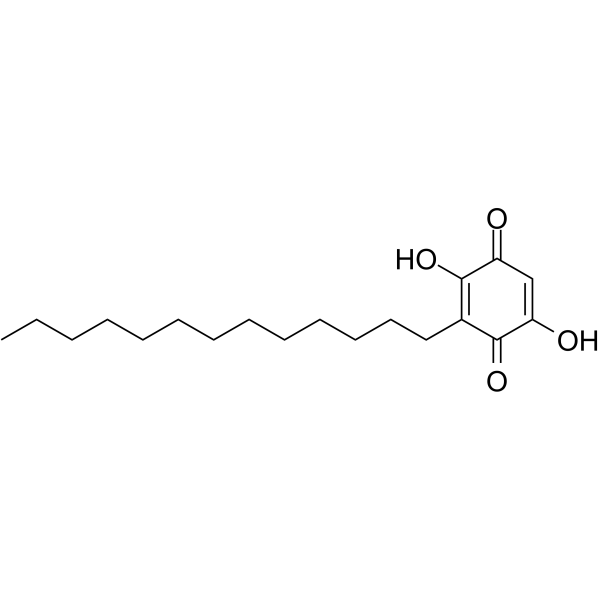
Rapanone hydroxyl-benzoquinone natural con una estructura quelante privilegiada, que tiene un amplio espectro de acciones biológicas, destacando sus actividades antiinflamatorias, antihelmínticas y citotóxicas
Products are for research use only. Not for human use. We do not sell to patients.
Cas No.: 573-40-0
Sample solution is provided at 25 µL, 10mM.
_1-3.$$$39978408@51.jpg');)
_1-9.$$$38538795@65.jpg');)
_1-9.$$$39112701@51.jpg');)
_1-7.$$$37316672@70.jpg');)
_366-372.$$$36198801@70.jpg');)
.$$$38565142@65.jpg');)
_1867-1883.$$$33248023@67.jpg');)
_eads6055.$$$39977546@45.jpg');)
_eadm9805.$$$40080571@45.jpg');)
_eadj3020.$$$39666821@45.jpg');)
_1-20.$$$39757301@28.jpg');)
_1-24.$$$38898113@28.jpg');)
_273-287.$$$36806353@46.jpg');)
_1-16.$$$37156877@44.jpg');)
_1-19.$$$37460805@44.jpg');)
_1291-1307.$$$34518654@46.jpg');)
Rapanone hydroxyl-benzoquinone natural con una estructura quelante privilegiada, que tiene un amplio espectro de acciones biológicas, destacando sus actividades antiinflamatorias, antihelmínticas y citotóxicas [1]. Rapanone exhibe potencial antioxidante al oxidar los radicales Fe(II) y O2⁻ , inhibiendo así las reacciones de Fenton-Haber-Weiss. La capacidad antioxidante de Rapanone se mejora en la interacción con Fe(II) o mitochondrias, y previene el daño mitocondrial inducido por el hierro o los radicales libres a través de múltiples mecanismos[1-2].
In vitro, Rapanone (25 and 50μM) induce la apoptosis en la línea celular MCF-7 después de 24 horas de tratamiento[3]. En el carcinoma hepático (HepG2), 24 horas de tratamiento con Rapanone (20-40μM) indujeron una disipación del potencial de membrana mitocondrial dependiente de la concentración, el agotamiento de ATP, la generación de peróxido de hidrógeno y la externalización de la serina fosfatidílica[4].
In vivo, la administración oral de Rapanone a ratones albinos hembras a dosis de 60mg/kg y 120mg/kg indujo alteraciones uterinas tanto en el primer como en el segundo período de gestación y disminuyó la tasa de embarazo de una manera dependiente de la dosis [5]. En ratones suizos hembra, el tratamiento con Rapanone (2.5, 5, 10mg/kg; i. p.) inhibió significativamente la formación de edema, así como el contenido de elastasa y Prostaglandin E2 (PGE2) de una manera dependiente de la dosis [6]. Después de exponer los embriones de pez cebra a Rapanone (160μM) durante 96 horas, la tasa de supervivencia del embrión fue del 90-98%, y Rapanone mostró baja toxicidad[7].
References:
[1] de la Vega-Hernández K, Antuch M, Cuesta-Rubio O, Núñez-Figueredo Y, Pardo-Andreu GL. Discerning the antioxidant mechanism of rapanone: A naturally occurring benzoquinone with iron complexing and radical scavenging activities. J Inorg Biochem. 2017;170:134-147.
[2] Wróbel-Biedrawa D, Grabowska K, Galanty A, Sobolewska D, Żmudzki P, Podolak I. Anti-melanoma potential of two benzoquinone homologues embelin and rapanone - a comparative in vitro study. Toxicol In Vitro. 2020;65:104826.
[3] Arunachalam A, Sankar M, Pandi B, Paul S, Thilagar S. Evaluation of Rapanone and Nectandrin B as novel inhibitors for targeting the metastatic regulator protein BACH1 using breast cancer cell line Mcf-7. J Biomol Struct Dyn. 2024;42(20):11185-11200.
[4] Pardo Andreu GL, Reis FZD, González-Durruthy M, et al. Rapanone, a naturally occurring benzoquinone, inhibits mitochondrial respiration and induces HepG2 cell death. Toxicol In Vitro. 2020;63:104737.
[5] Calle J, Olarte J, Pinzon R, Ospina LF, Mendoza MC, Orozco MJ. Alterations in the reproduction of mice induced by rapanone. J Ethnopharmacol. 2000;71(3):521-525.
[6] Ospina LF, Calle J, Arteaga L, Pinzón R, Alcaraz MJ, Payá M. Inhibition of acute and chronic inflammatory responses by the hydroxybenzoquinonic derivative rapanone. Planta Med. 2001;67(9):791-795.
[7] Mariyappan V, Munuswamy-Ramanujam G, Ramasamy M. Synthesis of novel rapanone derivatives via organocatalytic reductive C-alkylation: biological evaluation of antioxidant properties, in vivo zebrafish embryo toxicity, and docking studies. RSC Med Chem. 2023;15(2):623-635.
| Experimentos celulares [1]: | |
Líneas celulares | Células MCF-7 |
Método de preparación | Las células MCF-7 se sembraron en una placa de 6 pozos (1×10⁶/pocillo) y se incubaron a 37 °C durante 24 horas. A continuación, se retiró el medio y se sustituyó por (0,25, 5, 25, 50 y 100 µM) de Rapanone, que se suspendió en un medio sin suero. Las células se incubaron durante 24 horas, seguidas de un lavado con solución salina tamponada con fosfato (PBS) 3 veces. Luego, las células fueron teñidas con naranja de acridina y yoduro de propidio. |
Condiciones de reacción | 0,25, 5, 25, 50 y 100 µM; 24h |
Áreas de aplicación | Rapanone induce la apoptosis en la línea celular MCF-7 a una concentración de 25 y 50 μM. |
| Experimentos con animales [2]: | |
Modelos animales | Ratones suizos hembra |
Método de preparación | La respuesta inflamatoria se indujo mediante la inyección de carragenina (0,05 ml; 3% p/v en solución salina) en el área subplantar de las patas traseras derechas de grupos de seis animales. Rapanone se administró i. p. (propilenglicol/glicerol/agua destilada, 40:10:50, v/v/v) a dosis de 2,5, 5 y 10 mg/kg 1 hora antes de la inyección de carragenina. Los volúmenes de la pata se midieron utilizando un pletismómetro. Los ratones fueron sacrificados por dislocación cervical 5 horas después de la administración de carragenina, y las patas traseras se homogeneizaron en solución salina. Se determinó el contenido de prostaglandina E2 (PGE2) y la actividad de elastasa en homogeneizados de la pata. |
Forma de dosificación | 2,5, 5, 10 mg/kg; i.p. |
Áreas de aplicación | La administración intraperitoneal de Rapanone inhibió significativamente la formación de edema, así como el contenido de elastasa y PGE2 de una manera dependiente de la dosis. |
References: | |
| Cas No. | 573-40-0 | SDF | |
| Formula | C19H30O4 | M.Wt | 322.44 |
| Solubility | DMSO : 25 mg/mL (77.53 mM; ultrasonic and warming and heat to 60°C) | Storage | Store at -20°C,protect from light |
| General tips | Please select the appropriate solvent to prepare the stock solution according to the
solubility of the product in different solvents; once the solution is prepared, please store it in
separate packages to avoid product failure caused by repeated freezing and thawing.Storage method
and period of the stock solution: When stored at -80°C, please use it within 6 months; when stored
at -20°C, please use it within 1 month. To increase solubility, heat the tube to 37°C and then oscillate in an ultrasonic bath for some time. |
||
| Shipping Condition | Evaluation sample solution: shipped with blue ice. All other sizes available: with RT, or with Blue Ice upon request. | ||
| Prepare stock solution | |||

|
1 mg | 5 mg | 10 mg |
| 1 mM | 3.1014 mL | 15.5068 mL | 31.0135 mL |
| 5 mM | 620.3 μL | 3.1014 mL | 6.2027 mL |
| 10 mM | 310.1 μL | 1.5507 mL | 3.1014 mL |
Step 1: Enter information below (Recommended: An additional animal making an allowance for loss during the experiment)
 g
μL
g
μL
Step 2: Enter the in vivo formulation (This is only the calculator, not formulation. Please contact us first if there is no in vivo formulation at the solubility Section.)
Calculation results:
Working concentration: mg/ml;
Method for preparing DMSO master liquid: mg drug pre-dissolved in μL DMSO ( Master liquid concentration mg/mL, Please contact us first if the concentration exceeds the DMSO solubility of the batch of drug. )
Method for preparing in vivo formulation: Take μL DMSO master liquid, next addμL PEG300, mix and clarify, next addμL Tween 80, mix and clarify, next add μL saline, mix and clarify.
Method for preparing in vivo formulation: Take μL DMSO master liquid, next add μL Corn oil, mix and clarify.
Note: 1. Please make sure the liquid is clear before adding the next solvent.
2. Be sure to add the solvent(s) in order. You must ensure that the solution obtained, in the previous addition, is a clear solution before proceeding to add the next solvent. Physical methods such as vortex, ultrasound or hot water bath can be used to aid dissolving.
3. All of the above co-solvents are available for purchase on the GlpBio website.
Quality Control & SDS
- View current batch:
- Purity: >99.00% Appearance: A solid
- COA (Certificate of Analysis)
- SDS (Safety Data Sheet)
- Datasheet
Average Rating: 5 (Based on Reviews and 35 reference(s) in Google Scholar.)