

Rapanone |
Katalog-Nr.GC63860
 One-Click Copy Product Info
|

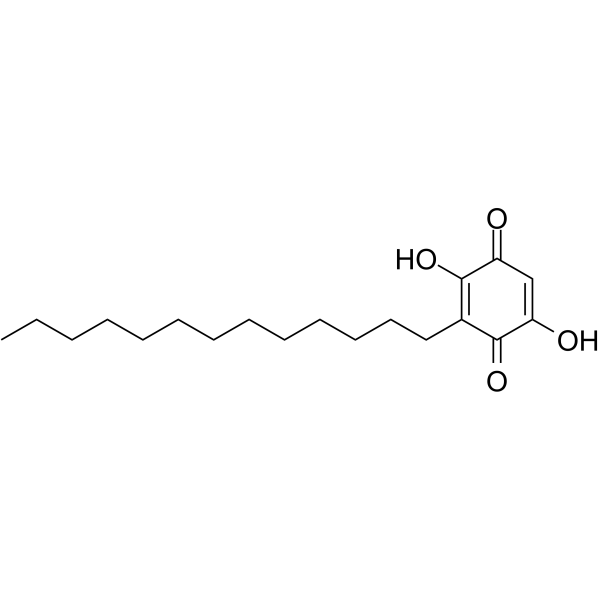
Rapanon ist ein natÜrliches Benzochinon.
Products are for research use only. Not for human use. We do not sell to patients.
Cas No.: 573-40-0
Sample solution is provided at 25 µL, 10mM.
_1-3.$$$39978408@51.jpg');)
_1-9.$$$38538795@65.jpg');)
_1-9.$$$39112701@51.jpg');)
_1-7.$$$37316672@70.jpg');)
_366-372.$$$36198801@70.jpg');)
.$$$38565142@65.jpg');)
_1867-1883.$$$33248023@67.jpg');)
_eads6055.$$$39977546@45.jpg');)
_eadm9805.$$$40080571@45.jpg');)
_eadj3020.$$$39666821@45.jpg');)
_1-20.$$$39757301@28.jpg');)
_1-24.$$$38898113@28.jpg');)
_273-287.$$$36806353@46.jpg');)
_1-16.$$$37156877@44.jpg');)
_1-19.$$$37460805@44.jpg');)
_1291-1307.$$$34518654@46.jpg');)
Rapanone naturally occurring hydroxyl-benzoquinone with a privileged chelating structure, having a broad spectrum of biological actions, highlighting its anti-inflammatory, anthelmintic, and cytotoxic activities[1]. Rapanone exhibits antioxidant potential by oxidizing Fe(II) and O2⁻ radicals, thereby inhibiting Fenton-Haber-Weiss reactions. Rapanone’s antioxidant capacity is enhanced upon interaction with Fe(II) or mitochondria, and it prevents iron or free radical-induced mitochondrial damage through multiple mechanisms[1-2].
In vitro, Rapanone (25 and 50μM) induces apoptosis in the MCF-7 cell line after 24 hours of treatment[3]. In the hepatic carcinoma (HepG2), 24 hours of Rapanone (20-40μM) treatment induced a concentration-dependent mitochondrial membrane potential dissipation, ATP depletion, hydrogen peroxide generation and phosphatidyl serine externalization[4].
In vivo, oral administration of Rapanone to female albino mice at doses of 60mg/kg and 120mg/kg induced uterine alterations in both the first and second gestation periods and decreased the pregnancy rate in a dose-dependent manner[5]. In female Swiss mice, treatment with Rapanone (2.5, 5, 10mg/kg; i. p.) significantly inhibited the formation of oedema as well as the content of elastase and Prostaglandin E2 (PGE2) in a dose-dependent manner[6]. After exposing zebrafish embryos to Rapanone (160μM) for 96 hours, the embryo survival rate was 90-98%, and Rapanone showed low toxicity[7].
References:
[1] de la Vega-Hernández K, Antuch M, Cuesta-Rubio O, Núñez-Figueredo Y, Pardo-Andreu GL. Discerning the antioxidant mechanism of rapanone: A naturally occurring benzoquinone with iron complexing and radical scavenging activities. J Inorg Biochem. 2017;170:134-147.
[2] Wróbel-Biedrawa D, Grabowska K, Galanty A, Sobolewska D, Żmudzki P, Podolak I. Anti-melanoma potential of two benzoquinone homologues embelin and rapanone - a comparative in vitro study. Toxicol In Vitro. 2020;65:104826.
[3] Arunachalam A, Sankar M, Pandi B, Paul S, Thilagar S. Evaluation of Rapanone and Nectandrin B as novel inhibitors for targeting the metastatic regulator protein BACH1 using breast cancer cell line Mcf-7. J Biomol Struct Dyn. 2024;42(20):11185-11200.
[4] Pardo Andreu GL, Reis FZD, González-Durruthy M, et al. Rapanone, a naturally occurring benzoquinone, inhibits mitochondrial respiration and induces HepG2 cell death. Toxicol In Vitro. 2020;63:104737.
[5] Calle J, Olarte J, Pinzon R, Ospina LF, Mendoza MC, Orozco MJ. Alterations in the reproduction of mice induced by rapanone. J Ethnopharmacol. 2000;71(3):521-525.
[6] Ospina LF, Calle J, Arteaga L, Pinzón R, Alcaraz MJ, Payá M. Inhibition of acute and chronic inflammatory responses by the hydroxybenzoquinonic derivative rapanone. Planta Med. 2001;67(9):791-795.
[7] Mariyappan V, Munuswamy-Ramanujam G, Ramasamy M. Synthesis of novel rapanone derivatives via organocatalytic reductive C-alkylation: biological evaluation of antioxidant properties, in vivo zebrafish embryo toxicity, and docking studies. RSC Med Chem. 2023;15(2):623-635.
| Cell experiment [1]: | |
Cell lines | MCF-7 cells |
Preparation Method | MCF-7 cells were seeded in a 6-well plate (1×10⁶/well) and incubated at 37°C for 24h. The medium was then removed and replaced with (0.25, 5, 25, 50 and 100µM) of Rapanone, which was suspended in a serum-free medium. The cells were incubated for 24h, followed by washing with Phosphate Buffered Saline (PBS) 3 times. The cells were then stained with acridine orange and propidium iodide. |
Reaction Conditions | 0.25, 5, 25, 50 and 100µM; 24h |
Applications | Rapanone induces apoptosis in MCF-7 cell line at a concentration of 25 and 50μM. |
| Animal experiment [2]: | |
Animal models | Female Swiss mice |
Preparation Method | Inflammatory response was induced by injection of carrageenan (0.05ml; 3%w/v in saline) into the subplantar area of the right hind paws of groups of six animals. Rapanone was administered i. p. (propylene glycol/glycerol/distilled water, 40:10:50, v/v/v) at the doses of 2.5, 5, and 10mg/kg 1h before injection of carrageenan. Paw volumes were measured using a plethysmometer. Mice were sacrificed by cervical dislocation 5h after carrageenan administration, and hind paws were homogenized in saline. Prostaglandin E2 (PGE2) and elastase activity content in paw homogenates were determined. |
Dosage form | 2.5, 5, 10mg/kg; i.p. |
Applications | Intraperitoneal administration of Rapanone significantly inhibited the formation of oedema, as well as elastase and PGE2 content in a dose-dependent manner. |
References: | |
| Cas No. | 573-40-0 | SDF | |
| Formula | C19H30O4 | M.Wt | 322.44 |
| Löslichkeit | DMSO : 25 mg/mL (77.53 mM; ultrasonic and warming and heat to 60°C) | Storage | Store at -20°C,protect from light |
| General tips | Please select the appropriate solvent to prepare the stock solution according to the
solubility of the product in different solvents; once the solution is prepared, please store it in
separate packages to avoid product failure caused by repeated freezing and thawing.Storage method
and period of the stock solution: When stored at -80°C, please use it within 6 months; when stored
at -20°C, please use it within 1 month. To increase solubility, heat the tube to 37°C and then oscillate in an ultrasonic bath for some time. |
||
| Shipping Condition | Evaluation sample solution: shipped with blue ice. All other sizes available: with RT, or with Blue Ice upon request. | ||
| Prepare stock solution | |||

|
1 mg | 5 mg | 10 mg |
| 1 mM | 3.1014 mL | 15.5068 mL | 31.0135 mL |
| 5 mM | 620.3 μL | 3.1014 mL | 6.2027 mL |
| 10 mM | 310.1 μL | 1.5507 mL | 3.1014 mL |
Step 1: Enter information below (Recommended: An additional animal making an allowance for loss during the experiment)
 g
μL
g
μL
Step 2: Enter the in vivo formulation (This is only the calculator, not formulation. Please contact us first if there is no in vivo formulation at the solubility Section.)
Calculation results:
Working concentration: mg/ml;
Method for preparing DMSO master liquid: mg drug pre-dissolved in μL DMSO ( Master liquid concentration mg/mL, Please contact us first if the concentration exceeds the DMSO solubility of the batch of drug. )
Method for preparing in vivo formulation: Take μL DMSO master liquid, next addμL PEG300, mix and clarify, next addμL Tween 80, mix and clarify, next add μL saline, mix and clarify.
Method for preparing in vivo formulation: Take μL DMSO master liquid, next add μL Corn oil, mix and clarify.
Note: 1. Please make sure the liquid is clear before adding the next solvent.
2. Be sure to add the solvent(s) in order. You must ensure that the solution obtained, in the previous addition, is a clear solution before proceeding to add the next solvent. Physical methods such as vortex, ultrasound or hot water bath can be used to aid dissolving.
3. All of the above co-solvents are available for purchase on the GlpBio website.
Quality Control & SDS
- View current batch:
- Purity: >99.00% Appearance: A solid
- COA (Certificate of Analysis)
- SDS (Safety Data Sheet)
- Datasheet
Average Rating: 5 (Based on Reviews and 35 reference(s) in Google Scholar.)